
The Pontiac V8 Built To Bury Chevy’s LS6 454
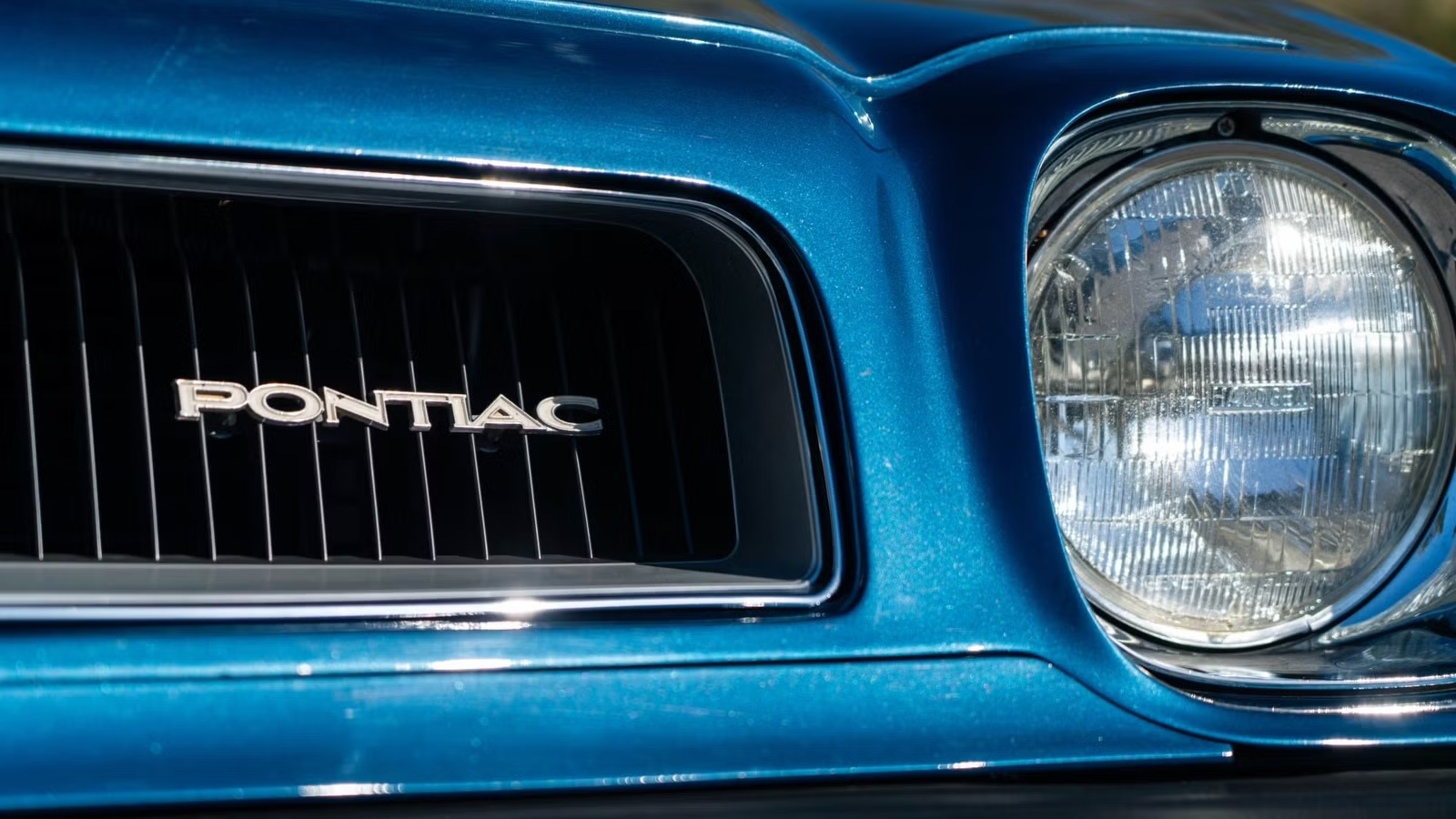
“If you aren’t first, you’re last” is a solid racing creed to believe in. Pontiac could definitely relate to it in the late 1960s and early 1970s as the Chevrolet 454 LS6 kept spanking it on the track. But instead of being a sore loser, especially against the Chevy Chevelle 454 LS6, the brand became inspired.

Pontiac went back to the drawing board to figure out how to take the famous Chevy big-block V8 engine down without any remorse. Its engineers went big, hoping to embarrass other muscle cars. As a result, the brand was able to maintain plenty of torque as increasing emission standards took their toll on the muscle car era.
This Pontiac V8 engine was so successful that it evolved into a professional racetrack monster, produced only in small numbers. Simply wanting to crush Chevy led to years of unmatched performance innovation. It pushed strict boundaries to keep the racing spirit alive while most engines were getting choked out.
The 1970 Pontiac GTO Judge Ram Air IV Wasn’t Cutting It

Most enthusiasts would love to get behind the wheel of the 1970 Pontiac GTO Judge Ram Air IV. However, we have to face the fact that it wasn’t cut out to tackle the Chevy Chevelle 454 LS6, despite having a few advantages such as better handling, enhanced weight distribution, and superior cornering.
The 1970 Chevy Chevelle 454 LS6 was the undisputed drag strip king. It had a 454-cubic-inch (7.4-liter) LS6 V8 engine producing 450 horsepower and 500 lb-ft of torque. This muscle car could accelerate from 0 to 60 mph in about 6.1 seconds, with the ability to cover a quarter mile in roughly 13.4 seconds and a top speed of 130 mph.
But the 1970 Pontiac GTO Judge Ram Air IV was no slouch. It had a 400 cubic-inch (6.6-liter) V8 engine that delivered 370 hp and 455 lb-ft of torque. This car accelerated from 0 to 60 mph in about 6.0 seconds and could cover a quarter mile in about 14.5 seconds, with a top speed of 130 mph. It wasn’t far behind, but it just couldn’t outrace the 454 LS6.
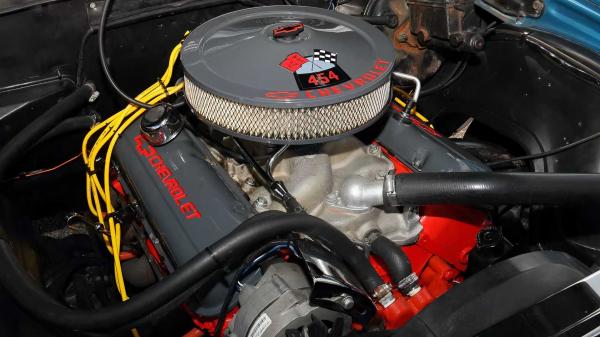
How The Chevy 454 V8 Compares To Pontiac’s 455 V8
Here’s how the two biggest-displacement V8 engines from Pontiac and Chevrolet ever stack up.
The Pontiac 455 High Output V8 Came To Race

The tables turned in 1971 when the Pontiac 455 High Output V8 hit the track. It was a 455 cubic-inch (7.5-liter) big-block V8 with 335 hp and 480 lb-ft of torque. This engine launched the Pontiac Firebird Trans Am from 0 to 60 mph in about 5.4 seconds and covered a quarter-mile in around 13.4 seconds. Plus, it had a top speed of 125 mph.
Due to increasing emission standards in 1971, Chevy had to drop the compression ratio of the 454 LS6 from 11.25:1. As a result, its output was reduced to 425 hp. However, it was still the most powerful engine available, even if it lost a bit of its bite. But suddenly, Chevrolet faced real competition from Pontiac.

The 455 H.O. V8 was designed to fight tightening emission regulations and decreasing compression ratios. Engineers increased the displacement to 455 cubic inches to deliver ample torque and keep their muscle cars operating at peak performance, even when paired with emission-compliant components.
This cast-iron block engine with four-bolt main bearing caps also features larger round-port cylinder heads, a more aggressive camshaft, a reinforced bottom end, and enhanced intake manifolds. It’s fed by an aluminum intake manifold and a Rochester four-barrel carburetor and was often paired with functional Ram air hood scoops.
The Pontiac 455 Super Duty Took Things Even Further

While the 455 H.O. V8 was an excellent engine for the street, it evolved into the Pontiac 455 Super Duty to dominate racetracks as well. The SD-455 delivered 355 hp and 390 lb-ft of torque in 1973 and was de-tuned to 290 hp in 1974. This engine was exclusively offered in the Firebird Trans Am and Formula.
It was bred for racing, with the ability to accelerate from 0 to 60 mph in roughly 5.4 seconds and cover a quarter-mile in about 13.5-13.8 seconds, with a top speed of 132 mph. Every engine was hand-built offline, separate from normal production. To withstand the extra stress of racing, it has a reinforced block with thicker main webs and four-bolt main bearing caps.
Chevrolet 454 LS6 Vs. Pontiac 455 Engines
|
Car |
Engine |
HP |
Torque |
0-60 MPH |
|
1970 Chevy Chevelle 454 LS6 |
454 ci 7.4-liter V8 |
450 |
500 LB-FT |
6.1 seconds |
|
1971 Pontiac Firebird Trans Am 455 H.O. |
455 ci 7.5-liter V8 |
335 |
480 LB-FT |
5.4 seconds |
|
1973 Pontiac Firebird Trans Am 455 Super Duty |
455 ci 7.5-liter V8 |
355 |
390 LB-FT |
5.4 seconds |
Unlike the 455 H.O., it featured a forged steel crankshaft, forged steel connecting rods, and forged aluminum pistons. The round-port cylinder heads featured constant cross-section porting, swirl-polished valves, and integrated steel inserts for an enhanced high-flow capacity. Plus, the 455 Super Duty features a heavy-duty oil pump and unique internal oil drain-backs to sustain high-RPM endurance.
The engine was topped with an 800-CFM Rochester Quadrajet four-barrel carburetor and a high-lift flat-tappet camshaft. Overall, this upgraded engine variant was better equipped to handle the demands of professional racing, while the 455 H.O. remained an excellent street engine.
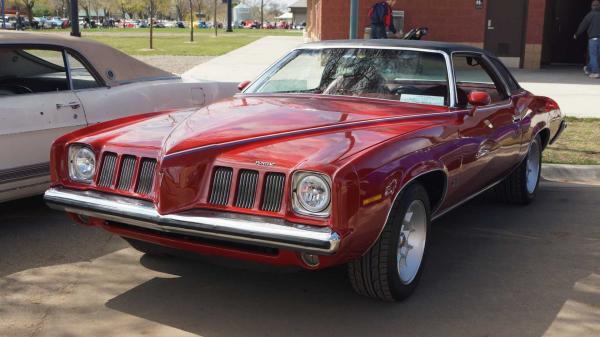
The Rarest Pontiac Muscle Car Ever Is A 455 Big Block No One Knew Existed
The performance-focused GM division built just one of these cars for testing.
Unfortunately, the 455 V8 Didn’t Last Very Long

The Pontiac 455 V8 engine was only in production from 1970 until 1976. The High Output was available from 1971 until 1973, but it didn’t become a high-performance icon until it received an aluminum intake and round-port heads in 1971. Also, the 455 Super Duty was only produced in 1973 and 1974.
This engine could have been de-tuned in 1976, but was discontinued instead. It failed to meet increasing Federal emission standards and changing fuel economy regulations, such as the switch to unleaded fuel. With the introduction of Environmental Protection Agency (EPA) regulations and the initiation of catalytic converters, the big-block muscle car era was facing new challenges. It didn’t help that rising insurance premiums targeting muscle cars made ownership extremely expensive.

General Motors decided to consolidate its engine manufacturing to cut costs while complying with federal environmental regulations. This was much more affordable than re-engineering, certifying, and testing unique engines across each of its brands. Its corporate strategy favored smaller, more efficient engines instead, so the large Pontiac V8 beasts didn’t make the cut.
This is not surprising, as the oil crisis caused gas prices to rise and buyers were looking for smaller, more practical options. About 3,838 H.O. V8 engines were made. Then roughly 295 455 Super Duty V8 engines were built in 1973, with production increasing to 1,001 in 1974. Now the rare engine lives on as a historic racing icon that did more than complete its mission to beat Chevrolet.
Source: How Stuff Works, Audrain Automobile Museum, Hagerty

Related posts




Latest Post


No Comments