The Toyota Three-Row Hybrid That Hits 37 MPG Without A Plug
9 minutes reading
Tuesday, 30 Jun 2026 12:00 0 67 autotech
Purchasing a new family SUV in 2026 is a daunting experience, considering how many affordability factors the average consumer now needs to consider. Beyond this, buyers are also required to investigate a checklist of prerequisites before they can even leave the dealership lot, especially if you are considering a plug-in hybrid or fully electric car.
For families who simply want to safely transport seven or eight people without breaking the bank at the pump, this forced electrification transition has induced consumer fatigue. Amidst this backdrop of infrastructural anxiety, Toyota has executed an accommodating electrification strategy, giving its consumers impressive daily versatility. Toyota is also one of very few brands that offers this HEV technology in a pair of three-row SUVs.
Toyota’s approach to electrification relies on its mechanical simplicity and generational refinement. For the 2026 model year, Toyota’s three-row hybrid strategy is led by a pair of distinct yet complementary models. Toyota has designed these two models to be cost-effective hybrids, rather than flashy and heavy plug-in hybrids or costly battery-electric vehicles. However, the brand is introducing an all-electric variant next year.
Toyota opts to perfect the traditional closed-loop hybrid setup. These two models function as the definitive benchmark for modern families who don’t want to compromise on space, long-distance viability, or fuel efficiency. Toyota’s efficient and reliable non-plug powertrain allows it to meet two different expressions of family utility, while maintaining a singular emotional payoff. In doing so, it provides a straightforward and friction-free path to mid-30s MPG with three rows of seating.
The Hybrid SUV With Toyota Reliability And Lexus-Level Comfort
These two hybrid SUVs offer reliability that’s similar to a Toyota, along with comfort levels that are already on par with Lexus.
The Toyota Highlander Hybrid Duo Brings Fuel Efficiency To The Segment
An aerial shot of the full trim lineup of the 2026 Toyota Grand Highlander.Toyota
For large families, physical space is a non-negotiable requirement. Unfortunately, this typically comes at the cost of fuel efficiency, due to these SUVs being heavier, resulting in the need for more powerful engines. The 2026 Toyota Grand Highlander Hybrid turns this compromise around by offering adult-sized comfort in all three rows alongside generous cargo capacity behind the rear seats.
Base Trim Engine
2.4L I-4 ICE
Base Trim Transmission
8-speed automatic
Base Trim Drivetrain
Front-Wheel Drive
Base Trim Horsepower
265 HP @6000 RPM
Base Trim Torque
310 lb.-ft. @ 1700 RPM
Base Trim Fuel Economy (city/highway/combined)
21/28/24 MPG
Base Trim Battery Type
Lead acid battery
Make
Toyota
Model
Grand Highlander
The primary difference between the 2026 Toyota Highlander and the Grand Highlander is physical scale and passenger utility, with the Grand Highlander being 6.5 inches longer and having a four-inch longer wheelbase. This extra length translates to a significant 5.5 inches of additional third-row legroom, making the Grand Highlander more adult-friendly in the rear row. Additionally, the Grand Highlander has the benefit of more usable cargo space, regardless of the rear seating position.
Toyota’s Trusty And Effective HEV Systems
2026 Toyota Grand Highlander engineToyota
Under the hood, you’ll find Toyota’s acclaimed naturally aspirated 2.5-liter four-cylinder engine, integrated with compact electric motor-generators. This combination generates 243 horsepower and 177 pound-feet of torque through an electronically controlled continuously variable transmission. As per Toyota’s claims, you can expect both drivetrains to cover a zero to 60 MPH acceleration sprint in 7.2 seconds with a 113 MPH top speed. You also get the benefit of towing 3,500 pounds.
Crucially, this extra structural volume does not result in poor fuel consumption. When configured with front-wheel drive, the Grand Highlander Hybrid achieves an EPA-estimated 37 MPG in the city and 34 MPG on the highway, balancing out to 36 MPG combined. The financial appeal of this vehicle becomes clear the moment you look at the base MSRP starting at $46,705.
The Grand Highlander’s Fan-Favorite Reputation
Front 3/4 shot of 2026 Toyota Grand Highlander Hybrid parked by lakeToyota
Thanks to Toyota’s longstanding reputation in the U.S. market, the Grand Highlander benefits from some impressive review scores and reliability ratings. J.D. Power awards the 2026 model year with an 82/100 consumer-verified overall score, including 82/100 for quality and reliability, 82/100 for the driving experience, 90/100 for resale, and 76/100 for the dealership experience.
On the depreciation front, iSeeCars indicates that you can expect to lose $14,601 or 35.7 percent of the Grand Highlander’s value after five years and 60,000 miles of usage, which is substantially better than the typical depreciation in this segment.
The Long-Lasting Hybrid That Rarely Needs Repairs And Seats Seven
This generation of the three-row hybrid has been in production since 2020, making it one of the most reliable seven-seater options available.
Toyota’s Smaller Alternative
Front 3/4 shot of 2026 Toyota Highlander Hybrid parked off-roadToyota
While the Grand Highlander targets families maximizing third-row cargo volume, the standard 2026 Toyota Highlander Hybrid remains the foundation of Toyota’s family SUV lineup. This model caters to buyers who prefer a more maneuverable, garage-friendly exterior. Pricing for this model starts at $47,620, which is more than the base Grand Highlander because it is only available with all-wheel drive. This layout utilizes a dedicated, independent electric motor positioned on the rear axle. Opting for this configuration means that drivers get the benefit of instant torque, better traction, and lower long-term maintenance and servicing costs.
No Changes To Engine Specification
2026 Toyota Highlander Hybrid Rear 3/4Toyota
The Highlander Hybrid features Toyota’s Atkinson-cycle 2.5-liter naturally aspirated four-cylinder engine with two integrated permanent-magnet synchronous electric motor-generators. This system utilizes an electronically controlled continuously variable transmission, paired exclusively with Toyota’s Electronic On-Demand all-wheel-drive system. Output is identical to the Grand Highlander’s quoted figures.
Base Trim Engine
2.4L I-4 ICE
Base Trim Transmission
8-speed automatic
Base Trim Drivetrain
Front-Wheel Drive
Base Trim Horsepower
265 HP @6000 RPM
Base Trim Torque
310 lb.-ft. @ 1700 RPM
Base Trim Fuel Economy (city/highway/combined)
21/28/24 MPG
Base Trim Battery Type
Lead acid battery
Make
Toyota
Model
Grand Highlander
The hybrid model manages a respectable 0-to-60 MPH acceleration time of 8.2 seconds with a 113 MPH limited top speed. The maximum towing capacity is also reduced to 3,500 pounds to preserve battery and drivetrain health. Despite the added weight and mechanical drag inherently associated with power-to-all-wheels capability, the standard Highlander Hybrid maintains an exceptionally high floor of efficiency. It delivers a 35 MPG city and 35 MPG highway consumption estimate, with certain trims reaching up to 36 MPG combined.
The Highlander’s Equally Trustworthy Reputation
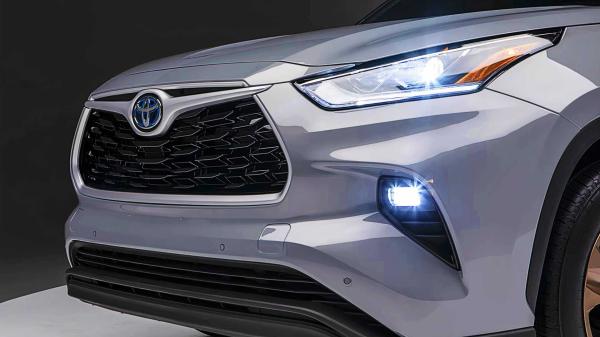
The front of a gray 2022 Toyota Highlander Hybrid. Toyota
Where the Highlander range truly shines is in its reliability and value retention abilities. iSeeCars gives the model an 8.3/10 overall score, which includes 7.7/10 for reliability, 9/10 for safety, and 8.3/10 for retained value. The publication indicates that the model will last for 12.9 years or 172,763 miles before you encounter any noteworthy issues, with a 32.9-percent probability of surpassing 200,000 miles. It also indicates that it will lose 36.3 percent or $16,531 of its value after five years of regular usage.
J.D. Power backs this with an 82/100 consumer-verified overall score, which includes 82/100 for quality and reliability, 82/100 for the driving experience, and 90/100 for resale. In terms of ownership costs, the Edmunds True Cost To Own calculator reveals that you can expect to spend $49,274 over the first five years when owning an XLE derivative.
The Three-Row Japanese Hybrid SUV With The Highest Fuel Cost Savings In 2026
Drivers who need everybody and everything aboard, without shelling out big bucks at the pump, won’t find much better than this three-row Japanese SUV.
PHEV Rivals Don’t Offer The Same Practicality
Front 3/4 shot of 2025 Mazda CX-90 PHEV Premium Plus in white parked on streetMazda
Plug-in hybrids have been marketed as the perfect halfway point between hybrids and fully electric vehicles, thanks to limited all-electric ranges that are practical and accommodating. However, real-world ownership quickly exposes the friction points of this layout. This is especially true when compared with Toyota’s hybrid-only drivetrain strategy. Competitors like the Mazda CX-90 PHEV and the Kia Sorento PHEV require owners to constantly manage a small battery capacity.
Sometimes owners may forget to plug their vehicle in overnight, or may need to cover long distances across states, typically exceeding the usual 25-to-30-mile estimated electric range. In this case, they are left hauling a heavy, uncharged battery pack, resulting in the real-world fuel economy dropping far below Toyota’s steady HEV baselines.
A gray Kia Sorento plug-in hybrid SUV. Kia
Furthermore, the true cost of a PHEV or a full three-row EV extends far beyond the dealership’s initial asking price. This includes hiring a licensed electrician to install a Level Two home charging station, upgrading an older residential electrical panel to handle a 40-amp load, and paying the premium MSRPs attached to complex PHEV powertrains.
Toyota’s Highlander duo bypasses this entire infrastructure hurdle. The hybrid system captures kinetic energy through regenerative braking and automatically recharges its own internal battery pack. With this method, it improves efficiency while relying only on conventional gasoline.
A Class-Leading Hybrid Warranty Coverage
Front 3/4 action shot of 2026 Toyota Grand Highlander Hybrid driving on roadToyota
Historically, the largest hurdle preventing value-conscious buyers from adopting hybrid technology has been the fear of long-term battery degradation and out-of-warranty replacement costs. Toyota has been able to resolve this by backing its 2026 hybrid lineup with an industry-leading 10-year or 150,000-mile hybrid battery warranty. This transferable protection guarantees that the vehicle’s battery is fully covered. The result is high residual resale values and peace of mind for families who prefer to buy their vehicles and drive them well beyond 150,000 miles.
The Japanese brand also includes its complimentary ToyotaCare maintenance plan with every new Highlander and Grand Highlander Hybrid. This program covers all factory-scheduled maintenance, including oil changes, tire rotations, multipoint inspections, and fluids for the first two years or 25,000 miles of ownership. Toyota’s hybrid components benefit from extensive research and development. These systems are known to drastically reduce wear and tear on traditional consumables like brake pads thanks to regenerative braking.
Sources: The EPA, iSeeCars, J.D. Power, and Edmunds.















No Comments