
The Performance Car Of The Year Pontiac Cancelled As Its Issue Hit Newsstands
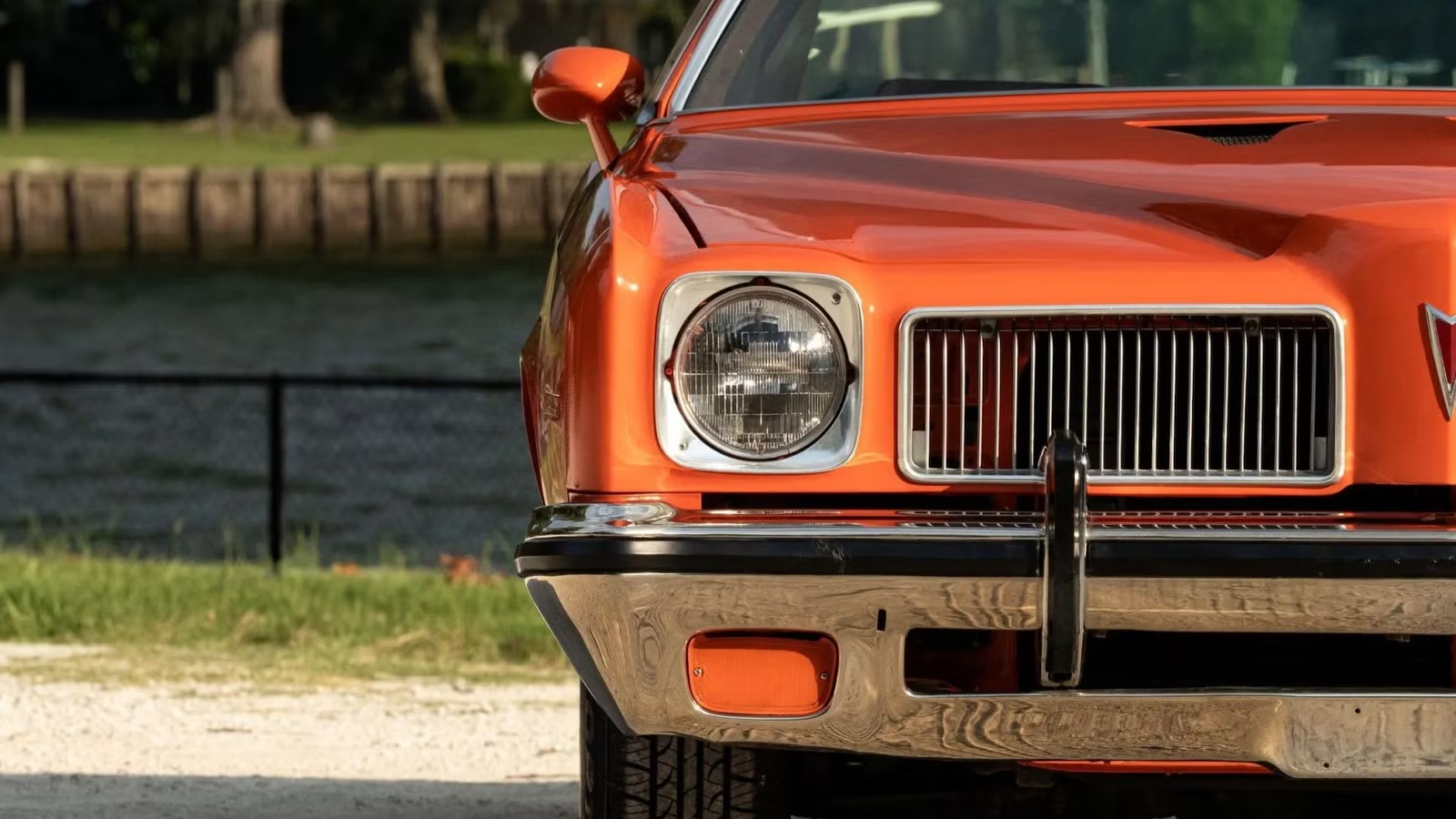
You shouldn’t call this canceled Pontiac muscle car the one that got away. In reality, it’s the award-winning powerhouse that never was. As a prototype tested by critics, it won the prestigious Top Performance Car of the Year award from Hi-Performance Cars. However, as magazines celebrating its win hit the newsstands, the Pontiac project was suddenly canceled. Enthusiasts could only read about it while settling for a less powerful option.
The 1973 Pontiac GTO SD-455 Never Made It To Production
Only one 1973 Pontiac GTO Super Duty 455 prototype was produced, and it was quickly sent out to critics for testing. The 455 cubic-inch (7.5-liter) OHV V8 was paired with a reinforced four-bolt main bearing, forged rods, round-port heads, and a Rochester four-barrel carburetor to deliver 310 hp and 395 lb-ft of torque.
Unfortunately, there are no official 0-to-60 times for the car. But one Pontiac Grand Am model with this setup was able to complete a quarter mile in about 14.8 seconds at 96 miles per hour, which was excellent for a car that weighed in at 4,200 pounds. Writers at Hi-Performance Cars were thrilled and amazed by the way the prototype performed with its responsive handling.
The team at Hi-Performance Cars officially named the prototype the Top Performance Car of the Year. Everything seemed promising as the Pontiac GTO SD-455 was celebrated and heavily promoted to the press while muscle car fans obsessed over the rumors. But unfortunately, no one else would get the chance to sit behind the wheel.


As the magazine went to print and fans rushed to the newsstands, the prototype was canceled. The Pontiac GTO SD-455 never entered production as Hi-Performance Car magazine promoted a beast that was never even built. No doubt a few enthusiasts at least enjoyed reading about the Pontiac that never existed.
Martin Caserio Killed The Pontiac GTO SD-455 And Diminished Pontiac Firebird
If blame must be assigned, Pontiac General Manager Martin Caserio is the place to start. But rising emission standards, rising insurance costs, and the 1973 fuel crisis also played a role in pressuring the automotive industry away from muscle cars. Muscle cars were getting too expensive to purchase and own.
As a result, Pontiac GTO sales were in rapid decline, and Caserio began shifting priorities away from high-performance gas-guzzlers toward improving fuel economy, safety standards, and flagship models. It didn’t help that the high-output Super Duty 455 engine was struggling to meet strict federal emission standards and pass-by noise requirements.
So, the SD-455 engine was pulled from A-body budget cars like the larger Pontiac GTO, and detuned for smaller options like the Pontiac Firebird. Detuning the 455 V8 engine involved swapping the aggressive K 308/320 camshaft for the milder Y 301/313 one to meet internal General Motors emission standards. General Motors enacted standards that were a little cleaner than the EPA’s to ensure that their engines remained compliant during their entire run.

This limited the 1973 Pontiac Firebird SD-455 to 290 hp and 390 lb-ft of torque. Models with the four-speed manual transmission accelerated from 0 to 60 mph in about 5.5 seconds and completed a quarter mile in roughly 13.8 seconds at 103 miles per hour. It had a top speed of around 123 mph.
Then The Pontiac Firebird SD-455 Engine Faced Delays

Troubles continued in 1973 as the Pontiac Firebird SD-455 faced significant delays and a scandal surrounding its struggle to pass emissions standards. Under the Clean Air Act, new engine architectures had to prove compliance over a 50,000-mile durability test. But the SD-455 was registered under the pre-existing Pontiac 455 architecture with the EPA, so it was only subject to a short 4,000-mile test.
Pontiac tried to get the engine to run cleanly enough during certain testing periods to meet certification requirements before running more aggressively on public roads. To attempt this workaround, Pontiac used an Exhaust Gas Recirculation (EGR) and vacuum advance setup that was controlled by timers and switches.
But the EPA identified what Pontiac was doing with control devices and calibration work to manipulate results, and it was not pleased. Under corrective action, the EPA forced Pontiac to recertify the engine, which led to significant testing delays. As a result, the launch of the Firebird SD-455 was pushed back by months, and it didn’t reach assembly lines until June.
1973 Super Duty 455 Production Was Limited

You had to be pretty lucky to get a car with the Super Duty 455 engine in 1973. Only one Pontiac Grand Am SD-455 model was built for the press to review, and zero GTO SD-455 models were made. Plus, only 295 Firebird, 252 Trans Am, and 43 Formula SD-455 models rolled off the assembly line. About 1,000 Trans Am and Firebird SD-455s were produced in 1974.
Miraculously, the SD-455 Grand Am engine was discovered by former General Motors engineer Rick Annis in the 1980s. He was searching for parts in a warehouse at the General Motors Proving Ground (GPG) in Arizona and spotted the engine sitting in a scrap pile. He salvaged it and had it installed in a 1967 Grand Prix that is likely priceless.
Meanwhile, surviving 1973 Pontiac Firebird SD-455 models come up for sale every few months. Models in rough project condition sell for between $88,000 and $110,000. Units in good, driving condition go for an average of $129,000. Then pristine examples cross the auction block for between $160,000 and over $350,000.
Source: Street Muscle Mag, Pontiac V8, Classic

Related posts





Latest Post


No Comments