
Three Mopars Carry A VIN Letter For An Engine Chrysler Said Never Reached Production
A Vehicle Identification Number (VIN) is a unique identifier for an individual car, but not everyone realizes that it isn’t just a randomized series of letters and numbers. A VIN can be decoded, with its characters encoding specific characteristics, revealing manufacturers, models, body styles, and more, right down to the model year and assembly plant.

For most of us, it might as well be gibberish. But for the nerdy few who can read a VIN like a composer scans sheet music, there’s plenty to be revealed.
A $150 Junkyard Find With An Impossible VIN
Russell Morgan was a seasoned Mopar hunter and exactly the sort of fellow who could look at an otherwise unremarkable string of VIN digits and raise a suspicious eyebrow. He found a junkyard Plymouth Road Runner from 1972 in South Carolina that had already been pilfered for some of its more desirable parts, and while a casual Mopar nerd might have gone straight to the Air Grabber hood, Morgan peeked at the VIN, beginning in RM23V2G.

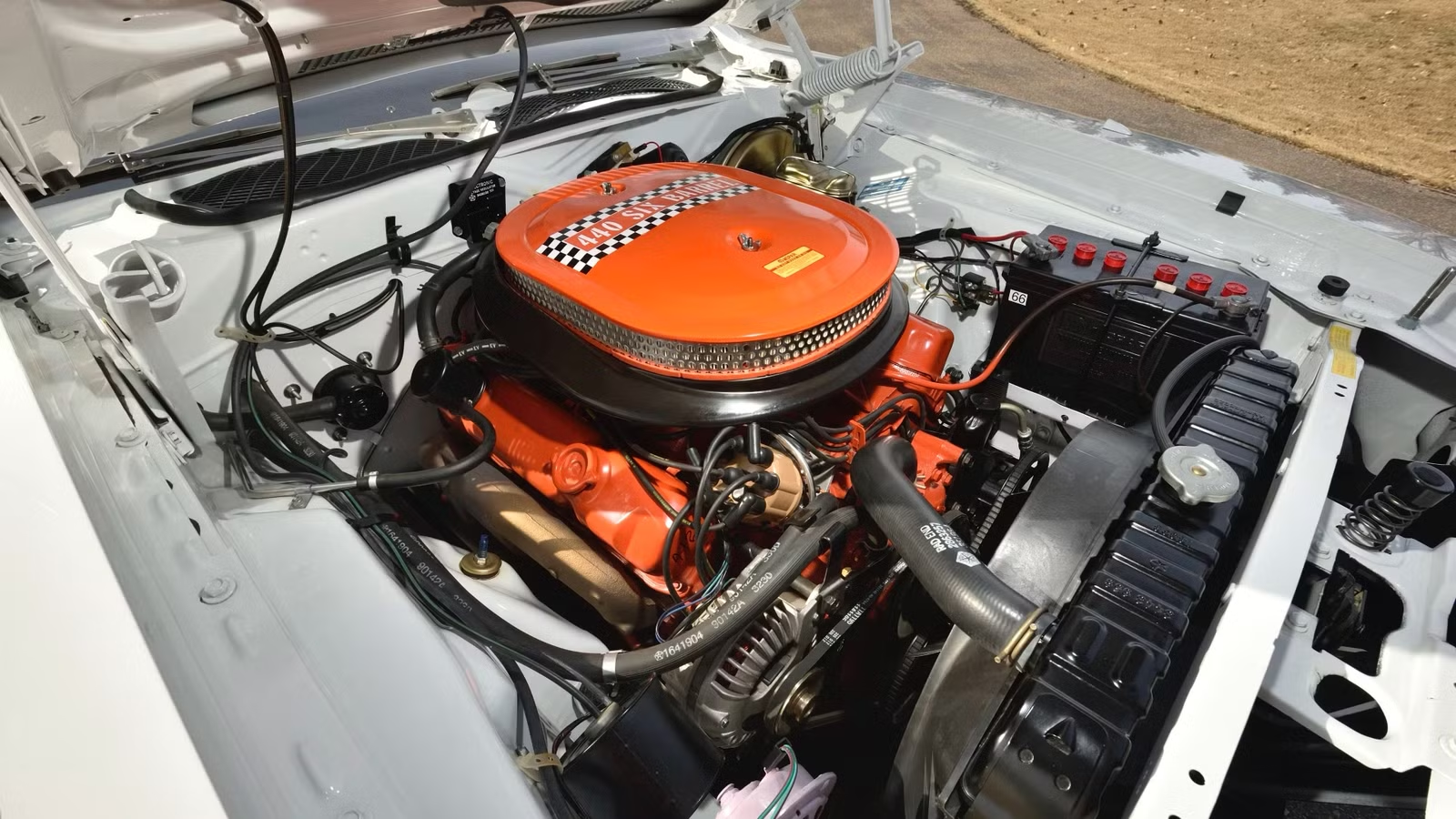
It was an eyebrow moment. That “V” sitting in the fifth spot designated Chrysler’s 440 Six-Barrel V8, an engine that as far as anyone knew had never been in a production Road Runner from that year. Morgan didn’t leave with the car, though he did snag the Air Grabber hood for $150.
Later, after chatting about the junked Plymouth and its puzzling VIN with other enthusiasts, he returned to the junkyard and bought the rest of the car that went with his hood. It cost him another $150, and it came with the title.
The 440 Six Pack Was Supposed To Be Dead
The 440 Six Pack was a well-known engine in its day. Chrysler introduced it in 1969, a 440-cubic-inch V8 with three two-barrel Holley carburetors earning it the name. Dodge called it the Six Pack, Plymouth went with Six-Barrel, and either way, the motor wasn’t supposed to make it into Chrysler’s 1972 production lineup.
The 426 Hemi had also been discontinued as emissions regulations tightened and the horsepower wars were winding down. Chrysler had planned to offer the 440 for ‘72, and it was included in brochures that landed in dealerships. It would have been available in the Dodge Charger Rallye and, yes, the Road Runner GTX.
But the engine was canceled, it didn’t seem to land in any 1972 cars, and it was the conventional wisdom of the Mopar faithful that no production cars had reached customers with it.
And yet.
Two Dodge Chargers Complete The Picture

The junkyard Road Runner recently relieved of its Air Grabber hood wasn’t the only example of the Six Pack showing up where it didn’t belong. Two 1972 Charger Rallyes have also surfaced with that seemingly impossible V-code.
A red one was owned by Ron Slobe of R&R Salvage, a well-known figure in Mopar circles. Slobe passed away and the car’s whereabouts have been uncertain since. In 2015, automotive historian Ryan Brutt reported that the car had made its way to the East Coast, but that remains unconfirmed.
Meanwhile, in the Detroit area, a Top Banana Yellow Charger purchased by Mike Shenk Sr. from a Chrysler lease lot remained in the family for more than 50 years. Shenk converted it into a Max Wedge car, and it appeared at the 1985 Mopar Nationals. That means the original engine implied by the VIN was replaced, but the car still carries the mark of something that not too long ago nobody thought had rolled off the line.
So now we’re up to three documented cars. One that might have started out as an oddity before being Max Wedged, another which landed in that South Carolina junkyard, and a third that for all we know is sitting in somebody’s garage in New Jersey, its owner blissfully unaware that they’ve got the Mopar equivalent of an elusive sasquatch.
So How Many Did Chrysler Actually Build?

Nobody seems to know for sure just how many of these are out there. Once, the answer would have been a straightforward zero. Over the decades, it’s become clear that the answer is some. There are largely unsubstantiated claims that state seven to ten with unverifiable confidence. But the three documented examples we’ve discussed are generally the only specific cars cited, offering little more than proof that Chrysler built at least a few.
Another open question is how these cars came to be. One theory is that the cancellation of the Six Pack simply ran up against production line timing, and a handful slipped through before the changeover. Another is that a few Chrysler executives quietly commissioned them for personal use, although there’s no solid evidence supporting that explanation.
Morgan, whose junkyard discovery started this whole thing, has said that a Chrysler insider insisted his Road Runner couldn’t be authentic. But the VIN, paperwork, and car itself seem to tell a different story.
And so the mystery remains. Though if you’re the right kind of car person and willing to become fluent in VIN coding, you just might be able to treasure hunt a car that nobody thinks exists.
Sources: Plymouth, Hot Rod

Related posts




Latest Post



No Comments