
The Tiny Renault That Somehow Got A V6 And A Mid-Engine Layout
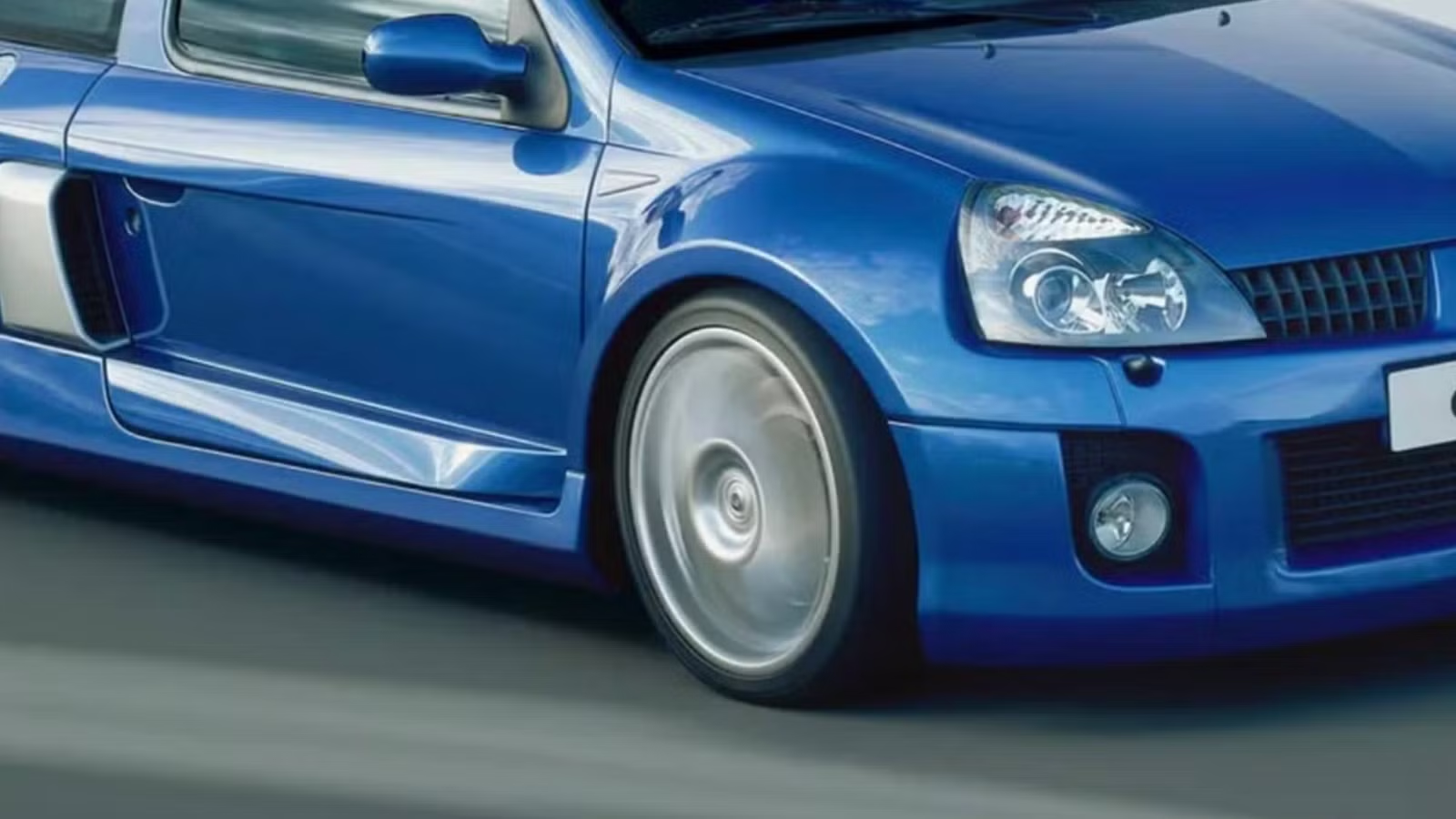
Since its debut in 1990, the Renault Clio has won over drivers in its home market, eventually becoming France’s best-selling car of all time. Compact and affordable, the Clio comfortably seats four and comes with endearing looks, making it the ideal daily companion for young drivers and small families. While Renault could have kept it at that, the French manufacturer partnered with an unexpected team to transform its Clio into an unrecognizable and ultra-desirable hot hatch packing a punchy engine.
The Ordinary Beginnings Of The Renault Clio

The Renault Clio started life as a practical, front-wheel-drive supermini, designed as an everyday car for French and European drivers. The Clio quickly became Renault’s most successful model. Depending on the generation, phase and trim level, the standard Clio has been offered with a wide range of inline-four engines, with displacement ranging between 1.1 to 2.0 liters, and with hybrid powertrains for later generations. Its affordability and practicality have made the small French hatch a global success, with over 17 million Clios sold across 120 countries according to Renault.
Over the generations, Renault also developed exciting trims for its Clio, notably with the 1990s limited-edition Clio Williams, built to meet homologation requirements for Group A and Group N rallying. Renault initially needed to build just 2,500 examples for homologation, but production eventually reached around 12,000 cars due to strong demand. The second-generation brought another important development to the Clio, with the introduction of the Renault Sport (R.S.) badge to offer more performance-oriented trims. Even with memorable editions such as the Clio Williams, these remained recognizable, faithful to the standard Clio and built around the front-engine, front-wheel-drive formula.
Teaming Up With Tom Walkinshaw Racing

Following the success of the first generation, the second-generation Renault Clio debuted in 1998. Things took an exciting turn at the 1998 Paris Motor Show, where Renault celebrated its 100th anniversary by unveiling a mid-engine Clio concept, with air ducts giving a clear nod to the legendary Renault 5 Turbo from the early 1980s. The concept was developed into a track-only car, the Clio V6 Trophy, but with an overwhelmingly positive response, Renault explored the possibility of putting the radical mid-engine race car into production, with the help of Tom Walkinshaw Racing (TWR)—the motorsport engineering company behind Le Mans-winning programs and the then-owner of the Arrows Formula 1 team. This ultimately gave birth to the Phase 1 Renault Clio V6, built at the TWR facility in Uddevalla, Sweden, as Renault lacked the necessary manufacturing capacity. Standard Clio bodyshells were shipped from France, and TWR was essentially responsible for all development and engineering of the Clio V6. The finished units were then sold at a fixed price to Renault and sent back to Dieppe.
How Renault Put A V6 Where The Back Seats Should Be

The Clio V6 was no ordinary hot hatch conversion, as the entire rear of the Clio had to be re-engineered to accommodate the new powertrain. Borrowing its engine from the Renault Laguna, the naturally aspirated 3.0-liter V6 was mounted at the back, directly behind the driver and front passenger seats, where you’d normally find the rear seats. The V6 produced 226 horsepower and 221 lb-ft of torque. Unlike the standard front-wheel drive model, power was sent to the rear wheels through a six-speed manual gearbox. Revised suspension featured MacPherson struts up front and a multi-link setup at the rear.
The result was a tiny hot hatch with outrageous proportions when compared to the original Clio model. With dramatically widened rear arches, the V6 was 6.7 inches wider than the standard Clio, with the front track widened by 4.3 inches and the rear by 5.4 inches.
With a punchy V6 and a mid-engine, rear-wheel-drive configuration fitted in a tiny hatch, the Clio V6 earned a reputation for being unforgiving, and handling proved to be challenging.
Phase 2: Building An Improved Renault Clio V6

In 2003, Renault released the Clio V6 Phase 2, addressing some of the Phase 1 Clio V6’s shortcomings. Unlike the Phase 1, production for Phase 2 returned to Renault’s plant in Dieppe, France. The naturally aspirated 3.0-liter V6 received reworked cylinder heads and a freer-flowing induction system, bringing the engine’s power output from 226 to 255 horsepower. Shorter gear ratios helped make better use of the additional power, allowing the Phase 2 to sprint from 0 to 60 mph in under 6.0 seconds for the first time. Renault also made substantial revisions to the chassis, with a slightly longer wheelbase and wider front track. The Phase 2 also got stiffer suspension components alongside new bump stops and longer trailing arms, to improve stability and make the car more predictable to address some of the handling concerns in the first generation. Changes in styling, especially with the new headlights, made the Phase 1 and Phase 2 distinct from one another. While keeping the same layout and philosophy, Renault was able to make the Phase 2 more refined and composed than its predecessor.
What Makes The Renault Clio V6 A Collector Car Today

Production of the Clio V6 Phase 2 ended in 2005, wrapping up a combined 5-year production run for both generations. Renault built 1,631 Phase 1 units, and another 1,309 units for Phase 2, making the Clio V6 a rare and sought-after hot hatch today, with certain paint finishes adding another layer of desirability. While a majority of Clio V6s were painted in Bleu Iliade (Illiad Blue), rare paints such as Liquid Yellow, Acid Yellow, or even Rouge de Mars (Mars Red) make such Clio V6 models highly collectible.
Despite Renault’s financial challenges during the 1990s global economic recession, the French manufacturer still went ahead with a daring but successful move, turning an ordinary economy hatchback into a mid-engine, rear-wheel-drive V6 sports car. Impractical and sometimes difficult to drive, those qualities are exactly what made the Clio V6 so memorable, cementing the unconventional Clio V6 as one of the most special and unforgettable French sports cars.
Sources: Renault, Iconic Auctioneers, Collecting Cars, Evo

Related posts





Latest Post



No Comments