
The Kawasaki That Makes Every Straight Feel Short
In the 1990s, Kawasaki had one eye fixed on the speedometer of its top motorcycle offering. The ZX-11 hit a radar-verified 176 mph in testing, making it the fastest production motorcycle measured at the time. Honda’s CBR1100XX Super Blackbird challenged that reign, before Suzuki changed the scale entirely when its first Hayabusa recorded 194 mph in 1999.

Kawasaki already had the ZX-12R coming, and expectations centered on whether it could finally crack 200 mph. Instead, the industry decided to step away from the contest in the name of sanity. Kawasaki would eventually return to chasing outrageous speed, but its next truly unhinged flagship would make the distance between corners feel more important.
The 186 MPH Truce Ended Kawasaki’s Obsession With Top Speed
By 2000, the top-speed war had become difficult for manufacturers to keep escalating, and for the right reasons. The Hayabusa had already demonstrated how close a production motorcycle could get to 200 mph, while the 178 horsepower ZX-12R was widely expected to beat it. Political pressure in Europe also raised the possibility of regulation for this mad chase for terminal velocity. An informal agreement among the major manufacturers followed, keeping production motorcycles capped at 300 km/h, or 186 mph.


The agreement was neither a law nor a perfectly rigid technical rule, but it effectively killed the top speed wars as the main objective. Kawasaki could still build faster, more powerful motorcycles, and the later ZX-14 and ZX-14R certainly did not lack straight-line performance. Another five or ten mph, however, was no longer the marketing victory it had been in the ZX-11 era. The scoreboard had changed, but Kawasaki’s interest and pursuit of speed had not.

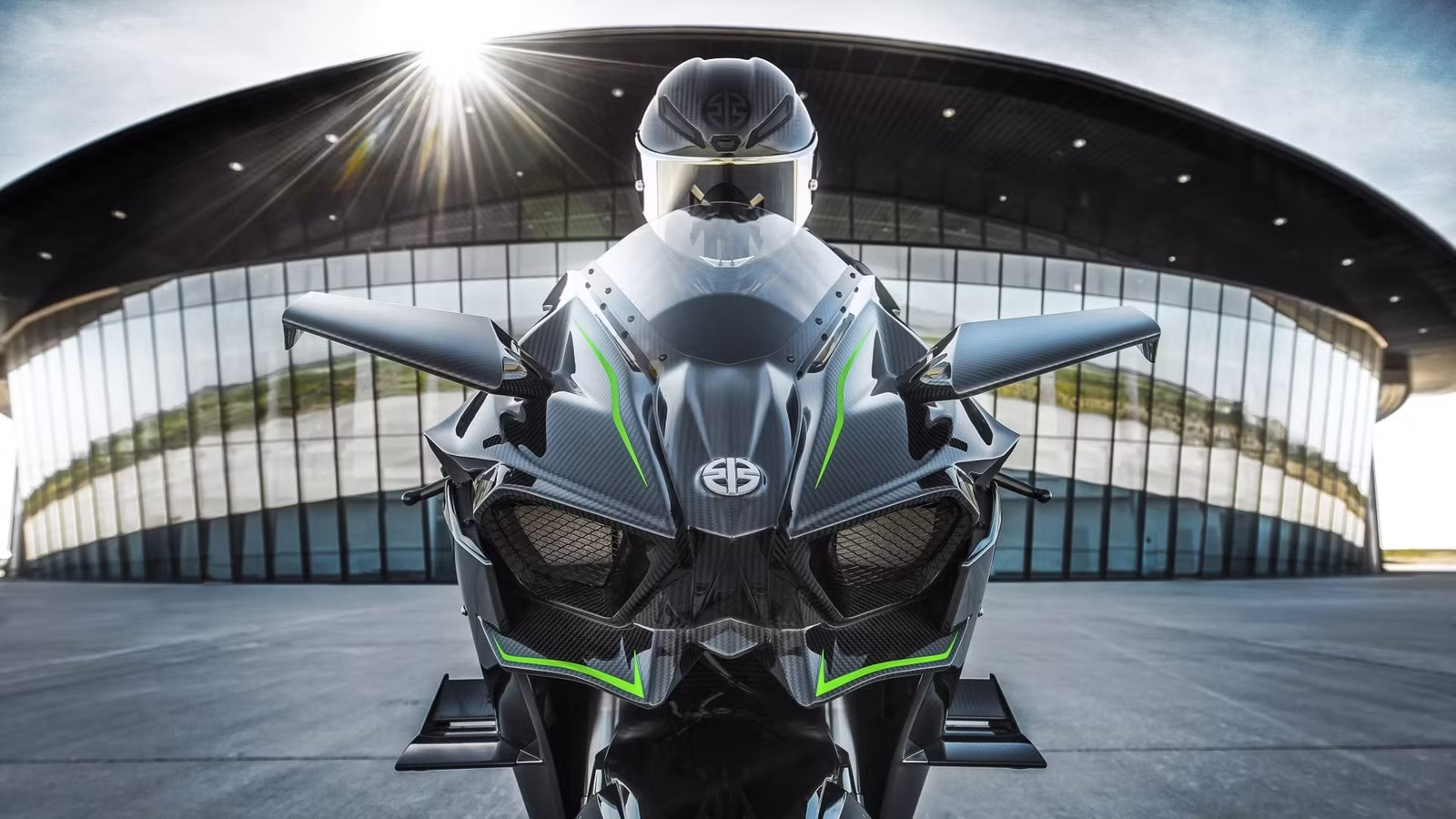
That agreement did not directly create Kawasaki’s latest flagship 15 years later. But what changed was the environment in which another Kawasaki halo bike had to stand out. By 2015, building another 186-mph road bike was hardly shocking, so Kawasaki removed road legality from the engineering memo and chased an ultra-high top speed. The result made how quickly a motorcycle crossed a straight become more memorable than its road-legal maximum top end.
The Ninja H2R Turns Straights Into Timing Problems

The current 2027 Ninja H2R produces 322 horsepower at 14,000 rpm and 121.5 pound-feet at 12,500 rpm from its supercharged 998cc inline-four. These are mind-boggling numbers that are paralleled by nothing else out there. It weighs 476.3 pounds ready to ride and costs a hefty $64,300, giving it an extremely limited-production special-order motorcycle status. Kawasaki also claims it’s already sold out for 2027.
What you get for the price are even more outrageous numbers. In one instrumented test, the H2R reached 124 mph in 6.5 seconds and needed only about 604 feet to get there. It reached 186 mph in 13.4 seconds, using roughly 2,165 feet, or 0.41 miles. A straight that looks comfortably long while exiting a corner can therefore lose most of its usable length in a little more than ten seconds.
The H2R Becomes More Absurd Once The Traction Problem Is Solved

Standing-start figures are just part of the story because the H2R cannot deploy all 322 horsepower while the front tire is trying to leave the ground. Another independent test recorded 124 to 186 mph in 6.17 seconds, compared with 13.80 seconds for a contemporary ZX-10R in the same comparison. Below roughly 124 mph, the gap was far smaller because both bikes were still working around controlling traction and wheelies. Once speed loads the chassis, the H2R keeps piling speed onto speed at the point where a naturally aspirated liter bike is fighting aerodynamic drag much harder.
The Supercharger Is Built For The Fast Half Of The Straight

Kawasaki’s centrifugal supercharger is at the center of that experience. A planetary gear train drives its impeller at up to 9.2 times the crankshaft speed, so around 14,000 rpm it approaches 130,000 rpm. The impeller can move more than 200 liters of air per second and raise intake pressure to as much as 2.4 times atmospheric pressure. High efficiency keeps the charge heating low enough that Kawasaki does without a conventional intercooler.
A six-speed transmission reduces the mass moved during shifts, while the quickshifter minimizes interruption between gears. Kawasaki even shaped the seat with hip-supporting pads to help brace the rider under hard acceleration. The farther along the straight you travel, the more the motorcycle’s strange engineering starts to make sense.
Every Braking Marker Arrives Earlier Than Expected

A 2015 test at the Lusail International Circuit, in Qatar, demonstrated this problem. Coming onto the front straight, the rear slick was breaking loose and hooking up while traction control managed wheelies into fourth gear. At the far end, the speedometer showed 203 mph while a VBOX recorded 191 mph, with roughly 1,500 rpm still left.
That is where the H2R’s wings, brakes, suspension, and steering damper come into play. A carbon-fiber aero package developed with Kawasaki’s aerospace engineers generates downforce to keep the front loaded. Dual 330mm front discs with Brembo Stylema calipers, an Öhlins electronic steering damper, and sophisticated ABS then help keep things under control.
Kawasaki Found A New Way To Chase Speed

Kenan Sofuoglu’s 2016 run to 400 km/h, or 248.5 mph, on Turkey’s Osman Gazi Bridge remains the H2R’s most famous demonstration, but it was a specially prepared record attempt rather than an official top-speed test. More relevant is what the run represented. Kawasaki had built a motorcycle capable of accumulating extraordinary speed within a limited stretch of pavement.
That separates it from Kawasaki’s old speed-war flagships. The ZX-11 and ZX-12R came from an era obsessed with the largest number a production motorcycle could eventually show on the speedo. The H2R turns the process of getting there into a whole event by itself. On most motorcycles, a long straight gives the rider time to use the engine. On this mad Kawasaki, the straight is usually the first thing to run out.
Source: Kawasaki

Related posts

Latest Post


No Comments