
The 155-MPH Diesel Superbike Nobody Remembers Because It Never Reached The TT Start Line
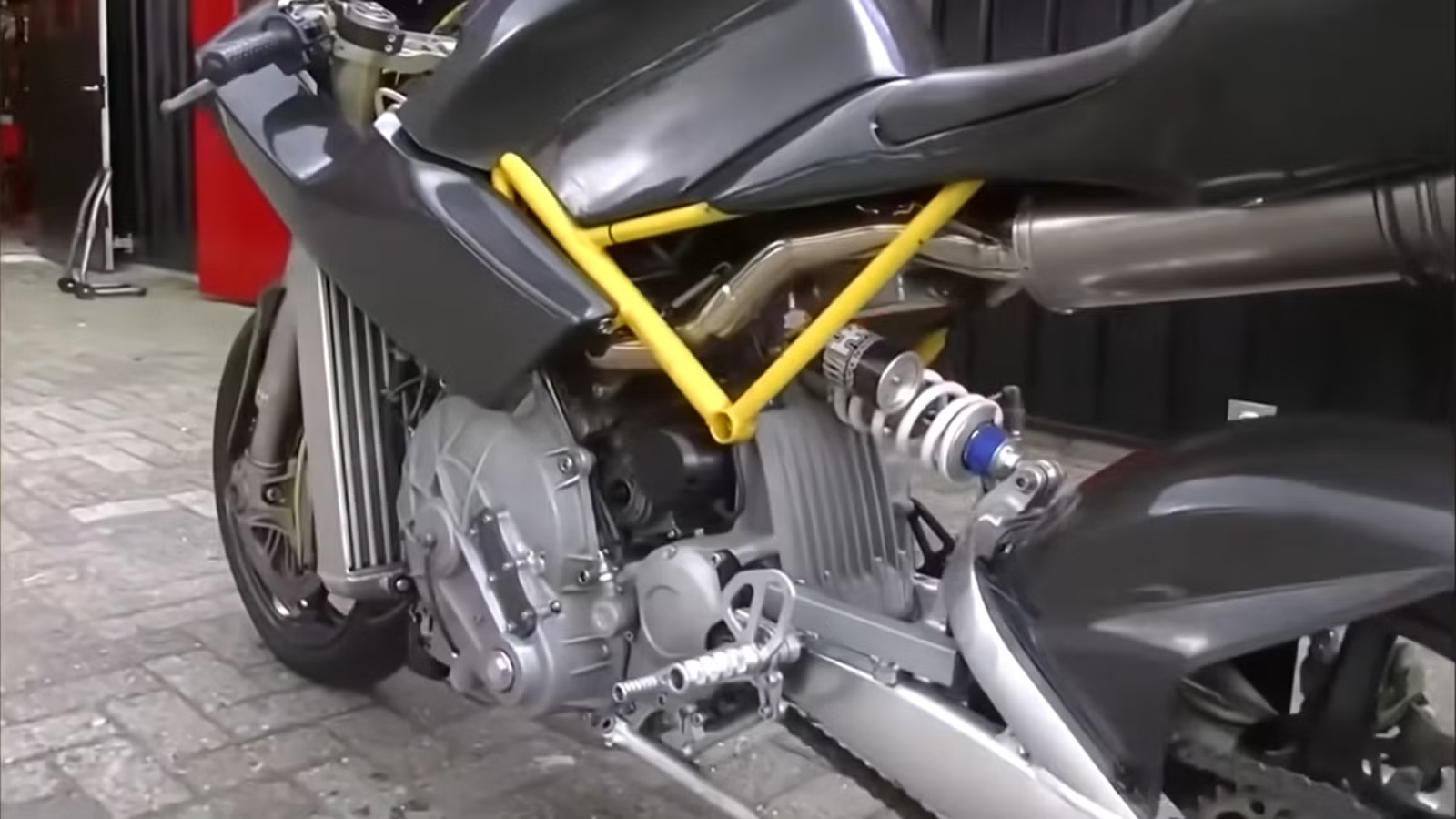
While motorcycles have always been about pioneering new and experimental ways of doing things, there’s one avenue that’s been left largely untested: fuel type. Sure, electric bikes are a thing now, and they’re fine, but gas has always been the fuel of choice for motorcycles. That’s not to say that nobody has tried other liquids, though, as one bike tried to make an exciting bike with the least exciting fuel, with impressive results.
When Diesel Ruled The Roads, Nobody Expected It To Challenge Superbikes

Diesel has never really been the “sexy” fuel choice. It conjures images of family cars, tractors, delivery trucks, and heavy commercial vehicles that need to focus on boring things like reliability and fuel economy rather than exciting performance. This was especially true when it came to motorcycles, as screaming, high-revving petrol engines mounted on lightweight frames with blistering acceleration are the antithesis of everything diesel stands for.
That’s not to say that nobody tried, of course. Royal Enfield unleashed the Taurus (the world’s first factory-produced diesel motorcycle) in 1993 to mixed reception, as the fuel economy (reportedly over 150 MPG) was adored, while its sluggish performance was lamented. It was practical and utilitarian, but its top speed of roughly 50 MPH meant that it was never going to chase superbikes. But that didn’t have to be true of all diesel bikes.
The Isle of Man TT Has Always Rewarded Engineering That Pushed The Boundaries


The Isle of Man TT has long been one of the most extreme challenges in the motorcycle world. The 37.73-mile Mountain Course is an incredible test on both man and machine, and one which many have, sadly, failed. But, despite the perpetual threat of death, engineers and riders have constantly tried to push the boundaries of what’s possible and go faster.
Norton brought its NRS588 Rotary to the island in the early 1990s, hoping that a Wankel engine could propel it to victory (which it did with Steve Hislop in 1992, when it won the Senior TT). New Zealand-based Britten brought its V1000 to the TT the year later and set the fastest lap with its utterly unique creation. But, much like when a team brought a Gold Wing to the IOMTT, not all experiments pay off on the unforgiving street circuit.
The Star Twin Thunderstar 1200 TDI Was A 155-MPH Diesel Superbike

Any normal person would say that the Volkswagen Lupo 3L is a terrible choice for a race bike. It’s a car, to start, but the 1.2-liter, three-cylinder turbo-diesel engine doesn’t exactly strike fear into the hearts of superbikes. Yet, in 2015, motorcycle builder Kees van der Starre and designer Jeroen Barnart tried to do the impossible, and use that engine as the basis for a bike that would take on the most fearsome bike race in the world.
Some changes had to be made, of course. The engine was taken out of the Lupo and, rather than simply being dropped into a motorcycle frame, it was given a specially-developed Mitsubishi turbocharger and a Yamaha gearbox. The chassis was a lightweight trellis design, while the bike also had BST carbon-fiber wheels and a neat suspension setup. The result wasn’t an agricultural bike hoping to win the TT on reliability while every other bike broke down, but a reportedly 125 HP, 155 MPH superbike that weighed some 452 lbs and was a considerable step-up on the Lupo’s original 61 HP and 102 MPH top speed.
However, while impressive, those numbers aren’t the only ones floating around for the bike. Some reports put it at 180 HP and 250 lb-ft of torque, while others put it as low as 95 HP. Fuel economy also varies depending on who you ask. Initial reports suggested that the Thunderstar could get between 150 MPG and 200 MPG, though a still-noteworthy 117 MPG was later reported when the engine was in fuel-saving mode.
Even if you took the more conservative figures, though, the Thunderstar was still a remarkable achievement. It showed that even a relatively run-of-the-mill turbo diesel engine could be adapted to deliver serious motorcycle performance without having to abandon the traits that made it attractive in the first place. More importantly, it challenged the assumption that high-performance bikes had to rely on conventional gas engines. The Thunderstar wasn’t an experiment in alternative fuel, but a potential superbike with an unexpected engine. But while it might have had superbike potential on paper, it was very different in practice.
Seven Years And €300,000 Could Not Get This Diesel Superbike To The Grid

While the Thunderstar never made an IOMTT race start, it did get to complete a lap of the course in 2015 with Japanese racer Yoshihiro Kishimoto. Kishimoto had the backing of Japanese biodiesel manufacturer Revo and, with the blessing of van der Starre, took the bike for its moment in the sun. A reported 110+ MPH average showed that the bike’s modified Lupo engine was more than up to the challenge and offered a glimpse at what could have happened had the bike had the opportunity to compete, but with around €300,000 (~$334,000) and seven years invested into the project, it was always going to struggle. Add in the fact that the three-cylinder, 1.2-liter engine didn’t fit neatly into any of the TT’s existing categories, and it was almost doomed from the start.
The Star Twin Thunderstar 1200 TDI Remains A Forgotten Motorcycle Engineering Experiment
The Thunderstar remains one of the most unusual motorcycle experiments ever attempted. It showed, arguably successfully, that a diesel engine could deliver exciting superbike performance, with a genuinely top speed and engineering that showed it wasn’t some slap-dash shed build. But its creators never managed to turn that achievement into a commercial opportunity, despite seven years and hundreds of thousands of euros. It remains as an example of what can happen when engineers are free to experiment without being waylaid by men in suits with spreadsheets and numbers to dull creativity. With just one created it was a bike as fleeting as thunder, but bright as a star.
Sources: Gallery Aaldering, The Kneeslider, The Autopian

Related posts

Latest Post


No Comments