
The Cruiser That Has Harley-Davidson Fat Boy Owners Reconsidering Their Choices
The Harley-Davidson Fat Boy is a true American icon that reaches far beyond the motorcycle world. Thanks to its unique styling elements, like the solid disc wheels and starring roles in Hollywood blockbusters, it created a bold look that defined the modern heavy cruiser. But being that famous comes with an obvious downside: when everyone wants one, you stop standing out in a crowd. Riders who want an equally commanding American V-twin with genuine road presence often find themselves looking past the default badge. Seeing fewer of them on the road does not mean the bike is inferior; it simply means the broader market has not caught on to how good this alternative really is.
The Hidden Everyday Penalties Behind Pop-Culture Ubiquity
Buying the default heavyweight cruiser brings some well-known everyday compromises. The Fat Boy gets its muscular stance from a massive 240-section rear tire and solid aluminum wheels, which look great but require real upper-body effort to lean into corners and keep steady through turns. On top of that, ubiquity ruins the feeling of owning something special; parking next to three identical bikes at a highway rest stop quickly takes the excitement out of the purchase. While the Milwaukee-Eight engine makes good top-end power thanks to its four-valve heads, peak horsepower is only a small part of the cruiser experience. Over a long day in the saddle, riders quickly realize that pure highway speed matters far less.
Marrying Classic Pushrod Character With Modern Technology

Breaking away from the market leader takes a brand willing to try new ideas rather than relying only on past glories. Indian Motorcycle stepped into this role by treating the big-twin recipe as something to build on with modern engineering. While traditional riders often push back against electronic gadgets, Indian showed that new tech belongs on classic iron as well. The bike we’re picking here is a fitting proof of that.
The Indian Super Chief Joins Authentic Big-Twin Heritage With Real Cross-Country Utility

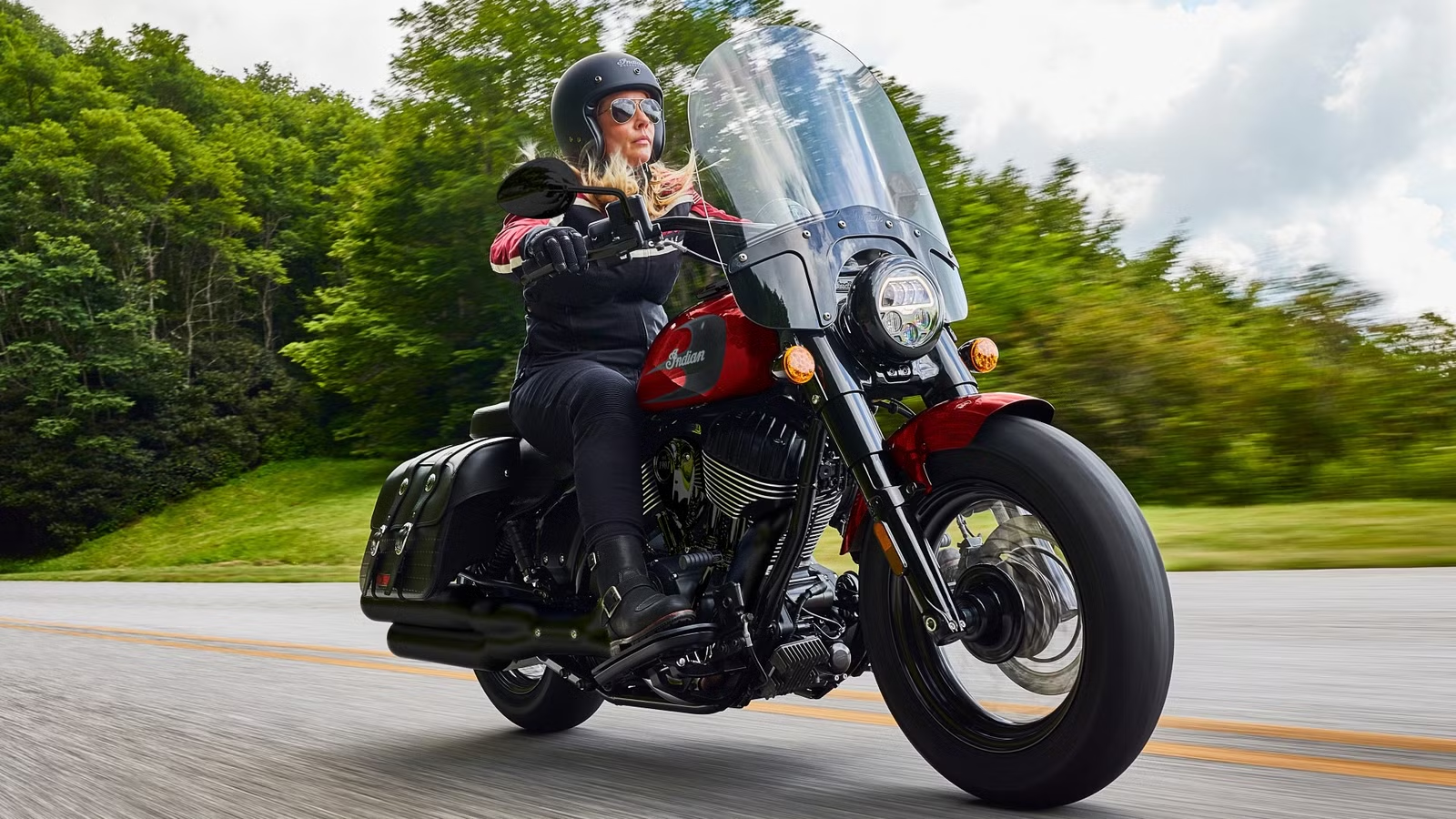
The $21,499 Indian Super Chief gives riders a direct alternative to the $22,599 Fat Boy when they love the classic look of an American heavyweight but do not want to ride the exact same machine as everyone else. It delivers the Harley experience without needing Harley money. It skips the horsepower race to deliver massive, easy-going low-end torque right off idle. By pairing this smooth pull with standard-width tires that steer easily, leather saddlebags, and a quick-release windshield, the Super Chief delivers comfortable road manners and cross-country usability right off the showroom floor.
A Bulletproof Thunderstroke Engine Delivers 120 Pound-Feet Of Low-End Muscle

The Super Chief gets its motive power from the Thunderstroke 116. This is an air-cooled V-twin that is built to last, one that has been known to hit 100,000 miles without much effort. It displaces 1,890 cc, and its headlining figure is 120 pound-feet at 2,900 RPM. It is mated with a six-speed gearbox with an assist-and-slipper clutch and a belt final drive. The Thunderstroke engine arguably has just as much character as any other American V-twin engine we have ever seen.
Low-Slung Geometry Transforms Low-Speed Handling

The Super Chief combines a dual-downtube cradle frame with 46 mm telescopic forks at the front, and twin rear shocks with preload adjustment. Suspension travel stands at three inches at the rear and 5.2 inches at the front. A 300 mm semi-floating front brake disc has a four-piston fixed caliper; at the rear, an identical disc has a two-piston floating caliper. Sixteen-inch wire-spoke wheel rims are fitted.
This is a full-size cruiser with a length of 90 inches, a width of 42.5 inches, and a 64-inch wheelbase, and it makes 500-mile days feel easy. The 26.2-inch seat height is one of the lowest in the business, but it also has a low ground clearance of 4.9 inches. The fuel tank can hold four gallons of fuel, and it weighs 739 pounds in running order. This makes it one of the heaviest cruisers around.
Standard Ride Command Tech And Leather Bags

The Super Chief truly gives Harley owners something to think about when it comes to features. Standard features include a 12-volt charging socket, keyless ignition, all-LED lighting, a touring seat with pillion accommodation, and leather saddlebags with nine gallons of storage. The highlight is the four-inch circular TFT touchscreen display with the Ride Command system. Not only does it offer Bluetooth and navigation, but it also has connected features that display the bike’s health and locate it. The by-wire throttle offers three ride modes, and dual-channel ABS and rear-cylinder deactivation are welcome additions.
Harley Breakout, BMW R 18, And Triumph Rocket 3 Offer Drastically Different Flavors

There is no shortage of competition for the Fat Boy. If you want to stick with Milwaukee, the Harley-Davidson Breakout costs similar money and has equal presence, if not the same style as the Fat Boy. Another motorcycle that will draw a lot of eyeballs is the BMW R 18; you will also end up saving a lot of money because it retails at just $15,395, although it does not offer the same safety suite as the Harleys.
Undoubtedly, the performance value king is the $15,799 Suzuki Boulevard M109R. It offers one of the greatest engines in automotive history, but does not have any modern safety to speak of; you will appreciate the inverted front forks and sport bike front brakes. However, if you are willing to spend a little more money than the Harley Fat Boy costs, there is a very interesting proposition.
At $26,695, the Triumph Rocket 3 Storm R boasts the largest engine on a production motorcycle in history and backs it up with eye-popping horsepower and torque figures—180 horsepower and 166 pound-feet. Additionally, it has a TFT screen with Bluetooth and navigation, a six-axis IMU, and quality suspension to balance torque, stability, and comfort like no other.
Source: Indian Motorcycle

Related posts
Latest Post


No Comments