
This 2028 Ferrari F40 Render Is A Purist’s Dream With A Major Problem
Whatever people say about modern Ferraris, they still have a knack for breaking the internet on a regular basis. The Maranello company stays at the front line of technology and supercar development, resolutely pushing the game on. However, this can also upset purists, with everything from the V12 Purosangue to the highly controversial Luce EV catching flack for not sticking to the Italian company’s supposed ethos. A modern F40 would fix that — bringing back one of the company’s most iconic supercars for the modern day.
This Modern F40 Render Shows An Alternative Range Topper For Ferrari

When the Ferrari F80 was launched in 2024, it was the perfect imposing flagship model from one of the most prestigious supercar manufacturers on earth. But some found fault, with online critics singling out everything from the “mustache” front to the blocky modern styling, to the use of a twin-turbocharged V6 hybrid rather than a V8 or V12 of old. You can’t please everyone, I guess. But should Ferrari have mined its classic back catalog, like Renault with the 5 Turbo 3E, and just delivered an F40 for the modern day? And what would it have looked like?
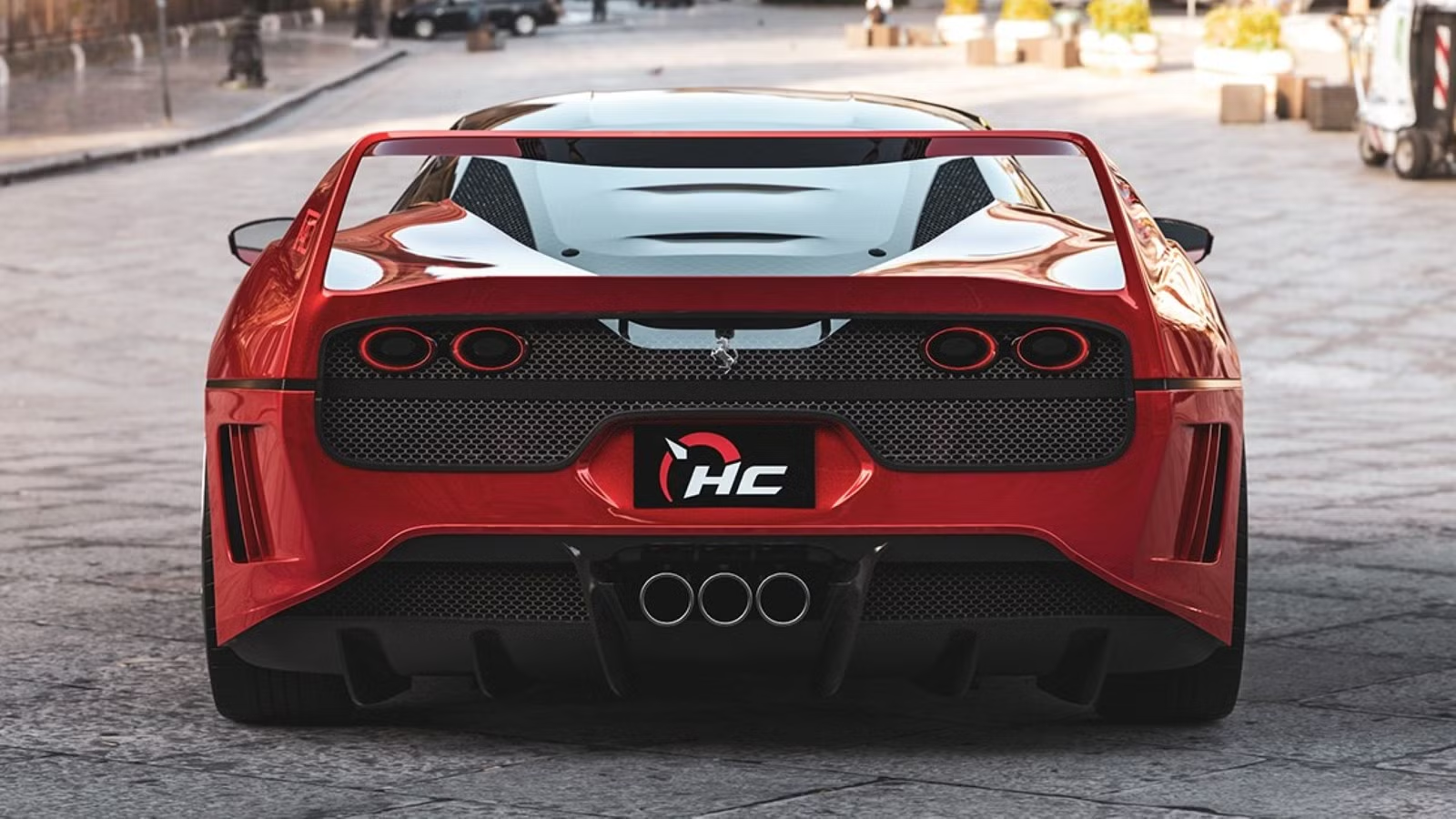
This digital render gives a good idea of the direction that car could have gone in. From straight ahead, there isn’t much of a clue as to what illustrious badge it wears, with the contemporary rounded looks and small headlights a nod to the 296. But look closer and you’ll see that trademark satin black painted side indent line (originally designed to hide the F40’s panel gaps) and the gently rising shoulder line. The hood intakes are also a subtle homage to the NACA ducts on the front of an F40.

The twin side intakes are pure F40, with the side profile ending in that unmistakable squared-off F40 rear spoiler (complete with indented badge). The rear spoiler has a slightly shallower rake, which, combined with the more rounded rear haunches, takes inspiration also from the later Ferrari F50 of the ’90s. At the rear, the render is the closest to the iconic 19080’s predecessor, with a race car-style mesh-filled opening, albeit with oval LED taillights instead of round. The killer touch is the triple tailpipe arrangement in the center. The modern F40’s wheels are similar to those found on the 849 Testarossa, albeit with a noticeable star pattern that apes the factory stock 17-inch Speedline split-rim, 5-spoke center-lock alloys on an F40.

Why The OG F40 Is So Iconic

If you follow social media, you’d be forgiven for thinking that everyone owns a classic Ferrari F40 these days. Whether it is Lewis Hamilton’s incredible renovation of a forgotten F40 that had sat for 30 years, to Tyler the Creator and even Gordon Ramsay showing up in one, this is definitely the car of the moment. Prices back this up, with F40s going from a few hundred thousand dollars not that long ago to multiple millions today — the ICE supercar is definitely back with a vengeance.
The Ferrari F40 was officially launched on July 21, 1987, at the Civic Centre in Maranello, Italy, powered by a 2.9-liter V8 and covered in Kevlar and carbon fiber. With the 2028 F40 render following so closely in the original’s footsteps, it would need a twin-turbo V8. Luckily, Ferrari has one on the shelf that it currently instals in the Testarossa 849.

The F154FC 4.0-liter twin-turbocharged V8 unit sits at the heart of the plug-in hybrid (PHEV) powertrain in the Ferrari 849 Testarossa, pumping out a combined 1,036 hp with three electric motors. This would be perfect for the F40’s modern reboot. It wouldn’t need more power either if the original F40’s no-frills approach was adhered to and the curb weight dipped a couple of hundred pounds under the Testarossa’s 3850 lbs. The cherry on the cake would be the 6-speed gated (“Manuale By-Wire”) manual shifter and clutch pedal built electronically for Ferrari’s 8-speed dual-clutch transmission, as seen in the 12Cylindri. So what’s the problem with a modern F40?
Why Bringing The F40 Name Back Is Problematic

Ferrari doesn’t really seem to do retro, in its top flight supercars and hypercars at least. Just look at the latest 849 Testarossa, a mid-engined supercar that goes out of its way to avoid visual association with the original ’80s Testarossa. It would appear that Ferrari doesn’t want to lose sight of its forward-leaning design and tech, without resorting to retro — and should be admired for that. The 12Cylindri, however, does bring back the essence of the Ferrari 365 GTB/4 ‘Daytona’, however, so it’s not off the table. The next problem is using that Testaross powertrain — it may not make the F40 distinct enough to command a higher price.
The final, and most important, reason why the F40 name is unlikely to come back is because of what it means. The name was derived from “F” for Ferrari and the number 40, celebrating the 40th anniversary of the first Ferrari approved for road use. It was also the very last Ferrari personally commissioned and approved by Enzo Ferrari, who passed in 1988. These are things that even the devoted Ferrari tifosi would probably agree are too special to be messed with.

Related posts
Latest Post


No Comments