
One In Every Five BMW And MINI Vehicles Sold In Q3 Was Electric
MINI
Europe is leading BMW Group’s electrification push, with nearly 35% of vehicles sold in Q3 being fully electric. The United States, by comparison, recorded a BEV share of just 4.7%.
Article Summary
- Fully electric vehicles accounted for 20% of BMW and MINI global sales in the third quarter of the year.
- Including plug-in hybrids, electrified models represented more than a quarter, reaching 27.4% of worldwide deliveries.
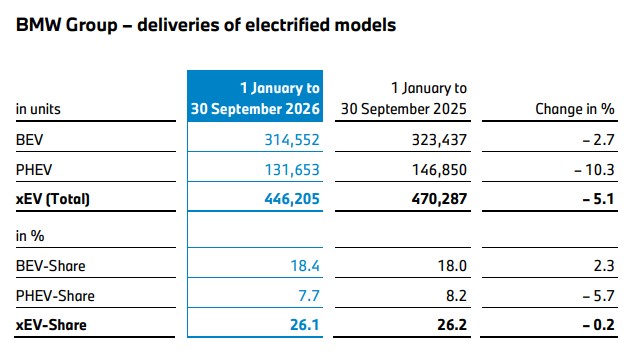
- Year to date, EVs account for 18.4% of combined BMW and MINI sales. Including plug-in hybrids brings the share of electrified models to 26.1%.
BMW Group’s transition to electric mobility is progressing at very different speeds depending on where it sells its vehicles. New third-quarter 2026 figures reveal a significant regional gap, with Europe emerging as the company’s strongest market for electric vehicles. The United States, meanwhile, has considerably more ground to cover.
Globally, fully electric vehicles accounted for 20% of BMW Group’s total sales between July and September. Including plug-in hybrids, the combined share of electrified vehicles (xEVs) climbed to 27.4%. In other words, more than one in four vehicles sold worldwide by BMW and MINI skipped the combustion engine, although the regional breakdown tells a much more interesting story.

Europe is comfortably ahead of every other region, with EVs representing 34.7% of BMW Group’s total sales in Q3. Add plug-in hybrids to the equation, and the share of electrified vehicles jumps to an impressive 46.9%. That’s nearly half of all vehicles sold in the region. The figures underline how important Europe remains to BMW’s electrification strategy. Stringent emissions regulations, government incentives in certain markets, and an increasingly diverse lineup of electric models have helped drive adoption.
The United States Has Some Catching Up To Do
Across the Atlantic, the picture is considerably different. EVs accounted for just 4.7% of the Group’s sales in the US during the third quarter, while the combined EV and PHEV share reached 11.4%. Of course, the numbers would look different if the iX1 and iX2 were available in the US, but sadly, BMW has decided not to offer either model across the Atlantic.

That puts the American market well behind Europe, highlighting the challenges of convincing buyers to switch to electric powertrains. Charging infrastructure, consumer preferences, lack of cheaper products, and the country’s political climate all shape demand. BMW still has plenty of room to grow, particularly as it expands its electric lineup with next-generation products.
China Has A Different Electrification Story
China posted a 6.5% EV share, rising to 6.6% when PHEVs are included. The almost identical figures suggest that plug-in hybrids contribute very little to BMW Group’s electrified sales mix in the world’s largest automotive market, which is also the company’s largest single market. That contrasts with Europe, where PHEVs account for a much larger share of electrified vehicle sales.
The remaining markets, grouped under Asia-Pacific, Eastern Europe, the Middle East, and Africa, recorded an 18% EV share and a 23.3% xEV share including PHEVs. While this is below Europe’s electrification rate, it comfortably exceeds the figures recorded in both China and the US.
There’s No One-Size-Fits-All Solution
BMW’s regional figures show that there isn’t a one-size-fits-all approach to electrification. Europe is already approaching the point where electrified vehicles account for half of the company’s sales, whereas the US remains heavily dependent on conventional powertrains. China presents another challenge, given the strength of its domestic EV manufacturers.
Looking at the year-to-date figures, fully electric vehicles account for 18.4% of combined BMW and MINI sales, meaning nearly one in five vehicles delivered so far this year has been a BEV. Plug-in hybrids add another 7.7 percentage points, bringing the combined share of electrified vehicles to 26.1%. In other words, more than a quarter of BMW and MINI vehicles sold in 2026 have a charging port, underlining the growing importance of electrified powertrains to the Group’s overall sales mix.
Several Neue Klasse EVs Are Coming Soon
The Neue Klasse is expected to accelerate BMW’s electric ambitions, especially with the i3 hitting the market this month, the next-gen iX1 coming in 2027, and the i1 following in 2028. An iX7 is also arriving soon, but its high price won’t make it a volume model. Even so, the company isn’t abandoning combustion engines or plug-in hybrids anytime soon. Instead, its Power of Choice strategy lets customers choose different powertrains based on their needs and local market conditions.
Ultimately, BMW doesn’t need every region to electrify at the same pace. It needs to offer the right products in the right markets while making sure its investments in electric mobility translate into sustainable sales growth. These Q3 figures suggest there’s still considerable work ahead, particularly in the US.

Related posts


Latest Post


No Comments