
2027 Nissan Rogue vs 2027 Toyota RAV4: Review
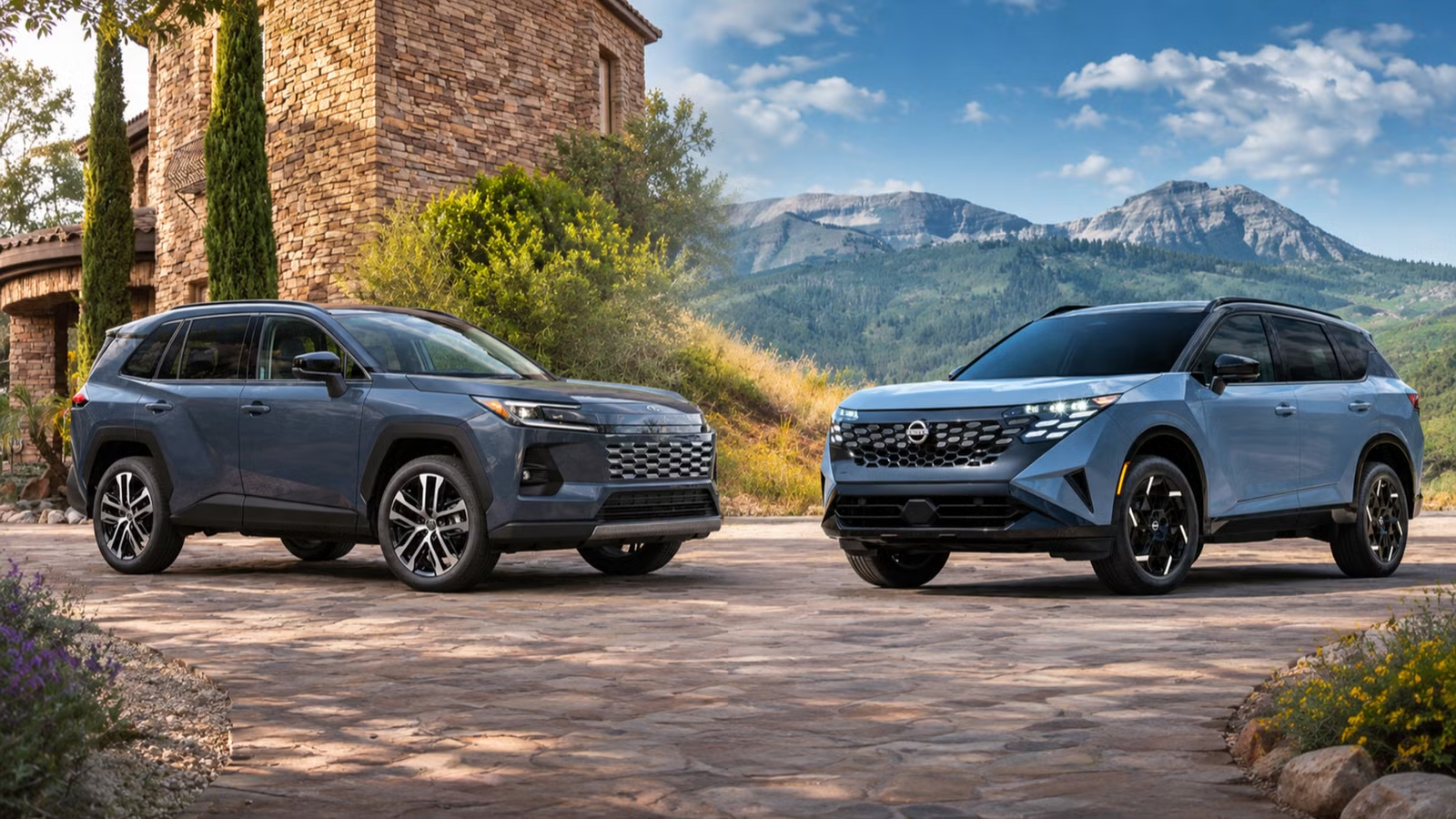
Remember when most mid-size crossover SUVs were more or less the same? Such was the 2010s in a nutshell, everything kind of just blended into a blur after a while. Well, it’s 2026 now, and here we have two mid-size hybrid crossovers that couldn’t be more different from each other if you tried. In one corner, we have the tried and true Toyota RAV4 Hybrid. In the other, there’s the all-new Nissan Rogue Hybrid. The two might share a market segment, but after spending the day with both, it’s fair to say not much else.
2027 Nissan Rogue Goes Bold While Toyota RAV4 Gets Tougher

Alright, neither of these crossovers are exactly striking to look at. They both sort of just blend into traffic in a way you expect a vehicle in this class to do. Still, from a more nuanced perspective, it’s nice to see the new Rogue look so profoundly different from the last generation. For years, a Rogue’s front fascia was defined by its horseshoe-shaped “V-Motion” chromed grille that defined most of the Nissan range for over a decade. It was the kind of design cue you either loved or hated—but now, the new model’s ditching it entirely in favor of a new, sleeker design.
With glossy-black front clip, a rising Mount Fuji motif along both rear flanks, and a thin light bar merging the rear brake lights, at least subjectively, it looks a lot nicer than the outgoing Rogue. With that said, it’s not like any mid-size crossover is a looker in the traditional sense, as the Toyota RAV4 reminds us. It’s still as utilitarian looking as the day the first generation hit showrooms in 1994.

Arguably, the monolithic front fascia and squinty headlights aren’t doing it any favors. Yet, because Toyota knows its audience, you could argue the fact a RAV4 could blend into an empty parking garage is one of its core strengths. It still looks rugged, chunky, and like it wants to protect your family above all else, aesthetics be darned. In short, you don’t buy a RAV4 to win a beauty contest, though it sorely loses one against the new Rogue. With that said, that’s a bit like winning best-dressed at Home Depot. It doesn’t really count for much.

2027 Nissan Rogue’s Upscale Interior Puts Toyota RAV4 Under Pressure

Toyota and Nissan have two opposite philosophies when it comes to interior design, and it shows most of all when you drive a Rogue-and-RAV4 back to back like this. Step inside a new Rogue, and you’re greeted with an interior that almost feels like an Infiniti without the badge. The semi-aniline leather seats on this test article were plush, supple, and had plenty of bolstering. The floating center console is positively cavernous, and closes with a delightful tactile click that feels very solid.
Not everyone is a huge fan of dual-use infotainment screens and digital gauge clusters merged into a single unit, but the optional twin 14.3-inch displays tested were crisp, high-fidelity, and had genuine smartphone-level snappiness to them. There’s still some cheap plastic here and there, and that push button shift mechanism left a lot to be desired. But hey, at least physical buttons are back in force for items like the radio and climate controls, and that’s a big relief.

Meanwhile, it’s clear Toyota values durability over decadence. At least, that’s probably how it justifies lagging so far behind Nissan in interior refinement. Credit where it’s due, the 12.3-inch digital gauge cluster and available 12.9-inch infotainment center screen is a lot more conventional than Nissan’s blended unit, and the physical shifter mechanism is far nicer than Nissan’s button system. Still, the amount of hard plastic and sub-par-feeling materials serve as reminders of Toyota’s intentions. The seats weren’t anything to write home about either; so to speak, if you want a nice interior, buy a Lexus NX instead. For the moment, the interior advantage goes handily to Nissan. Whether that’s true a decade from now might be a different story, and we’re assuming that’s what Toyota is banking on.
Two Polar Opposite Hybrid Drivetrains

So far, it’s pretty baffling just how different these two ostensibly rival crossovers are. Well, get ready to widen that gap a few thousand miles, because these are two wholly different ways of fielding a hybrid drivetrain. Starting with the Rogue, its third-generation e-Power series hybrid drivetrain rocks a 1.5-liter turbo three-cylinder gas engine that never physically drives the wheels. It’s just a generator that powers one AC electric motor per drive axle to provide full-time all-wheel-drive. Because electric motors drive the wheels, there’s no need for a gearbox either.
With 225 horsepower combined, it doesn’t sound like a whole lot. Yet, because the Rogue is effectively an EV with an on-board generator, all its torque is available the second you stomp the throttle. Zero to 60 happens in roughly 6.7 seconds, which Nissan claims is the best in the segment. The ride was cushy, easily soaking up cobblestone bumps and pot holes with ease, and selectable e-Pedal regenerative braking allows you to accelerate and brake by using the throttle alone. In truth, it’s easy to forget there’s a gas engine on board. After all, it only fires up depending on the battery’s state of charge. Also, don’t get too used to that e-Pedal, you’ll probably rear end a truck if you have to drive something else one day

Meanwhile, the RAV4 is as traditional of a hybrid setup as you’re liable to come across. It’s a typical parallel hybrid with a 2.5-liter Atkinson cycle four-cylinder engine and either two or three electric motors depending on the trim. In this AWD-tri-motor setup, you get 236 horsepower, and the engine directly drives the wheels along with the electric motors through an eCVT. It makes the throttle response feel far more like a gas car than an EV. The engine revs rise and fall with the throttle input, the eCVT spools up and rubber bands like you expect, and to its credit, the RAV4 Hybrid is no slouch. We’re talking zero to 60 in 7.1 seconds, still pretty zippy for everyday driving. Still, if you want more, the GR trim is always an option.
Both Are Practicality Champions

The new Rogue isn’t just an improvement in the tech department, it’s also just downright clever. Its doors open nearly 90 degrees thanks to extra movement in its door hinges, making entrance and egress a breeze. With the rear seats upright, a full 36.5 cubic feet of cargo space, plus 74.1 with the rear seats stowed, is nothing to sneeze at either. The RAV4 counters with its on-brand flavor of practicality. With 37.5 cubic feet of cargo space with the rear seats up and just under 70 when they’re flat, the Toyota just barely has more room than the Nissan. In the ultimate metric for a hybrid crossover, fuel economy, the Rogue and RAV4 are both top contenders.
With its 2.5-liter setup, the RAV4 easily sips fuel to manage 38 and 44 MPG combined, depending on trim, or better in lower-trimmed FWD Variants. The Rogue is a fuel sipper in its own right, just not to the same degree as the RAV4. 38 MPG combined is what you can expect out of the new Rogue, with the tradeoff being an entirely different driving dynamic to the RAV4.

Either one will serve you well, and each will stave off the worst of the current gas crisis with considerable skill. The only question is, do you want to face the storm in abject refinement, or supreme durability? Whichever you chose is as much an indictment of your personality as it is your taste in cars.
The Verdict: Both are Great, With Different Use Cases

If your weekly mileage is heavy on commuting, or you view your vehicle as a family-hauling multi-tool and don’t mind scratching the mildly mediocre plastic trim, the RAV4 is the default logical choice as it’s been for decades. It’s a proven platform with very obvious downsides, but ones Toyota’s customers are willing to put up with for supreme reliability and practicality.
Meanwhile, the Rogue is a refined, marginally stylish, and supremely impressive platform that’s totally unproven in every way. It’s a classic case of picking your poison, and whichever path you choose, you’re not exactly losing much.
Sources: Toyota, Nissan

Related posts



Latest Post


No Comments