
The Japanese SUV You Buy When You’re Done Playing Russian Roulette With Reliability
Today’s buyers want daily comfort, family-friendly space, a premium feel, and enough driving character to make the purchase feel worthwhile rather than purely obligatory. As sticker prices climb and luxury-brand ownership costs grow harder to justify, that combination is increasingly difficult to find at a price that makes long-term sense.

The answer, it turns out, comes from a Japanese brand that has been quietly closing the gap with the luxury segment — without abandoning the value proposition that built its reputation. Two strong powertrain options, genuinely upscale materials, composed road manners, and compelling ownership numbers make the long-term case far more interesting than the badge alone might suggest.
Why SUVs Are The New Norm In The U.S.
SUVs have become the default daily driver because they solve more problems than sedans or traditional sports cars can. They offer cargo space, all-weather confidence, a higher seating position, and enough flexibility to handle commuting, errands, road trips, and family use without asking owners to keep a second vehicle around.

That shift has also raised expectations. Buyers no longer want an SUV that is merely practical — they want one that feels refined, drives well, and delivers enough technology and comfort to make every day feel easier. Luxury brands answer that demand, but they also bring higher purchase prices, steeper depreciation, and more expensive maintenance.
That is where Mazda’s current SUV strategy becomes relevant. The brand has been pushing steadily into near-luxury territory, with more upscale interiors, smoother powertrains, and driving dynamics that feel closer to European than mainstream. The result is an SUV lineup aimed squarely at buyers who want premium execution without fully committing to premium-brand costs.
The model that best represents that strategy is also the one that makes the strongest case for long-term ownership.
The Mazda CX-70 Is Mazda’s Most Complete Daily Driver

The 2026 Mazda CX-70 is where Mazda’s near-luxury ambitions come into sharpest focus. It shares the same large rear-biased platform as the three-row CX-90, but trades the third row for a more athletic two-row layout and expanded cargo flexibility — making it a better fit for buyers who want premium SUV presence and space without hauling seats they will rarely use.
The CX-70 Undercuts Luxury SUVs Without Feeling Basic

The 2026 Mazda CX-70 is offered in seven distinct configurations for the U.S. market, with base MSRPs starting at $42,750 for the 3.3 Turbo Preferred and scaling up to $56,870 for the 3.3 Turbo S Premium Plus. The electrified PHEV SC and SC Plus models occupy the middle bracket at $44,550 and $47,450, respectively, while all models require a destination and delivery fee. Standard comfort and convenience features across the line include a 12.3-inch center display with Alexa Built-in, wireless Apple CarPlay and Android Auto, a power sunroof, and heated front seats.
Moving into the Premium and Premium Plus trims adds upscale amenities such as a 12-speaker Bose Centerpoint surround system, a 360-degree view monitor, a hands-free power tailgate, and ventilated front seats with Nappa leather. The high-output S trims further elevate the experience with a 12.3-inch fully digital gauge cluster, driver seat memory, and signature LED lighting, while the flagship Turbo S Premium Plus features exclusive tan quilted Nappa leather, a suede-wrapped dashboard, and a 150-watt cargo area power outlet. While most features are grouped by trim, standalone options are largely limited to premium paint colors such as Soul Red Crystal Metallic, Rhodium White, Polymetal Gray, Zircon Sand, or Melting Copper Metallic, each carrying a $595 surcharge.
What Our Test Drive Revealed
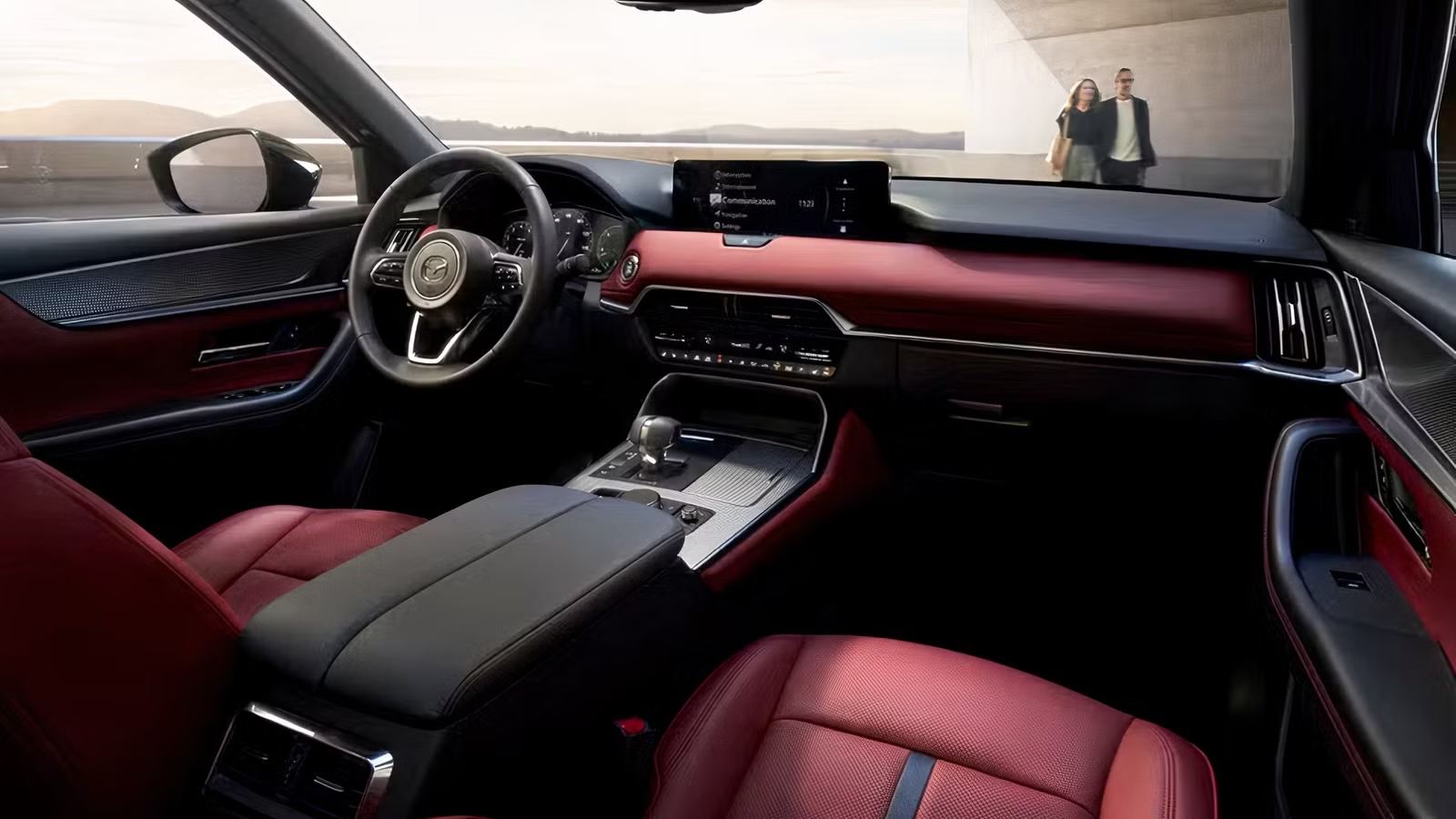
Our team had a chance to test drive the CX-70, giving us a clear picture of how this premium Japanese SUV performs away from the spec sheet. Initial praise went, naturally, to the luxury-like appearance and build quality, both inside and out. Mazda has done an impressive job of styling the CX-70 to look muscular and planted. Inside, it is easy to forget you are in a mainstream SUV, thanks to the premium design and material choices. Comfort and cabin NVH are well managed regardless of trim or powertrain.
It rides smoothly, too, with a quiet interior and the sort of road composure you normally associate with much more expensive nameplates. The inline six engine feels robust, providing ample passing power and smooth operation.
The Inline-Six And PHEV Options Make The CX-70 Feel More Expensive Than It Is

The 2026 Mazda CX-70 pairs its rear-biased i-Activ all-wheel-drive architecture exclusively with an eight-speed automatic transmission, though its performance character varies meaningfully across three distinct powertrain calibrations. The entry-level 3.3 Turbo models feature a 48-volt mild-hybrid inline-six producing 280 horsepower and 332 pound-feet of torque. For buyers who prioritize performance, the high-output 3.3 Turbo S variants use a more aggressive tune of the same engine to produce 340 hp and 369 lb-ft of torque on premium fuel, enabling a 0–60 mph sprint in 6.5 seconds.
Alternatively, the PHEV model pairs a 2.5-liter four-cylinder engine with a 68-kW electric motor for a combined system output of 323 hp and 369 lb-ft of torque. Thanks to the immediate delivery of electric torque, the PHEV is the quickest off the line, reaching 60 mph in 5.9 seconds. Mazda electronically limits the top speed of these utility vehicles to 130 mph.
The PHEV Is The Smartest Long-Term Pick For Fuel Savings

Opting for the entry-level turbocharged variant yields an EPA-estimated fuel economy of 24/28/25 mpg city/highway/combined. Upgrading to the Turbo S nudges city consumption down to 23 mpg. With an 18.5-gallon fuel tank on the Turbo and a 19.6-gallon tank on the Turbo S, range estimates come in at approximately 462 miles for both engines.
The EPA indicates that the base Turbo will cost around $2,700 annually in fuel and approximately $4.50 per 25 miles driven — coming in notably above the average new vehicle. The Turbo S model carries higher running costs still, with around $3,250 in estimated annual fuel spend and approximately $5.45 per 25 miles driven.
The CX-70 PHEV is the model to go for if fuel savings are a priority. This earns an estimated 61 MPGe combined rating from the EPA, together with an all-electric range of 26 miles, transitioning to 26 mpg combined once the battery is depleted. This model features an 18.4-gallon tank and a total gas-electric range of 520 miles. You’ll still spend around $2,250 more on fuel over five years and approximately $1,950 on gas and electricity over a year. You can also expect to spend around $2.02 to charge the battery, $5.24 to drive 25 miles on gasoline, and roughly $100 to fill the tank.
The Ownership Data Is Strong, But Not Perfect

According to J.D. Power, the 2026 Mazda CX-70 holds a consumer-verified overall score of 77/100, which includes 83/100 for the driving experience, 82/100 for resale, and 82/100 for the dealership experience. Notably, it earns only 69/100 for quality and reliability. The model holds an outstanding 4.6/5 average rating on the Edmunds consumer review portal, with reliability and manufacturing quality, ride quality, and value among its strongest suits.
According to iSeeCars, the 2026 Mazda CX-70 will lose approximately $18,180, or 43 percent of its value, after five years of ownership — slightly better than the segment average of 46.3 percent.
CarEdge indicates that you can expect to spend around $50,314 on the CX-70 over the same period, which includes approximately $19,433 in depreciation, $9,240 in fuel, and $2,649 in maintenance.
Sources: Mazda, the EPA, Edmunds, J.D. Power, iSeeCars, and CarEdge.

Related posts




Latest Post




No Comments