
Infiniti’s Crossover Officially Outran Every SUV Since The GMC Typhoon
In the early 2000s, luxury SUVs were getting bigger, heavier, and more expensive. Most promised comfort, commanding views, and enough leather to furnish a small apartment. Sharp handling and sports-car acceleration rarely topped the shopping list. Infiniti saw an opportunity to challenge that thinking: Nissan‘s luxury division had struggled to compete with established premium brands, but its engineers had access to serious performance hardware. What followed changed Infiniti’s reputation almost overnight.
Infiniti Needed More Than Comfortable Luxury Cars To Compete
Infiniti entered the American luxury market in 1989 but struggled to establish a clear identity throughout the 1990s. The J30, introduced for 1993, featured unusual rounded styling and a 3.0-liter V6 related to the Nissan 300ZX’s engine. Unfortunately, its sleek roofline restricted rear headroom, and its flowing body concealed a cramped cabin. The smaller G20 offered respectable handling, but its front-wheel-drive layout and modest four-cylinder engine hardly made it a serious BMW 3 Series rival.
Meanwhile, BMW had built its reputation around sports sedans, Mercedes-Benz offered prestige, and Lexus combined comfort with reliability. Infiniti delivered refined cabins and solid Nissan engineering, but neither gave buyers much reason to abandon established luxury brands. Infiniti needed a stronger identity, and Nissan already had the engineering to make that happen.
Nissan’s Sports Car Engineering Gave Infiniti An Unexpected Advantage


Nissan’s Front Midship (FM) architecture provided the foundation for Infiniti’s transformation. Engineers positioned the engine farther back in the chassis, with much of its mass behind the front axle line. This improved weight distribution and reduced the load on the front tires during cornering. Combined with rear-wheel drive and sophisticated suspension, the platform promised sports-car handling. It also underpinned the Nissan 350Z, allowing Infiniti to benefit from proven performance engineering without developing a separate architecture.
The 2003 Infiniti G35 sedan demonstrated this strategy. Introduced in March 2002, it featured a 260-horsepower, 3.5-liter V6, rear-wheel drive, and a chassis closely related to the 350Z. A five-speed automatic arrived first, followed by a six-speed manual. The G35 coupe offered up to 280 horsepower.
The 2003 Infiniti FX45 Was The Quickest SUV Car And Driver Had Tested Since The GMC Typhoon

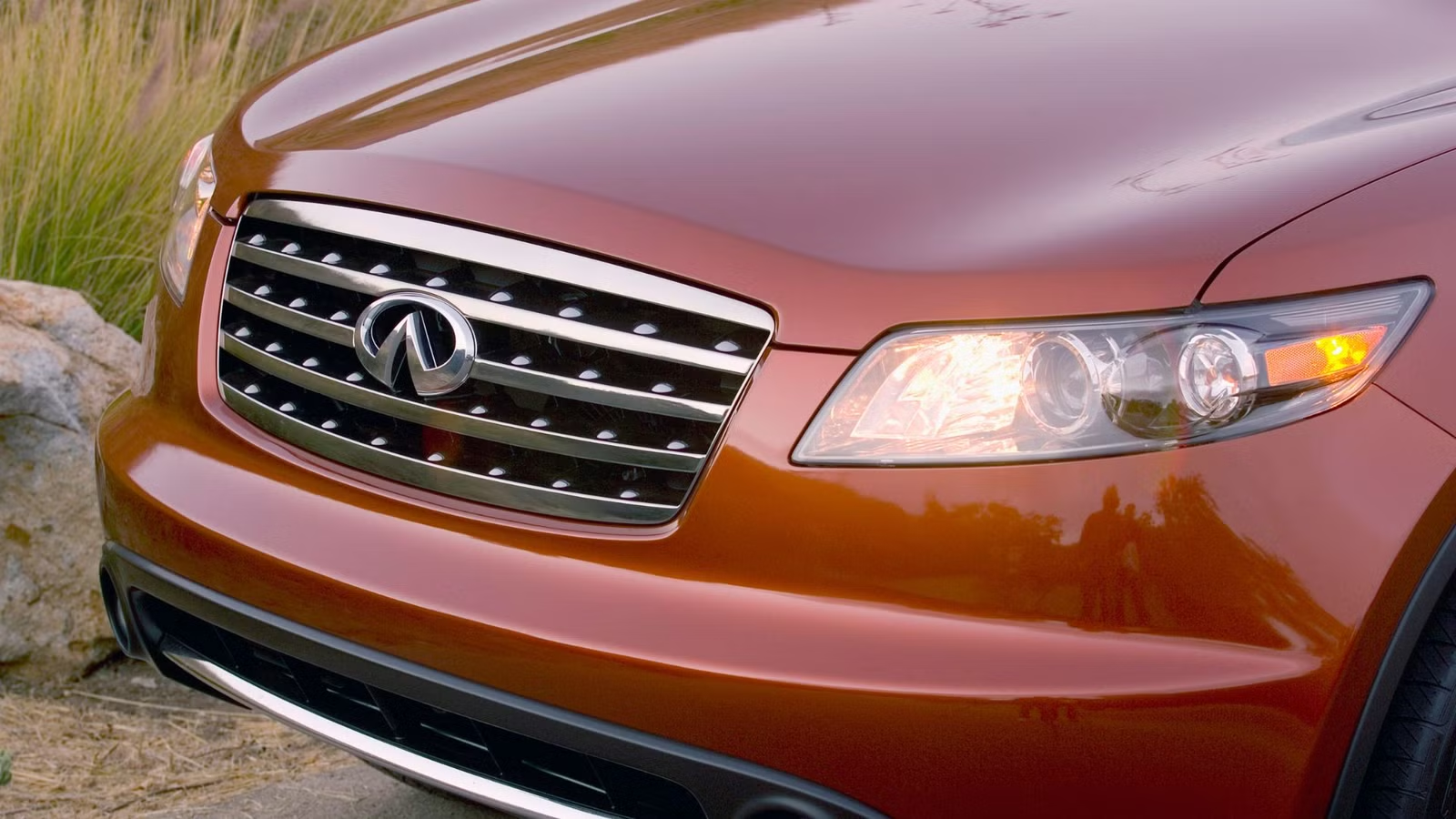
The G35 established Infiniti’s new direction, but the 2003 FX45 took the idea somewhere unexpected. Built around the same FM platform family as the G35 and Nissan 350Z, the crossover featured a long hood, low roof, wide stance, and massive 20-inch wheels. Its rounded body looked more like a muscular sports coupe than a traditional SUV. Infiniti developed the styling around its “Bionic Cheetah” design concept, emphasizing the agility and athletic proportions of a hunting cat. The name sounded like something from a science-fiction movie, but the design stood apart from the boxy SUVs dominating American roads.
The mechanical specifications supported its aggressive appearance. Under the hood sat a naturally aspirated 4.5-liter VK45DE V8 producing 315 horsepower, paired with a five-speed automatic transmission. Infiniti’s ATTESA E-TS all-wheel-drive system normally favored the rear wheels but could send up to half the available torque to the front axle when necessary. Independent suspension, firm springs, substantial anti-roll bars, and wide performance tires completed the package. Infiniti prioritized paved corners over muddy trails, making the FX45 a luxury crossover designed around sporty road manners.

The results justified that approach. In its February 2003 road test, Car and Driver recorded a 6.3-second sprint from 0 to 60 mph, making the FX45 the quickest production SUV it had tested since the turbocharged GMC Typhoon of the early 1990s. The Infiniti beat both the BMW X5 4.6is and Mercedes-Benz ML55 AMG, which had recorded 6.5-second runs. It also completed the quarter-mile in 15.0 seconds at 93 mph, generated 0.87 g on the skidpad, and stopped from 70 mph in 160 feet. The latter two figures established new SUV benchmarks in the magazine’s testing. Its firm suspension compromised ride comfort, but the FX45 proved that a luxury crossover could deliver serious performance.
The G35 And FX45 Gave Infiniti A Winning Identity, But It Didn’t Last

Together, the G35 and FX45 established Infiniti as a credible performance-luxury alternative. The sedan combined rear-wheel-drive handling with strong V6 power and competitive pricing, while the crossover delivered sports-car-inspired engineering in a practical package. Both offered distinctive personalities that justified their premium badges. Unfortunately, Infiniti struggled to maintain that momentum. Its 2014 model-year naming overhaul replaced the familiar G37 sedan name with Q50, while the G37 coupe became the Q60, weakening recognition among enthusiasts.
Aging products, inconsistent investment, and growing competition created bigger problems. Several Infiniti models struggled to differentiate themselves from less expensive Nissan relatives. The sales figures illustrate the consequences. Infiniti reached an all-time U.S. record of 153,415 vehicles in 2017, but deliveries fell to approximately 52,846 in 2025, a decline of roughly 66%.
Infiniti’s Next Comeback Could Depend On Rediscovering The FX45 Formula

Infiniti’s QX65 shows that the company still recognizes the original FX’s appeal. Revealed in 2026 for the 2027 model year, the coupe-styled crossover brings back a sloping roofline, broad shoulders, and sporty proportions. However, its engineering follows a different approach: the QX65 shares its architecture with the QX60 rather than the rear-wheel-drive-based FM platform. Its 268-horsepower, 2.0-liter turbocharged four-cylinder also lacks the character of the FX45’s V8. The resemblance is largely visual, making it a styling tribute rather than a mechanical successor.

A planned Q50 revival could offer a stronger connection to Infiniti’s performance heritage. Reports suggest the new sports sedan will use Nissan Skyline architecture, rear-wheel drive, and a twin-turbocharged 3.0-liter V6 potentially producing more than 400 horsepower. A manual transmission could also return, giving enthusiasts something increasingly rare. Contemporary reporting points toward a 2027 U.S. arrival, potentially as a 2028 model.
The strategy recalls what made the G35 successful: proven Nissan sports-car engineering wrapped in a premium package. The FX45 demonstrated how far that philosophy could stretch. Rediscovering it might give Infiniti its best chance at another comeback.
Source: Infiniti, Nissan, Car and Driver

Related posts
Latest Post


No Comments