
Chrysler Tilted Its Six 30 Degrees To Fit The Valiant, And A Legend Followed
When you think about Mopar in the ‘60s, you think of 426 Hemis, 440 Magnums and Super Commandos, and maybe the trusty 383 if you’re feeling bold. Together, these are the thumping great V8s that defined a generation of Chrysler performance and a lineage of Dodge as well as Plymouth muscle cars. But make no mistake, they didn’t make up the bulk of sales. Instead, it was something simpler, and far more humble.
Entry-Level Mopar: A Whole Different World Than V8s

Even at the height of the muscle car wars when Mopar’s marketing championed its V8s as the best in the world, those alone couldn’t balance the books at Chrysler Corp. To remain profitable, they needed an indestructible workhorse for the daily commuter. These days, that job is taken up by turbo four-cylinder engines, typically supported by electric motors and battery packs for optimized fuel economy. Yet back in the 1960s, American four-cylinder engines were underpowered by modern standards, meaning inline-six engines were the only logical answer.
Chrysler had always had a complicated relationship with the inline-six, relying for decades on heavy flathead designs that were rugged but painfully outdated by the time the space age rolled around. The last of the great flathead engines were on their way out the door by the mid-1950s, but instead of cutting corners to save money, Chrysler engineered a cast-iron engine block that spawned some of the most enduring folklore in Detroit history. To make it happen, Chrysler’s engineers had to design the block around the engine bays of the cars this motor was meant to power, and that led to some considerable design changes.
For starters, Chrysler wanted a modern overhead valve straight-six with a long stroke to maximize torque for everyday driving. The biggest challenge was making that design fit under a low, sweeping hood line that gave a sporty appearance to a typical daily driver. This was no easy feat.

A New Kind of Straight-Six

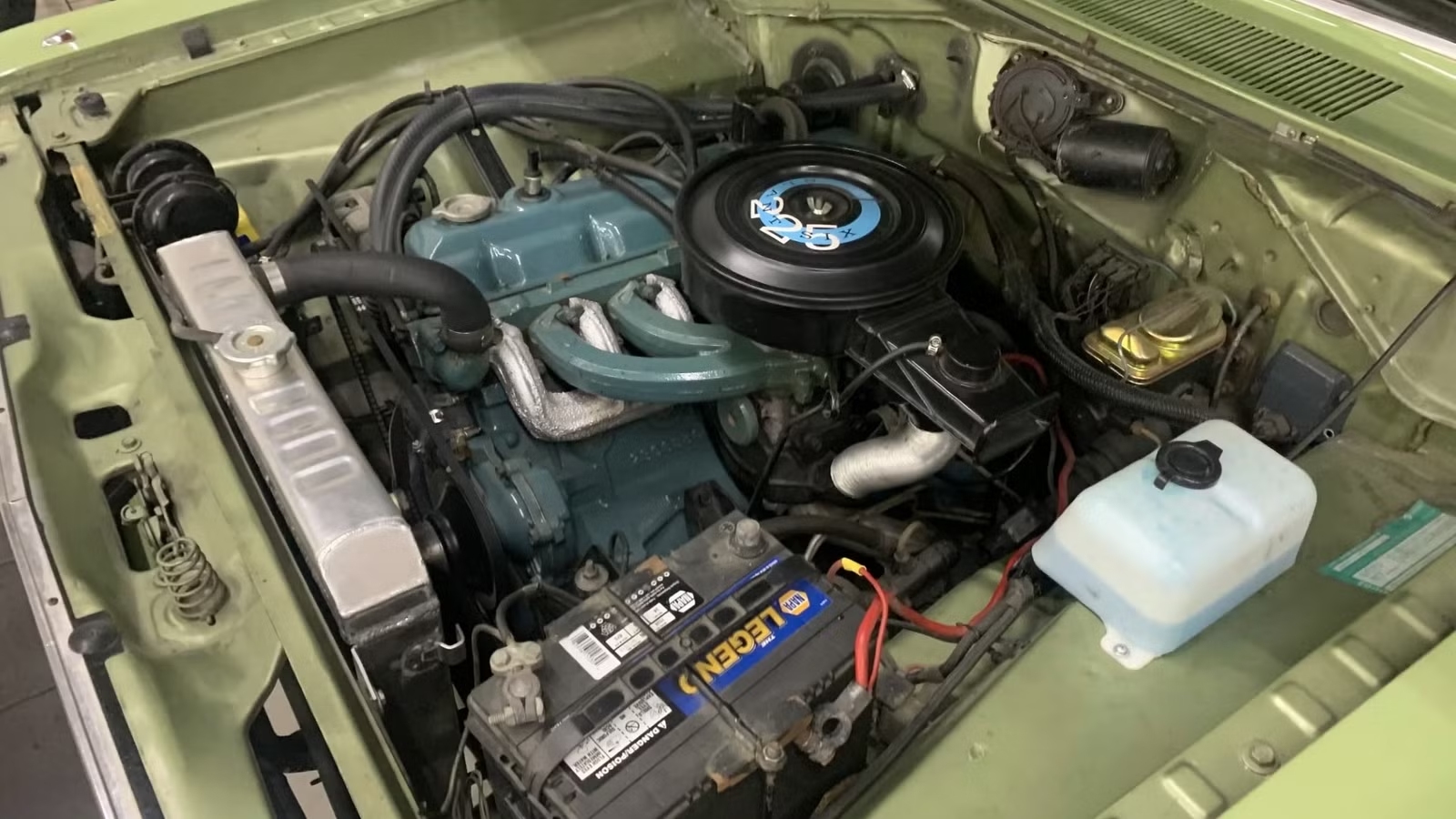
To design an overhead-valve I6 to Chrysler’s exact specifications, engineers had to get creative and clever. A tall and upright inline block simply wouldn’t fit without wrecking the sleek styling the design department was working day in and day out to perfect. Rather than spending millions to develop a shorter engine, the engineering team arrived at a brilliantly simple solution. They just tilted the entire cast iron block 30 degrees towards the passenger side, allowing the water pump and valve cover to clear the low, sweeping hood with room to spare.
As a direct consequence, the aggressive tilt created a considerable void on the opposite side of the engine bay. Engineers capitalized on that open space by casting a sweeping long-runner intake manifold that significantly boosted low-end torque. With a deep-skirt iron block, a forged steel crankshaft, and four main bearings, the resulting engine was as tough as it was ingeniously designed.
This overbuilt foundation and unconventional dimensions kept the block strong and dependable over hundreds of thousands of grueling miles, but it also ensured that when things did go wrong, parts were easy to access and readily replaceable through Mopar’s extensive parts catalog. The results were legendary.
The Chrysler Slant Six: A Bread and Butter Motor Underneath Giant V8s

The first Chrysler slant-six slid off the assembly line in 1959 for the 1960 model year. Ostensibly built for the then brand-new Plymouth Valiant, these initial slant-sixes displaced a modest 170 cubic inches, or 2.8 liters, good for about 101 hp depending on the source. Soon after, taller 198 and 225 cubic-inch variants were unveiled, complete with longer strokes for a much-needed bump in power and torque.
Before long, the slant-six was the backbone of the Chrysler lineup, showing up in fleet cars, taxi cabs, police cruisers, and even odd-ball things like marine equipment and aircraft tugs. Dozens of models used it over the course of decades: mainstays like the aforementioned Plymouth Valiant and its counterpart the Dodge Dart, the Plymouth Duster, and even the sporty Plymouth Barracuda, the second- and third-generation Dodge Charger, Dodge Challenger, Dodge Coronet, Plymouth Belvedere, Plymouth Satellite, and even the D-series pickup and B-series van.
Far from just a commuter engine, the slant-six had the capability of big power via the rare Hyper Pak options package. It included a cast-iron long-ram intake, a Carter four-barrel carburetor, dual exhaust headers, higher-compression pistons, and a more aggressive camshaft profile to boost the humble 170-cubic-inch variant up to 150 hp. At the time, the Hyper Pak was the closest thing to a high-strung performance package that daily drivers could find.
The Million-Mile Afterlife

It was the larger 225 cubic inch variant that truly cemented the bulletproof reputation of the slant-six. Fleet operators loved them because they required almost zero maintenance and simply refused to quit. Owners routinely reported achieving 22 miles per gallon at a time when larger engines seldom cracked ten. Even after surpassing the 150,000-mile mark, these engines refused to give up, a rare feat for domestic powerplants of that era.
In fact, the engine proved so reliable that Chrysler had a remarkably difficult time retiring it. United States passenger car production officially ended in 1984, and the motor was finally phased out of Dodge trucks by 1987. The block was so incredibly durable that marine and industrial versions continued rolling out of factories until 1991.
According to deep Mopar lore, brand-new replacement engines were reportedly still being cast in Mexico as late as 2000. That’s a kind of longevity matched by only a handful of engines in the entire world, and it serves as the ultimate irony of the classic muscle car era. While the Hemis grabbed all the magazine covers and set auction records, it was this cast-iron workhorse that actually kept the company profitable.
Source: Engine Labs

Related posts





Latest Post


No Comments