
Why A Carbon Fiber Crankshaft Would Fail
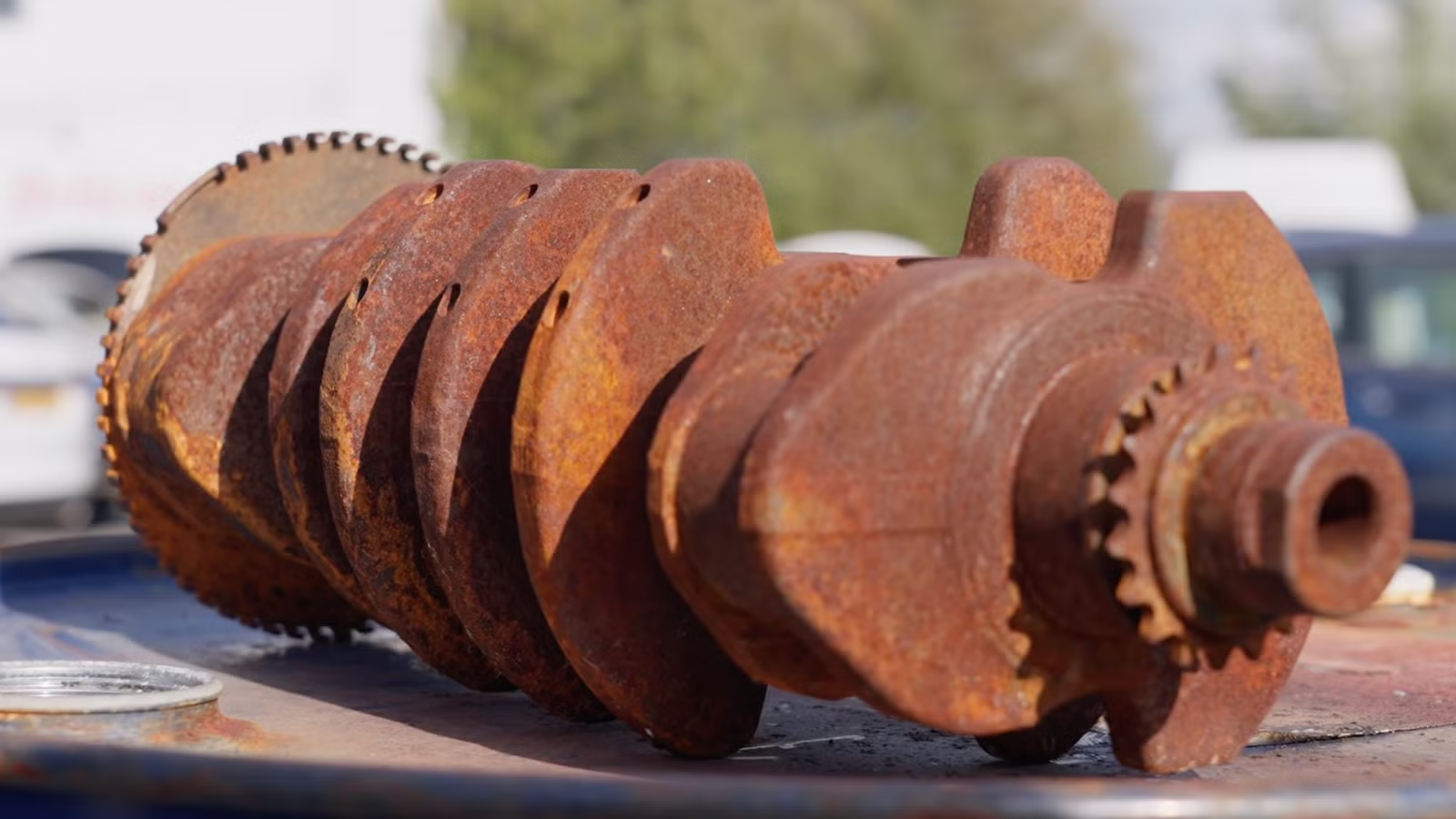
An Instagram post showed off what it called the world’s first carbon fiber crankshaft for Honda’s K-series engine. The post claimed it was 70% lighter than a forged steel crank, could spin past 12,000 rpm, and delivered sharper throttle response.

The image is AI-generated, and the caption admits it’s a joke, but plenty of gearheads took the bait. YouTuber Mike Fernie had fans asking him to film with the workshop that built it. With carbon fiber already all over modern engine bays, a carbon crank doesn’t sound crazy at first.
Carbon Fiber Has Already Crept Into The Engine Bay
Physicist Roger Bacon created the first high-performance carbon fibers at Union Carbide in Ohio in 1958. The US Air Force soon put them to work in rocket nozzles, missile nose tips, and aircraft structures.

Formula 1 caught on in 1981 with the McLaren MP4/1, the sport’s first carbon composite car. The first production car with a carbon fiber monocoque came in 1990, but engine bays picked up carbon body panels, valve covers, intake manifolds, and plenums much sooner with cars like the Ferrari 288 GTO.
A crankshaft sits low in the block and turns the pistons’ up-and-down motion into rotation that feeds the flywheel, clutch, and gearbox. Heavy counterweights keep it balanced, and the whole assembly is usually cast iron or forged steel.
Why A Carbon Fiber Crankshaft Would Fail
Heat is the first problem, since the resin binding carbon fiber together gives up long before the fibers do. Past its glass transition temperature, resin turns rubbery and the part loses stiffness, and even heat-cured epoxy tops out around 392°F for continuous use. Hot engine oil also chemically attacks the resin over time.
Carbon fiber is strongest when pulled along the direction of its fibers, but a crank gets twisted, bent, and hammered by every combustion event at once. Steel spreads those loads and bends predictably before it breaks, while carbon tends to delaminate, crack, and snap without warning.
The rod and thrust bearings ride on pressurized oil, but there’s still a little contact, and carbon wears poorly against metal and itself. A crank also needs incredibly tight machining tolerances, which layered carbon can’t hold.
In his video breakdown, Fernie notes the viral design keeps steel journals and makes only the counterweights carbon, which defeats their purpose. Counterweights need mass to offset the pistons and rods, so a featherweight crank would struggle to idle. Add it all up, and his verdict is simple: “a carbon fiber crankshaft would suck.”
Carbon Has Only Made It As Far As Connecting Rods

Mercedes once ran aluminum-beryllium pistons and cylinder liners in its F1 engines, which let it use a longer stroke while still matching Ferrari’s revs. The FIA eventually banned the material on cost grounds.
Carbon has only managed to sneak into connecting rods, which face simpler loads than a crank. In 2016, Lamborghini said it was developing forged-composite rods 40 to 50% lighter than steel ones. A recent study found carbon rods can match aluminum’s mechanical properties, but they remain experimental.
If carbon still hasn’t conquered a part as simple as a con rod, a carbon crank isn’t showing up in a Civic Type R anytime soon.

Related posts






Latest Post


No Comments