
The Touring Bike That Feels More Manageable Than Its Size Suggests
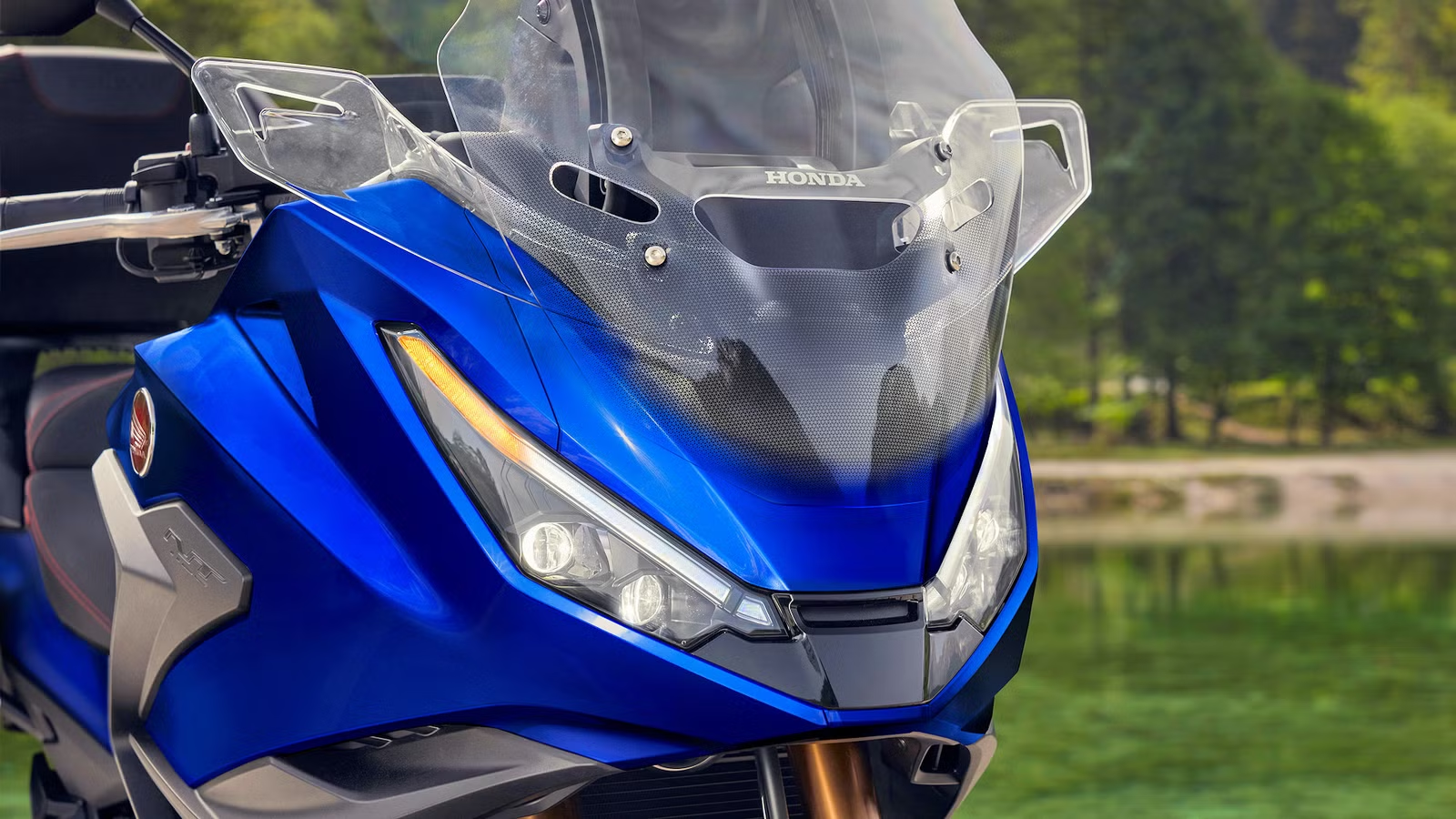
Middleweight adventure bikes promised riders the “ultimate travel companion.” Unfortunately, many soon came to the realization that although a middleweight is relatively light and nimble on the street, it is also awkward, and anything but confidence-inspiring off-road. Some riders have stepped down to a smaller ADV or dual-sport. But those who have come to the realization that they are not all that interested in blasting down fire roads have turned to more comfortable sport-touring bikes. Particularly, crossover bikes that look like ADVs but have 17-inch wheels.
Midweight Crossover Bikes Make Touring Comfort Accessible

Over the past few years, pretty much every manufacturer has either brought out a street-oriented ADV or middleweight touring bike. All these bikes offer the same commanding riding position associated with adventure bikes, but are just that much more comfortable to ride over long distances.

The biggest difference between these bikes and their more off-road-oriented counterparts is how much value they offer. While they may not go off-road, they are still incredibly versatile machines and are all loaded with features. The bike in question might seem a little bigger than the rest of the bikes competing in this space, but it has a neat trick up its sleeve that makes it a degree more manageable than you might think.

10 Affordable Touring Bikes That Refuse To Break Down
One of these affordable touring bikes can be your perfect travel companion
The Honda NT1100 DCT Is An Impressive Budget-Friendly Tourer
MSRP: $11,999

What makes the NT1100 a little unusual is that it is a sport touring bike based on an ADV platform. Underneath all those plastics lies the same robust steel chassis you will find on the Africa Twin. It gives the tourer its tall stance and makes it a fair bit heavier than the direct competition. This frame is expressly designed to handle the rigors of off-road riding, and is in many ways overkill for a street bike. But that is also the reason why the bike is so affordable, and the fact that it is a pure automatic makes it that much easier to deal with the added weight. The only bummer is the lack of luggage as a standard inclusion and no electronic suspension on offer. The latter is available in other markets, though.
A Proven Parallel-Twin Derived From A Reliable ADV
Power: 101 Horsepower

Honda makes good use of this Unicam engine. It was initially installed in the Africa Twin a decade ago and has seen regular updates. With the 2020 update, the displacement was increased to 1084cc, and the Rebel 1100 was added to the lineup. In all three bikes, it has proven to be perfectly reliable over the years (the NT1100 is relatively new in the US, but has been around for quite some time in other markets). While the horsepower figure isn’t all that impressive compared to the quickly evolving competition, its 83 pound-feet of torque is a genuine point of difference. The vast majority of which are available relatively early on in the rev range.
Automatic Motorcycles Are Better Than Ever

In the past, automatic motorcycles were laughed at, and if you were to ride a bike that had one of the early versions of the DCT installed, you would quickly see why. At best, low-speed maneuvering was annoying, and at worst, rather disconcerting because of how poorly the transmission was calibrated lower down in the rev range. That is no longer the case. Honda, in particular, has been at this for a long time now and has had time to make the necessary adjustments. In traffic, the bike acts like a big scooter, but that isn’t where it excels.
The Bike That Gets Everything Almost Perfect
The Africa Twin is a rare gem in the adventure touring segment with its combination of off-road inspired chassis, auto ‘box, and electronic suspension
The NT1100 Has A Comprehensive Features List

There are those who would prefer to have an NT1100 with a manual, but there is no denying that it is a match made in heaven for this particular model. While it might feel like a big scooter in traffic, it shines on the open road and adds a layer of convenience to the tourer. By only shipping one transmission option, it brings overall costs down to such an extent that it costs around as much as a base model manual would. To the right buyer, who would have chosen the DCT anyway, this decision adds value. The value proposition doesn’t end there, either.
In terms of features, the NT1100 will not leave you wanting for more. It gets cornering ABS, lean-sensitive traction control, a 6.5-inch TFT dash with smartphone connectivity, ride modes, cruise control, heated grips, and a tall adjustable windshield. All for under $12k. It really is a bargain all things considered, but no motorcycle is perfect, least of all a touring bike based on an ADV.
Some Things Are Missing, Though

Firstly, the most apparent feature that is missing is the luggage. To many touring bike buyers, this can be a dealbreaker. Naturally, Honda offers color-matching saddlebags at an extra expense, but that added cost will increase the price to such an extent that you will now be saying no to a few other bikes that offer more dynamic handling. Which brings us to the second issue, which might be more concerning for some.
If you push it too hard on a canyon road, Honda’s ADV chassis will be found out. This is not helped by the fact that the transmission will occasionally leave you in the wrong gear as you exit a corner. While you can downshift by using the manual shift button, once you get to that point, much of the theater is already lost, and you will most likely just lug along in the wrong gear. It might be considered a sport touring bike by category, but the word “sport” is missing to some degree.

For others looking for a plush tourer with excellent wind protection, the NT1100 is ideal. Its excellent midrange performance means roll-on acceleration is sublime, so overtaking is a breeze, and it is more than comfortable enough to ride across the country with a passenger and luggage (sold separately!).
Chassis, Suspension, And Weight Specifications
|
Chassis |
Steel semi-double cradle frame |
|
Front Suspension |
43 mm inverted Showa SFF-BP fork (5.9-in travel) |
|
Rear Suspension |
Pro-Link Showa single shock (5.9-in travel) |
|
Weight |
547lbs |
Source: Honda Powersports

Related posts



Latest Post


No Comments