
Dodge’s Six-Cylinder Charger Is More Powerful Than The Old V8
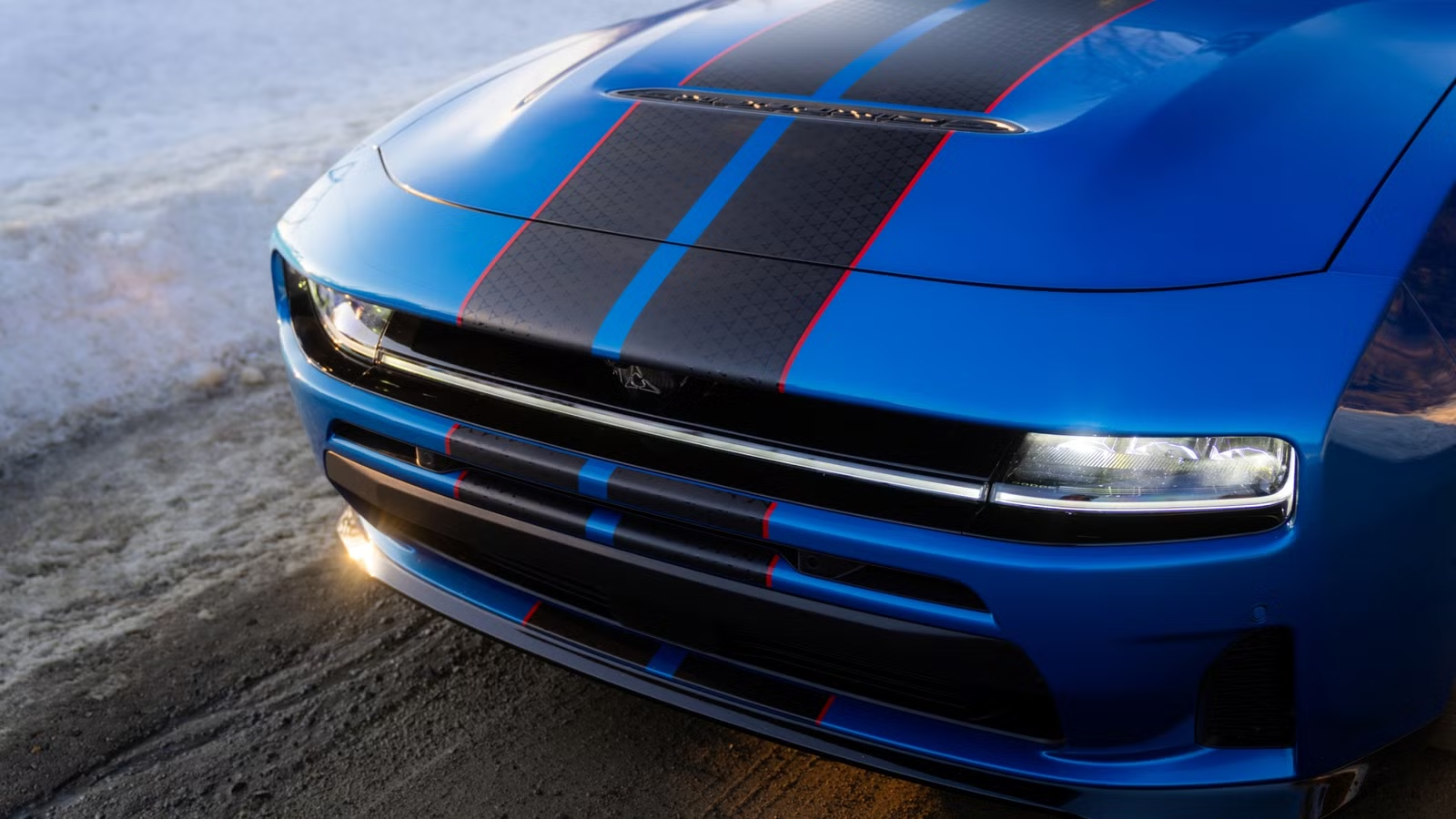
Losing two cylinders sounds like the wrong direction for a Dodge Charger. When a car’s identity rests on V8 noise, tire smoke, and displacement, replacing its Hemi with a smaller six-cylinder engine creates a problem that horsepower alone cannot entirely solve.

But the 2026 Charger R/T makes dismissing that replacement difficult. Its twin-turbo inline-six produces 420 horsepower, giving you 50 horsepower more than the outgoing 5.7-liter Hemi R/T, along with a substantial torque increase. The contradiction is real, although understanding what those numbers mean requires looking beyond the engine badge.
Muscle-Car Buyers Have A Reason To Question The Cylinder Count
The Hemi Made Eight Cylinders Part Of The Charger’s Identity
The Hemi’s appeal extended beyond acceleration. Its exhaust rhythm and naturally aspirated response made the Charger R/T feel special during ordinary driving, long before you found somewhere to use its full output. That matters because buying a muscle car is rarely an exercise in finding the most efficient transportation. You pay for an experience, and the engine supplies a large part of it. Replacing that familiar V8 changes the experience even if the replacement wins the horsepower comparison.

The outgoing R/T also occupied an understandable position in the lineup. It offered the traditional V8 experience without requiring the commitment of a Scat Pack or Hellcat, making the Hemi an accessible part of the Charger’s personality. The relevant question is whether the new six-cylinder engine delivers enough performance and character to justify losing the V8. Having fewer cylinders establishes neither success nor failure, but it does give Dodge something to prove.
The 2026 Charger R/T Turns That Assumption Upside Down
The SIXPACK Delivers 420 Horsepower From Just 3.0 Liters


The 2026 Charger R/T uses a 3.0-liter twin-turbo inline-six from the Hurricane engine family, branded SIXPACK in this application. Its standard-output specification delivers 420 horsepower and 468 pound-feet of torque, putting serious muscle behind what is now the entry-level gas-powered Charger. This is an inline-six, not a V6, and that distinction describes a completely different engine layout. Six cylinders sit in one row, while turbocharging provides the airflow needed to produce output that would once have required considerably more displacement.
You also need to distinguish this R/T from the gas-powered Scat Pack. The latter uses a 550-horsepower high-output SIXPACK, while the electric Charger carries the Daytona name. The R/T’s argument does not depend on borrowing either model’s performance figures.
The Old 5.7-Liter Hemi Falls Behind By 50 Horsepower

The outgoing Charger R/T’s 5.7-liter Hemi produced 370 horsepower and 395 pound-feet of torque. Against those figures, the new six gains 50 horsepower and 73 pound-feet of torque, increases of approximately 13.5 percent and 18.5 percent, respectively. Those are meaningful improvements, particularly because the torque gain is proportionally larger than the horsepower increase. The replacement engine does more than produce a better headline number; it gives the drivetrain additional twisting force to work with.
The comparison still needs clear boundaries. The 420-horsepower R/T exceeds the old 5.7-liter R/T’s output, but it does not surpass the former 485-horsepower, 6.4-liter Scat Pack. Calling it more powerful than the old V8 is accurate when the discussion stays focused on the model it replaces.
Twin Turbos Change How The Charger Makes Its Muscle
Boost Makes Up For The Missing Displacement

The Hemi relied on displacement and atmospheric pressure to fill its cylinders. The SIXPACK uses exhaust-driven compressors to force additional air into a smaller engine, allowing it to burn more fuel and generate greater output than its displacement might suggest. That explains why comparing 3.0 liters with 5.7 liters tells only part of the story. Displacement measures swept cylinder volume, but it does not tell you how much air a boosted engine can process under load.
Dodge specifies up to 22 psi of boost for the R/T and full peak torque by 2,500 rpm. The practical promise is substantial pulling power without needing to chase the upper end of the rev range, although throttle response still depends on operating conditions, gear selection, and how quickly boost builds.
AWD Helps Put The Added Power To Work

The new R/T pairs its engine with an eight-speed automatic and standard AWD. That changes the launch equation because acceleration depends on how much force the tires can transmit, rather than simply how much power the engine produces. Sending torque through both axles can help the Charger use its output when accelerating from a standstill. However, AWD does not eliminate tire limitations, and it should not be mistaken for a guarantee of shorter braking distances or unlimited grip.
Dodge also provides a selectable RWD mode that sends torque exclusively to the rear wheels. That preserves a familiar handling option, while making the distinction clear: some of the new car’s performance comes from the engine, and some comes from the traction system surrounding it.
More Horsepower Does Not Settle Every Argument
Acceleration Must Account For The New Charger’s Weight

Dodge claims a 4.6-second sprint to 60 mph and a 12.9-second quarter-mile for the R/T. Its published comparison describes improvements of 0.5 second and 0.6 second, respectively, over the previous Hemi R/T. Independent testing supports the new car’s strong launch performance. Edmunds recorded 4.7 seconds to 60 mph and a 13.0-second quarter-mile at 105.7 mph from a four-door R/T Plus equipped with launch control, but that car also weighed 4,907 pounds.
Car and Driver’s separate R/T test illustrates why the extra horsepower needs context. Its 4,921-pound example reached 60 mph in 4.7 seconds, yet its 5-to-60-mph rolling-start result was 5.7 seconds against 5.6 seconds for the publication’s previously tested Hemi R/T. These were different cars tested years apart, but the results show that stronger launches do not necessarily mean stronger acceleration in every situation.
The New R/T Makes A Stronger Case On Performance Than Nostalgia
The Six-Cylinder Fits Buyers Who Want Usable Muscle

If you want a gas-powered Charger with substantial output and AWD traction, the R/T deserves consideration on its own terms. Its engine makes the old six-cylinder-versus-V8 shopping hierarchy largely irrelevant, and you can choose either two-door or four-door bodywork.
Dodge lists starting MSRPs of $49,995 for the two-door and $51,995for the four-door, before destination and other charges. The gas-powered Scat Pack starts $5,850 higher in the corresponding body style, so comparing equipment matters as much as comparing engine output.
The Hemi’s Appeal Survives Even As Its Numbers Fall Behind

The strongest case for the old Hemi is the experience it delivers. If its sound and naturally aspirated response are central to what you want from a Charger, another engine’s horsepower advantage may never outweigh those qualities. However, preferring the V8’s character does not erase the new R/T’s output advantage. The SIXPACK delivers more horsepower, more torque, and strong launch acceleration, making it difficult to dismiss as a weaker substitute based solely on its cylinder count.
The result is a change in how the Charger creates its muscle. You lose the familiar Hemi soundtrack, but the engine replacing it brings 50 additional horsepower, and enough performance to earn a judgment from the driver’s seat.
Sources: Dodge, Stellantis, Edmunds, Car and Driver

Related posts





Latest Post


No Comments