
Honda’s Rarest Bike Was Decades Ahead Of Its Time
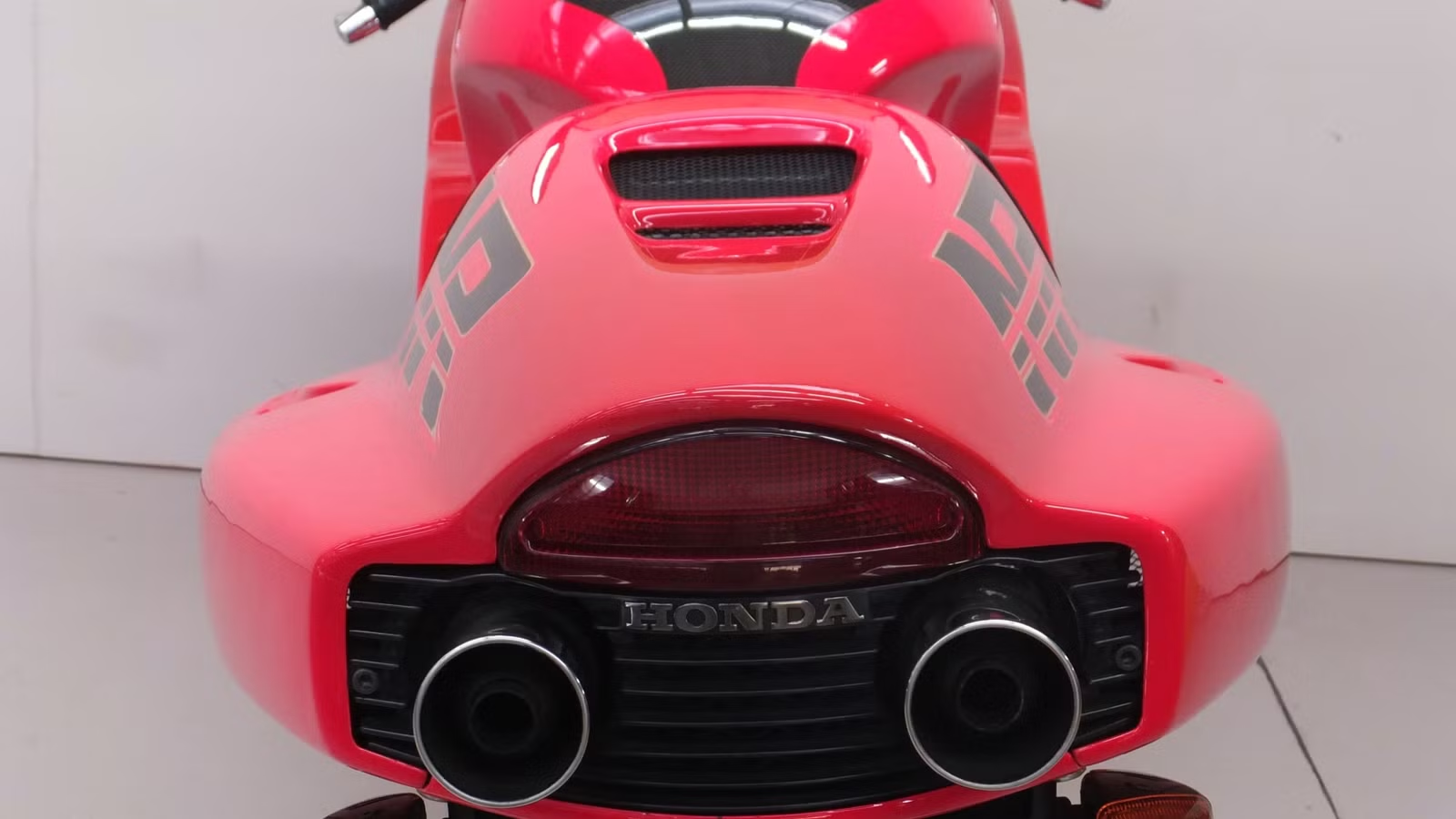
Imagine a street-legal motorcycle with eight valves per cylinder, full carbon bodywork, and a price tag exceeding $60,000 from Japan. That sounds too hard to fathom in 2026, given how Japanese bikemakers have started taking a logical approach to the motorcycle segment. Yet, if you go back decades, Honda went ahead and built such a machine. Introduced in 1992, this extraordinary machine brought nearly a decade of experimental racing technology to public roads. It was expensive, complicated, and unlike anything else on two wheels. More than three decades later, its engineering still feels remarkably unusual.
Honda Was Stubborn About Four-Stroke In Grand Prix

During the late 1970s, two-stroke engines dominated the 500cc Grand Prix motorcycle racing category. Honda wanted to prove that a four-stroke engine could compete against them, but the rules restricted engine configurations to four cylinders. That created a difficult engineering challenge: how could Honda get enough airflow through a four-cylinder four-stroke engine to compete with the much more frequent power strokes of a two-stroke? The answer was to rethink the piston itself.
Thus, Honda’s NR program began in 1979. Early calculations suggested that an oval-piston engine could potentially produce around 130 horsepower at an astonishing 23,000 rpm. Reaching those figures in a functioning, durable engine, however, would prove far more difficult than putting them on a drawing board.
The Oval-Piston Workaround

The trick behind the oval-shaped piston was that engineers could fit eight valves per cylinder, with two connecting rods doing the work underneath. Think of it as a V8’s breathing in a four-cylinder package. The shape also allowed narrower cylinders instead of what two round pistons would need, thus keeping the engine compact. The idea was brilliant on paper but a lot messier in the real world.

The NR500 had flashes of promise, like Freddie Spencer beating world champion Kenny Roberts in a Laguna Seca heat race, but it never lived up to the hype. An oval-piston endurance racer at Le Mans in 1987 lasted about three hours before a loose big-end bolt blocked an oil passage and seized a piston. Honda still wasn’t ready to let go. So the obvious question hung in the air: what if this technology made it to the road?
The 1992 Honda NR750 Was A Rabbit Out Of A Hat

Honda’s answer arrived in 1992 as the NR750, internally codenamed RC40. The NR750 name technically belongs to the endurance racer, but the label stuck. It wasn’t cheap, either. In Japan, the price was ¥5.2 million. Dollar figures from the period run from about $50,000 to over $60,000. One auction house says even the lower number was roughly five times the price of Honda’s previous top sport bike. Honda didn’t pitch it as a race replica, either. It marketed the NR as an extraordinarily expensive collector’s bike, and it couldn’t be homologated for racing anyway. Only 300 samples of the NR750 were reportedly built worldwide.
The One-Of-A-Kind V4 With An Oval Piston

Under the bodywork sat a 747cc, 90-degree V4 with eight valves per cylinder. Inside, eight titanium connecting rods worked with nickel-plated, Teflon-coated pistons. Because those oval pistons were so long, each needed three rings to seal against the cylinder walls. Honda rated the engine at about 125 bhp at 14,000 rpm, with a redline near 15,000 rpm.
The road bike’s piston wasn’t the NR500’s straight-sided oval, either. It was an elliptical shape with long curved sides. To show what the engine could really do, Honda built a sub-400-pound, 155 hp record machine for Loris Capirossi to ride at Italy’s Nardo test track. The NR remains the only chance customers ever got to buy an oval-piston Honda.
The NR’s Tech Was Ahead Of Its Time

The NR carried Honda’s PGM-F1 fuel injection, with two injectors per cylinder. For Honda, that was a departure, with global media outlets calling it the most advanced system seen on a production bike. This was 1992, when carburetors still ruled most showroom floors. Today, electronic fuel injection is simply how every internal combustion engine breathes. The NR was already there, quietly doing what everyone else would do years later.
Chassis, Bodywork And Details

The hardware around that engine reads like a wish list for the next decade. There was an inverted fork, magnesium wheels, a twin-spar aluminum frame, and an underseat exhaust. Carbon-fiber bodywork wrapped it all, topped with a titanium-tinted windscreen. The radiators sat on the sides, a first for Honda. Even the key got special treatment, made of nickel silver and carbon fiber with an oval-piston motif. It wasn’t even remotely subtle as Honda lettered a boast about a decade of perfection onto the tank and rear wheel.
Why America Never Got Its Own NR

Here’s the awkward part. Despite its global significance, the Honda NR750 never received an official American launch. Why the cold shoulder? Most probably because the math wasn’t friendly. There was a price north of $50,000, tiny volume, and performance that didn’t match the sticker. The UK-spec bike was rated at 125 hp at the crank but made about 108 at the rear wheel, and 125 bhp wasn’t much better than what the Fireblade dished out.
Gray Imports And US Values Today
American enthusiasts who wanted one had to look beyond regular Honda dealerships, making private imports the sole route into the country. Importation and registration paperwork added another layer of difficulty, particularly when dealing with a motorcycle that has never officially been sold through the domestic dealer network. Auction results in 2021 ranged from $90,000 to $118,000, including $110,000 for a bike with just about 3 miles on the odometer. That one sat on display in a small Japanese dealership for nearly three decades. Low-mileage survivors like that are the real unicorns. The bike that confused buyers in 1992 is the one everybody wants now.
Source: Honda Global, Iconic Motorbike Auctions, Mecum Auctions

Related posts


Latest Post


No Comments