
The Japanese Touring Bike That Makes 500-Mile Days Feel Short
‘Touring bike’ has different meanings for different demographics. For instance, American brands whip them up with torque-heavy V-twins, massive saddlebags, and batwing fairings, all aimed at making 500-mile freeway days feel short. In contrast, Japanese bikemakers achieve the same goal via a vastly different, more versatile approach: crossover-type sport touring bikes.

These are the new norm by brands from the Land of the Rising Sun, with Honda, Kawasaki, Suzuki, and Yamaha all jumping into the segment in recent years. Out of these, there’s one simple pick if making 500-mile days feel short is your key requirement.
Long-Haul Capable Touring Bikes From Japan Come In Different Sizes
Since American riders love long-haul rides, Japanese bikemakers have a variety of such touring motorcycles on sale today. The Gold Wing is arguably the best of the best, as it beats usual American-made rivals fair and square in nearly every regard. However, this is a massive machine (minimum 800 pounds heft) with an MSRP that makes cars seem cheaper. So it’s out of reach (from a financial and skill point of view) for most of us.

On the opposite end of the spectrum, we have bikes like the Honda NC750X. This is a stripped-back crossover-type tourer that checks the necessary boxes and comes at an attainable MSRP. The problem here, though, is the low power output and small size, both of which can feel inadequate during serious tours.
But 500-Mile Touring Days Require The Sweet Spot Between Extremes

What you need then is something in the middle. After all, a proper heavyweight will make life difficult once you encounter traffic, whereas a petite machine will miss out on modern conveniences. So you need ample performance for sitting at 80 MPH all day long, then having enough accessibility for steering into the city streets.
You also need standard luggage–ideally with a quick-release setup–topped with modern-day tech to make life easier on the go. Large saddles for both occupants with a comfortable riding triangle is another key requirement. Finally, the MSRP needs to be under $20,000–a largely attainable figure for most touring fanatics.
The Kawasaki Versys 1100 Stands Out As The Long-Haul Master For 500-Mile Days

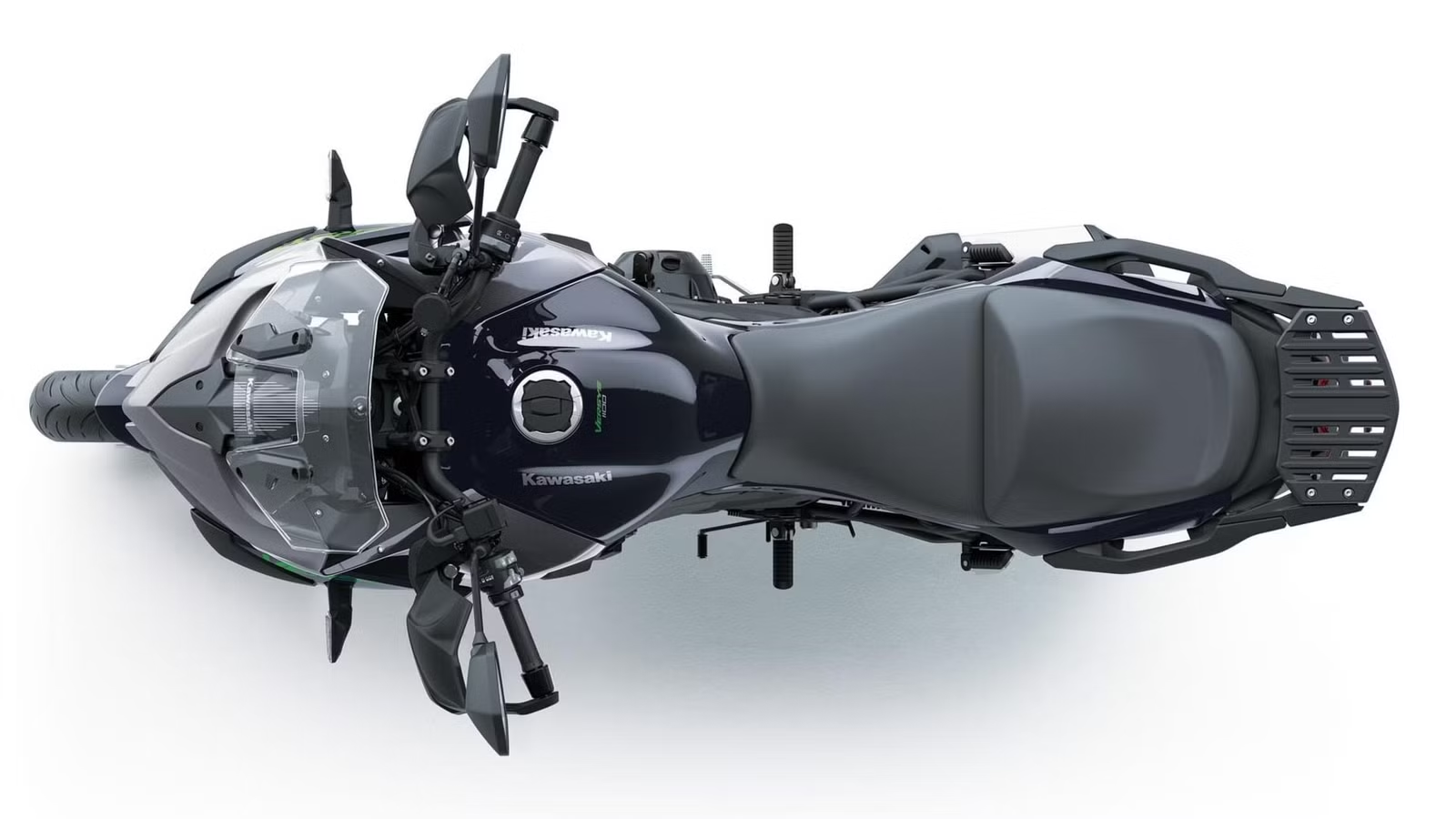
Taking all those things into account points us straight to the $19,499 Kawasaki Versys 1100 SE LT. You get top-drawer equipment all over, be it in terms of creature comforts, a relaxed yet powerful engine, or the semi-active underpinnings. At the same time, this remains accessible for the masses in terms of heft. The weight is around 570 pounds fully fueled, which should promise solid stability at speed.
At the same time, this is just 24 pounds up from the comparatively less powerful and loaded Honda NT1100 while being a sizable 230 pounds less than the Gold Wing. So this shouldn’t make life difficult should you encounter traffic in your final stretch of the 500-mile day. Or when you take it out of the parking lot in the morning. Another plus is that the saddlebags have Kawasaki’s Quick-Release function, so taking them off and putting them on is effortless. All in all, it’s the sweet spot in our books in the premium Japanese touring space.
A Deep Dive Into The 2026 Versys 1100 SE LT

If the above argument made you happy, the below details will only make life better. You see, the flagship Versys has just received one of its biggest updates in the past decade, bringing more power, usability, and premium features to the package. So the deeper you look, the more impressive things get. On that note, let’s dive in.
The 1,099cc Engine Has Oodles Of Torque With Inline-Four Smoothness

The ‘1100’ in the Versys’ name is thanks to its engine capacity. This has Kawasaki’s new 1,099cc powerhouse that builds on the previous 1,043cc setup by adopting a longer stroke, a new piston shape with a higher compression ratio, a new intake funnel length, a new intake port shape, and a new cam profile. Low-end punch remains the focal point, as evidenced by the output of 133 horsepower and 82.5 pound-feet, kicking in at 9,000 RPM and 7,600 RPM, respectively. For reference, usual liter-class inline-four engines make their peak power well over 11,000 RPM.

Attention has also been paid to real-world usage. The first four gears remain short, so you have enough playfulness in the city. Whereas, Kawasaki says the fifth and sixth gears are longer here to lower the vibes and RPMs when you’re sitting at freeway speeds for hours. A positive side effect is the 42 MPG claimed efficiency–a figure that’s higher than its arch-rivals. It also equates to a theoretical range of around 230 miles with the full 5.5-gallon tank.
Electronic Showa Suspension Brings The Composure In Varied Conditions

No 500-mile day is the same, and it can throw random challenges (like broken roads) at you. That’s where the crossover nature of the Versys will come in handy, armed with long-travel electronic suspension. This includes Showa’s Skyhook EERA (Electronically Equipped Ride Adjustment) technology. That means both the 43 mm USD forks (5.9-inch travel) and BFRC monoshock (5.9-inch travel) have electronic adjustability and semi-active modes, using information from the IMU and ECU every 10 milliseconds.
Electronic rebound and compression adjustment on the fly, along with three preload settings (rider only, rider with luggage, and rider with passenger and luggage), are standard. Four base settings (Sport, Road, Rain, and Rider) ensure there’s something for everyone to enjoy. Tied up to the suspension is a set of 17-inch alloy wheels that house Brembo brakes. An aluminum main frame and a sturdy subframe round things off to ensure predictable handling.
The Saddle Height Might Make Life A Little Difficult

The suspension’s near-6-inch travel comes at a slight cost, though. You’re looking at a saddle height of 33.1 inches, which should feel tall if you’re under 5’8. And we all know tip-toeing on a 570-pound machine can lead to some hairy situations. Luckily, Kawasaki has an optional Ergo-Fit saddle that trims the ride height by almost an inch. Aside from this, some other dimensions worth noting are:
- Tank capacity: 5.5 gallons
- Wheelbase: 59.8 inches
- Ground clearance: 5.9 inches
- Rake: 27 degrees
- Width: 37.4 inches
Safety And Comfort Features Are In Heaps

Being a flagship, Kawasaki has tricked out the 1100 with its premium tech package. Safety is via a six-axis IMU and ride-by-wire, both of which work together to allow two power modes, three modes of traction control, cornering ABS, and a two-way quickshifter. Topping this is an equally impressive creature comfort package for making touring effortless. Heated grips, cruise control, cornering lights (mounted on the fairing), and smartphone connectivity with turn-by-turn navigation–these are all standard.
Finally, you access these via a semi-digital instrument cluster. There’s an analog tachometer inspired by the H2 lineup, paired with a large rectangular TFT on its right. Varying brightness levels, two display modes, and all of the necessary information are present on this TFT. A couple of underrated plus points include six-way adjustable levers and self-healing paint!
Source: Kawasaki

Related posts


Latest Post


No Comments