
The Toyota Family Car That Owners Almost Never Regret Buying
Most family crossovers ask for a leap of faith. You sign the loan, hope the fuel economy numbers hold up in real driving, and pray the resale value doesn’t collapse the moment you drive off the lot. Every automaker claims reliability and value, but the data tells a different story for most of them. Buyers who’ve been burned by surprise depreciation or inflated fuel estimates approach every new purchase with a bit of skepticism. Yet there’s one segment leader that keeps turning up at the top of value, safety, and satisfaction rankings, year after year, generation after generation.
Toyota’s Best-Selling Family Crossover Has Become Hard To Ignore

Compact crossovers are the default family vehicle in America now, and one nameplate has quietly dominated that fight for nearly three decades. It has weathered SUV fads, truck-based competitors, and a wave of three-row alternatives without losing its grip on the sales charts. Part of that staying power comes from a formula Toyota has refused to overcomplicate: useful cargo space, a comfortable ride, dependable mechanicals, and a price that doesn’t require a luxury-brand budget to access.

That formula has produced staggering numbers. Since this crossover first arrived on the US market in 1996, more than 6.4 million examples have made their way onto American roads, and it remains the segment’s top seller today. It’s currently the best-selling small SUV in the country, and depending on how you slice full-size trucks out of the equation, it’s frequently cited as the best-selling vehicle in America outright. For 2026, Toyota didn’t rest on that reputation. It tore the model down to its foundation and rebuilt it as a sixth generation, and the result is worth a closer look before writing it off as just another appliance-grade crossover.
The 2026 Redesign Goes Boxier, Smarter, And More Tech-Forward Without Losing What Made The RAV4 A Family Default


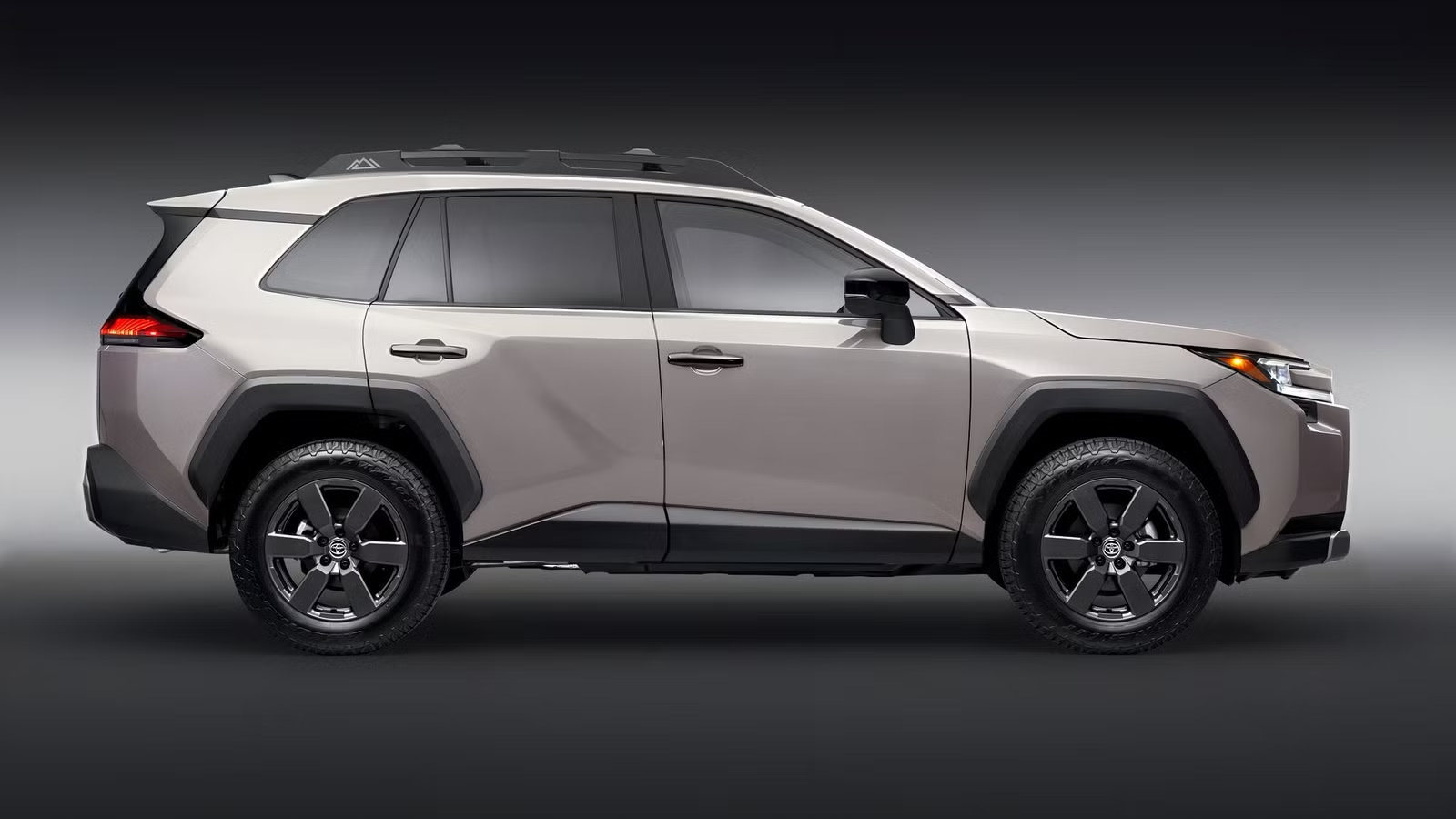
The subject here is the 2026 Toyota RAV4, and the redesign is more significant than the styling refresh its badge might suggest. Toyota gave the RAV4 boxier, more upright sheet metal that improves visibility and road presence while keeping the compact footprint that makes it easy to park and maneuver.
Inside, the changes matter more. Every trim now gets a 12.3-inch digital gauge cluster as standard equipment, with higher trims stepping up to a 12.9-inch tablet-style touchscreen running Toyota’s new Arene software platform, a system built to support over-the-air updates rather than growing stale the moment it leaves the factory.

None of that would matter much if the basics slipped, but Toyota kept the RAV4’s practical bones intact. Cargo space remains generous by class standards, the seating position stays high enough to satisfy buyers who came from larger SUVs, and the cabin materials, while not luxurious, hold up to the scuffs and spills that come with actual family use. The RAV4 was never meant to impress on a spec sheet full of exotic materials. It was built to survive a decade of school runs, and the 2026 version doubles down on that mission rather than chasing a more premium identity.
Hybrid Power Gives The RAV4 A Major Advantage At The Fuel Pump

The 2026 RAV4 drops its gas-only engine option completely, becoming hybrid-only across the entire lineup for the first time in the model’s history. Buyers choose between a standard hybrid and a plug-in hybrid, and both versions post numbers that make a real dent in a family’s monthly fuel budget.
The standard hybrid produces 226 horsepower with front-wheel drive or 236 horsepower with all-wheel drive, a meaningful jump over the outgoing gas engine’s output. Front-wheel-drive hybrid models rated LE, SE, and XLE Premium top the efficiency rankings with an EPA-estimated 47 mpg city, 40 mpg highway, and 43 mpg combined, the best a non-plug-in RAV4 has ever delivered. Stepping up to all-wheel drive costs only a mpg or two depending on trim, with LE and SE AWD models still rated at 46 city and 42 combined.

Buyers who want to go further can opt for the plug-in hybrid, which pairs a 324-horsepower powertrain with an EV-only range in the neighborhood of 50 miles, enough for most commuters to complete an entire day of local driving without the gas engine firing at all. Once the battery depletes, the PHEV settles into hybrid operation rated at around 41 mpg combined, and Toyota estimates a total driving range of past 490 miles on a full tank and charge. For a family doing school drop-offs, grocery runs, and weekend errands, that combination of numbers translates directly into fewer stops at the pump and a fuel bill that barely moves month to month.
Why The RAV4’s Safety Tech Is Standard On Every Trim — Not A Premium Add-On

Fuel savings mean little if the vehicle isn’t safe enough to trust with a family, and this is where the redesigned RAV4 leans hardest into its reputation. Every trim comes standard with Toyota Safety Sense 4.0, the automaker’s latest driver-assistance suite, built around upgraded sensors and sharper detection capability than the system it replaces.
The package covers the essentials families actually rely on: forward collision warning with pedestrian detection, automatic emergency braking, adaptive cruise control, lane-departure warning with steering assist, lane-centering assist, automatic high beams, and traffic-sign recognition—all included without forcing buyers to climb the trim ladder just to get basic protection.

Toyota didn’t stop at carrying over the last generation’s tech either. The new Safety Sense suite adds features like front cross-traffic alert, lane-change assist, and predictive curve speed control, and because the system runs on the Arene software platform, updates can arrive over the air rather than requiring a dealership visit. That matters for families who keep a vehicle for the long haul, since the safety tech doesn’t freeze in place the day you drive off the lot.
Everyday convenience gets the same standard-issue treatment. Items that used to be reserved for pricier trims, like a full digital gauge cluster, a respectably sized touchscreen, and smartphone integration, now come baked into the base model. It’s the kind of feature parity that removes the guilt of buying the entry-level trim, since families shopping on a budget aren’t stuck with a stripped-down experience just to reach a lower price point. The redesigned RAV4 was reviewed favorably enough on these merits to earn a Compact SUV Best Buy award for 2026, a recognition built on exactly this mix of standard safety gear, efficiency, and value.
Strong Resale Value Could Make The RAV4 An Even Smarter Long-Term Buy
The part of ownership most families overlook until it’s too late is depreciation, and this is where the RAV4’s reputation turns from anecdotal to measurable. Depreciation analysis covering millions of vehicle transactions shows the RAV4 retains about 75 percent of its value after five years, a figure that sits roughly 15 percent above the average for small and compact SUVs. That gap compounds over time. A family that buys a RAV4 instead of a comparably priced rival with average depreciation could walk away with thousands of extra dollars when it comes time to trade in or sell. A RAV4 loses only around 5.5 percent of its value in the first three years, a remarkably shallow depreciation curve for a mainstream family vehicle.
None of that happens in isolation. Toyota as a brand posts the best average five-year resale value of any automaker in the US, retaining roughly 63.6 percent of MSRP, ahead of every other manufacturer, including traditionally strong performers in the truck segment. The RAV4 sits near the top of that already strong lineup, which means buyers aren’t just betting on one good model, they’re buying into a brand-wide reputation for holding value that dealerships, insurers, and used-car buyers all recognize.

Add it up and the picture becomes clear. A family shopping the compact crossover class is choosing between vehicles that mostly do the same job on paper, but the numbers separate the RAV4 from the pack in ways that matter years down the road. With strong fuel economy that shrinks the cost of daily driving, a full suite of safety tech that doesn’t require an upsell, and a depreciation curve gentle enough to make the eventual resale feel like a bonus rather than a loss, the RAV4 delivers on every front that matters to families. That’s the kind of track record that turns a car purchase from a leap of faith into a genuinely low-risk decision, and it’s exactly why so few RAV4 owners end up wishing they’d bought something else.
Sources: Toyota U.S., Kelley Blue Book & iSeeCars

Related posts




Latest Post


No Comments