
Harley-Davidson Should Be Nervous About This Long-Distance Touring Machine
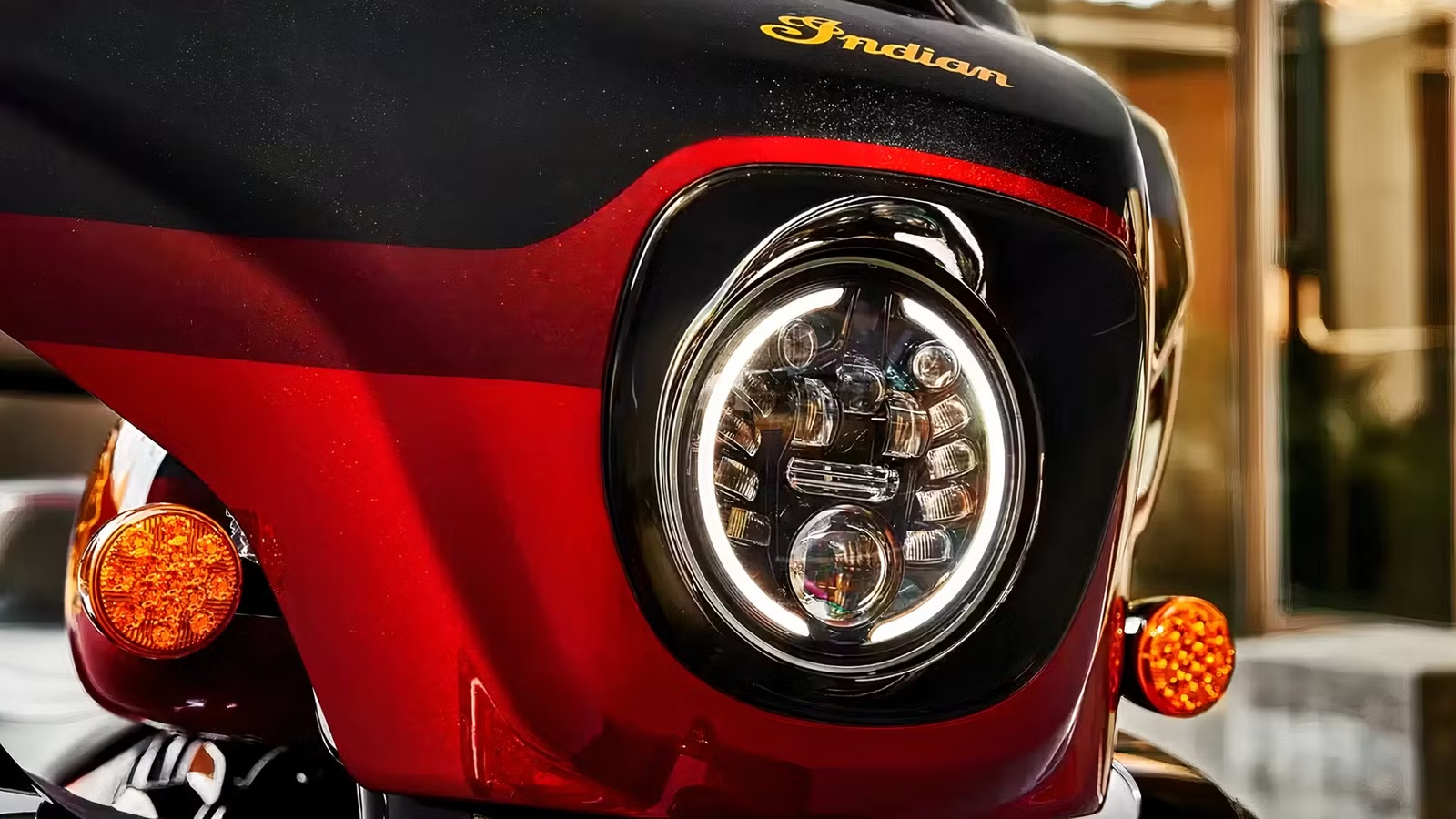
For decades, Harley-Davidson has been the first name many American riders associate with long-distance touring. The company’s big touring bikes have built a loyal following among riders who regularly cover hundreds of miles in a day, often with a passenger and enough luggage for a week on the road. Competing manufacturers have spent years trying to win over the same customers.

Indian Motorcycle has been pursuing the same customer with a different approach to engine development and onboard technology. Its latest heavyweight touring models retain the traditional American V-twin appearance but use liquid cooling, electronically adjustable equipment, and increasingly sophisticated rider assistance. For buyers considering a premium Harley-Davidson touring model, there are now alternatives worth examining on their own merits.
American Touring Bikes Are No Longer Just A Harley-Davidson Game
The American touring segment has traditionally favored large-displacement V-twins. Harley-Davidson’s Electra Glide established much of that formula decades ago, with later generations and other models adding increasingly sophisticated fairings, suspension, infotainment, and electronic rider aids.

The category itself doesn’t traditionally compete on horsepower. A touring motorcycle needs predictable handling at low speeds, stability on the interstate, effective weather protection, and smooth suspension. Passenger comfort is a key element, particularly when two people are spending several hours aboard.
Indian Has Been Building Direct Rivals For More Than A Decade

Indian returned to the heavyweight motorcycle market under Polaris ownership in 2013, introducing the Thunder Stroke 111 V-twin and a new generation of Chief, Chieftain, and Roadmaster motorcycles. The Roadmaster arrived for the 2015 model year with a large front fairing, integrated luggage, passenger accommodations, and the traditional styling expected of an American luxury tourer.
Indian subsequently expanded the range with the liquid-cooled PowerPlus engine, initially introduced on the Challenger for 2020. Unlike the air-cooled Thunder Stroke, the PowerPlus uses overhead camshafts, four valves per cylinder, and liquid cooling. That gave Indian a different technical foundation for its performance-oriented touring motorcycles. The company eventually brought the PowerPlus architecture to more traditional touring models, including the Roadmaster.
The Indian Roadmaster PowerPlus Is Built For Serious Highway Miles

The 2026 Indian Roadmaster PowerPlus brings Indian’s newer PowerPlus engine to its traditional full-dress touring format. The Limited starts at $32,499, putting it almost directly against Harley-Davidson’s $32,999 Road Glide Limited. Both offer large fairings, passenger backrests, integrated luggage, and six-gallon fuel tanks. The Indian, however, uses a substantially different engine architecture beneath its familiar styling.
It is a substantial motorcycle, weighing 933 pounds in running order with the 112ci engine. The wheelbase measures 65.7 inches, the seat sits 26.5 inches above the ground, and the chassis provides 31 degrees of available lean angle. Indian fits dual front Brembo brakes with 12.6-inch rotors, along with a single rear disc. These are the dimensions and components of a motorcycle intended to carry considerable weight over long distances, not something designed primarily for short weekend rides.
Its 112ci Liquid-Cooled V-Twin Makes 126 Horsepower

Though not the most important feature on a cruiser, the PowerPlus 112 produces 126 horsepower, which is quite high for a torquey bagger. Speaking of which, it also produces 133 lb-ft of torque, with peak torque arriving at 3,600 rpm. It uses an 11.4:1 compression ratio, dual overhead camshafts, four valves per cylinder, and a six-speed transmission. Liquid cooling allows Indian to manage engine temperatures independently of the airflow reaching the cylinders. The engine also uses an assist clutch, reducing the effort required at the lever.
For comparison, Harley-Davidson rates the 2026 Road Glide Limited’s Milwaukee-Eight VVT 117 at 106 horsepower and 131 lb-ft. The Indian therefore produces 20 more horsepower, although its peak torque advantage is only 2 lb-ft. Both motorcycles have sufficient low-speed pulling power for touring, but Indian offers considerably more peak output without requiring a performance-oriented special edition.
Indian Gives The Rider A Lot Of Touring Equipment From The Factory

Front three quarter look of 2024 Indian Roadmaster Elite

The Roadmaster PowerPlus Limited comes equipped with a powered windshield, heated grips, and a heated seat with separate controls for the rider and passenger. Its hard lower fairings incorporate adjustable vents, allowing the rider to regulate airflow around the legs as conditions change. Indian also includes cruise control, keyless ignition, tire-pressure monitoring, and remote-locking luggage. These are practical features on a motorcycle intended to spend entire days on the highway.
Storage capacity exceeds 36 gallons across the saddlebags, trunk, and additional compartments, and the trunk can be removed when the extra carrying capacity isn’t needed. The seven-inch RIDE COMMAND touchscreen provides navigation, configurable instruments, Bluetooth connectivity, and Apple CarPlay. A four-speaker, 200-watt audio system is standard on the Limited, with a more powerful PowerBand system available. Indian has also retained conventional analog instruments alongside the touchscreen, giving the cockpit a more traditional appearance.
Electronic Rear Preload Makes Two-Up Touring Much Easier

The Roadmaster PowerPlus uses a rear monoshock with electronically adjustable spring preload, controlled through the RIDE COMMAND display. That allows the rider to compensate for additional luggage or a passenger without reaching for a mechanical adjuster. The system changes spring preload rather than electronically controlling compression or rebound damping. It is a useful distinction because Indian is providing convenient load adjustment, not a fully active suspension system.
The rest of the suspension is relatively conventional, with a 43mm inverted front fork offering 5.1 inches of travel and a rear shock providing 4.5 inches. Proper preload helps maintain the intended suspension attitude as the load changes, preserving available travel and steering geometry. It is one of the more useful touring features because the rider can make adjustments without interrupting the trip to reach for tools.
The Roadmaster PowerPlus Is More Modern Than Its Styling Suggests

Indian has retained the Roadmaster’s traditional proportions, with a large fork-mounted fairing, substantial chrome trim on the Limited, and integrated hard luggage. The engine and electronics are much more modern. Beyond the higher compression ratio, rider modes and liquid cooling, The Road master includes a brilliant feature where the rear cylinder can be deactivated to reduce heat when the motorcycle is stationary.
A six-axis Bosch inertial measurement unit supports Indian’s SmartLean technology, which adjusts traction control and ABS operation according to the motorcycle’s lean angle. The 112ci models also receive electronically linked braking and Bike Hold Control, which can maintain brake pressure when stopped on an incline. Neither feature changes the Roadmaster’s basic touring character, but both address situations that can become more demanding on a heavy motorcycle.
Radar-Based Rider Assistance Changes The Long-Distance Equation

The PowerPlus 112’s Rider Assist package adds a rear-facing radar system that monitors surrounding traffic. Blind Spot Warning uses indicators in the mirrors and dashboard to alert the rider when another vehicle is detected alongside or behind the motorcycle. Tailgate Warning identifies vehicles following too closely, with alerts displayed through RIDE COMMAND. Rear Collision Warning can also activate auxiliary rear lighting to warn approaching drivers when the system detects a potential collision.
These systems are particularly relevant to long-distance highway riding, where surrounding traffic can change quickly and the rider may spend hours maintaining a steady pace. Indian allows several of the alerts to be customized or disabled, so they need not operate at their most sensitive settings all the time. The radar is not an autonomous riding system, and it does not replace mirror checks or the rider’s responsibility to monitor traffic.
Harley-Davidson Still Has One Major Advantage

A Harley Davidson Dealership
Harley-Davidson’s greatest advantage may be its established U.S. dealer presence, extensive accessory catalog, and large community of touring owners, which make it an appealing choice for riders who intend to keep a bike for many years. The 2026 Road Glide Limited also offers a competitive equipment package, including a Milwaukee-Eight VVT 117, heated seating, a Grand Tour-Pak, and Skyline OS navigation. At $32,999, its starting MSRP is only $500 above the Roadmaster PowerPlus Limited.
The Indian makes a strong case on its own specifications, particularly with its 126-horsepower engine, electronic rear preload, and standard radar-based assistance on the 112ci version. It is not substantially cheaper than its closest Harley competitor, and at 933 pounds running order, it certainly isn’t a lightweight alternative. For someone considering a fully equipped American V-twin tourer, the Roadmaster PowerPlus deserves to be compared directly with the Harley rather than treated as a secondary choice.
Source: Indian Motorcycle, Harley-Davidson, Indian Motorcycle Newsroom

Related posts



Latest Post


No Comments