
The Kawasaki That Gives Riders More Motorcycle Than They Expect
Since 1966, Kawasaki has been selling motorcycles in America, and racing has been part of the pitch for most of that time. Eddie Lawson’s back-to-back AMA Superbike titles in 1981 and 1982 are still big parts of the lore. These days, the brand markets one platform as a seven-time WorldSBK champion. A resume like that usually comes with a punishing seat, a scary price, and a bike that’s miserable anywhere outside a racetrack. This one skips most of that. It gives you more value than its rivals, more usability than you’d guess, and more tech than the sticker suggests.
Kawasaki Has Several High-Value Motorcycles On Sale Today

Kawasaki’s U.S. motorcycle lineup is broad enough to make the brand difficult to pigeonhole. A rider walking into a Kawasaki dealership can choose from inexpensive entry-level sport bikes, middleweight Ninjas, naked streetfighters, adventure motorcycles, sport tourers, cruisers, retro machines, and some seriously exotic superbikes. The current range stretches from the cheap mini Z125 Pro to the $34,400 Ninja H2, with plenty of interesting territory in between. This value approach shows up in different ways.
The Z900 brings a 948cc four-cylinder engine and 123 hp to the street for $9,999, while the Ninja 1100SX starts at $13,999 and adds touring-focused equipment without moving into truly premium-bike money. Then there are the adventure and touring bikes. The Versys 650 starts at $10,399, while Kawasaki’s KLR and KLE families cover everything from inexpensive dual-sport versatility to more serious long-distance and off-road use.
This Extends To Sports Bikes As Well

Sport bikes might be where it shows up most. The range starts with the Ninja 500 and its 451cc parallel-twin that makes 51 hp. The Ninja 650 sits at $7,599 without ABS. Step up to the ZX-6R, and you’re looking at $11,599 non-ABS or $12,599 with ABS for a 636cc inline-four. This middleweight sport bike pumps out 127 hp, versus a class average of 116 hp. That said, keep climbing the ladder and things usually get uncomfortable, because the liter class is where price tags and the intimidation factor both spike. Kawasaki has a different idea up there.

The Kawasaki Ninja ZX-10R Offers A Premium Superbike Experience Under $17k
Base Price: $16,999

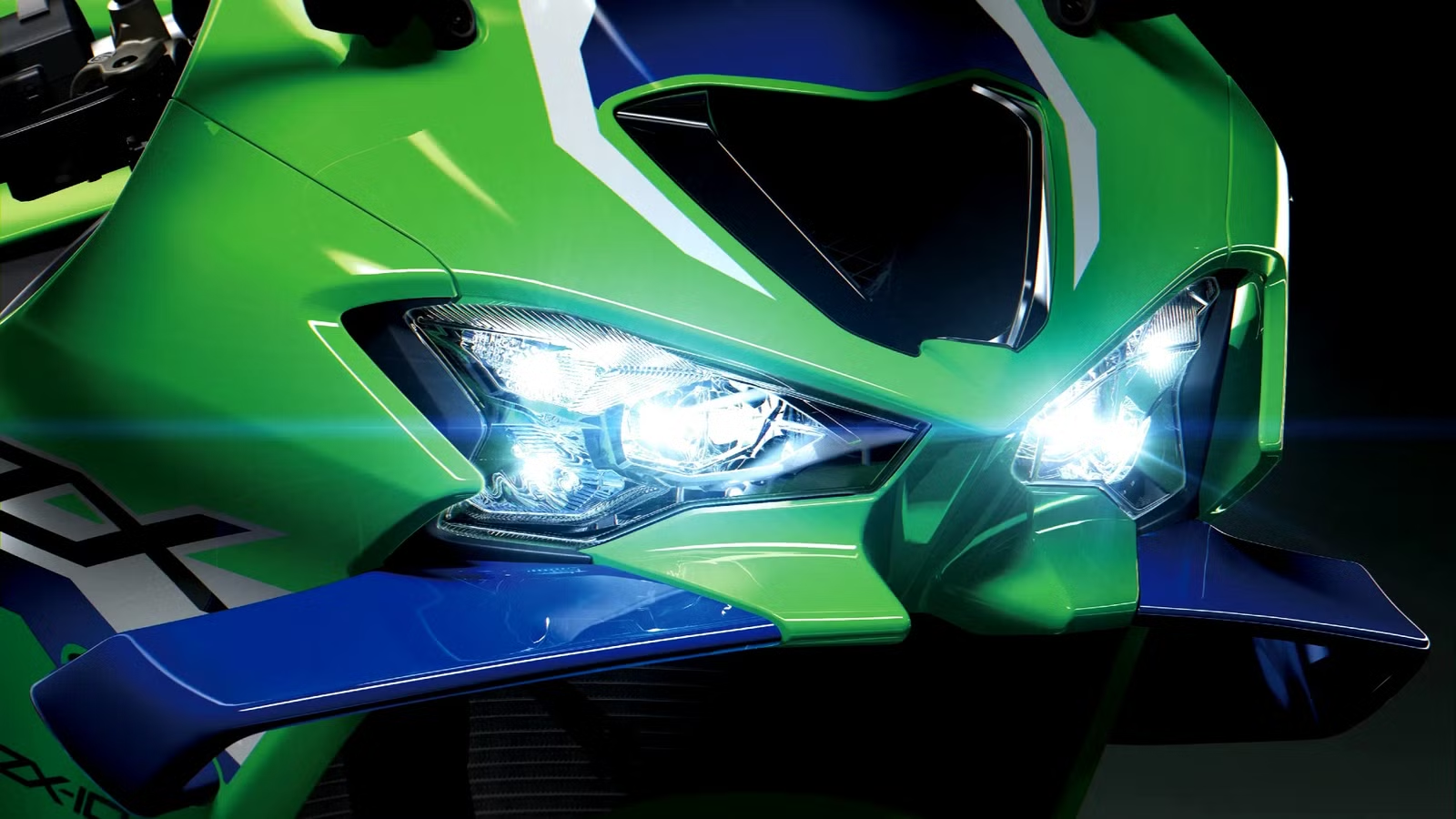
The Kawasaki Ninja ZX-10R is not pretending to be a budget motorcycle. It’s a race-bred superbike, but what makes it interesting is that its pedigree isn’t the only thing that Kawasaki offers. There’s real-world value too. Pricing starts at $16,999 for the non-ABS model and $17,999 with ABS, the same as the MY2025 model, with an $840 destination charge on top. 2026 brings new winglets, for which Kawasaki claims 25 percent more downforce for a 0.3 percent drag penalty, a repositioned ram-air intake, and a bigger 5-inch TFT.
For that money, you get Brembo M50 brakes, Showa suspension, an Öhlins steering damper, a quick-shifter, and an IMU-based electronics package. Against the competition, the ZX-10R undercuts nearly all of its liter-bike rivals, with the base Suzuki GSX-R1000 at $16,399 the lone exception.
There’s A Lot To Like On The New Kawasaki Ninja ZX-10R

We start to dive deeper, and first up is the engine. Power comes from a 998cc inline-four rated at 82.5 lb-ft of torque and 190 hp at 11,500 rpm. That’s down from last year’s claimed 196 hp. Mechanically, the only real changes are an updated catalyst and a second downstream O2 sensor for Euro5+ compliance. The other Japanese liter bikes feel some of that squeeze too.
The hardware is where it gets fun. Since 2019, the engine has used finger-follower valve actuation designed by Kawasaki’s World Superbike engineers. Compared with the old bucket-and-shim setup, finger followers cut valvetrain mass and allow much more aggressive cam profiles, so the valves open and close faster. Higher lift is what buys top-end power. Since the cam hits a small contact patch on each follower, they carry a DLC (Diamond-Like Carbon) coating to protect against wear.
High-End Underpinnings For The Price

On the chassis side, suspension is a fully-adjustable Showa 43mm inverted fork and a piggyback rear shock absorber, with an Öhlins steering damper in the standard kit, all hanging off an aluminum twin-spar frame. For 2026, the chassis has also been revised around the additional downforce generated by the new winglets. Kawasaki says the aerodynamic package increases front-end downforce by 25 percent, while the swingarm pivot has been raised by 2mm to improve rear-wheel traction.
The fork, triple clamp, and damping settings were also fine-tuned as part of the update. Weight is not particularly low by modern superbike standards; Kawasaki quotes a curb weight of 458.6 lb for the non-ABS model and 463.1 lb for the ABS version. The bike rides on 120/70 front and 190/55 rear tires wrapped in Bridgestone Battlax Racing Street RS12 tires and uses a 57.1-inch wheelbase. That combination creates a motorcycle that is serious on a racetrack but not so specialized that the average experienced rider cannot make sense of it.
The Electronics Suite Is Up There With The Best From Japan

The rider aid package is comprehensive: IMU-based chassis awareness, sport traction control, cornering management, launch control, engine-brake control, and power modes, plus a quick-shifter. Three preset ride modes — Sport, Road, and Rain — are joined by four customizable Rider modes. ABS-equipped variants also get Kawasaki’s KIBS anti-lock system.
It isn’t flawless everywhere. Traction and wheelie control can’t be adjusted independently, which most European and Japanese rivals today allow. Beyond the rider aids, there’s a new 5-inch TFT with a shift light, all-LED lighting, and Rideology connectivity with voice command and turn-by-turn navigation, both of which require a purchased license. Electronic cruise control is on the list as well.
It Is Friendlier Than Its Superbike Reputation

The ZX-10R looks like the kind of motorcycle that should constantly be trying to scare its rider. In reality, the 2026 model seems determined to make the first few miles less intimidating. Kawasaki gives it a 32.5-inch seat height and a 4.5-gallon fuel tank, figures that are not unusual for the class but make the bike manageable enough for experienced riders who are moving up from a middleweight. And that usability isn’t just theoretical, with multiple pieces of evidence on public forums across the internet.
The Kawasaki Ninja ZX-10R does not give riders more motorcycle by simply adding another few horsepower to an already excessive number. It gives them more through the combination of a WorldSBK-linked engine, premium brakes and suspension, sophisticated electronics, useful road equipment and aggressive aerodynamics — all at a price that remains remarkably close to the entry point of the liter-bike class. For a machine carrying seven WorldSBK titles worth of pedigree, that is an unexpectedly generous package. And for riders who actually get to live with one, that might be the ZX-10R’s biggest surprise of all.
Source: Kawasaki

Related posts

Latest Post


No Comments