
The Yamaha Bike That Makes Every Dollar Work Harder
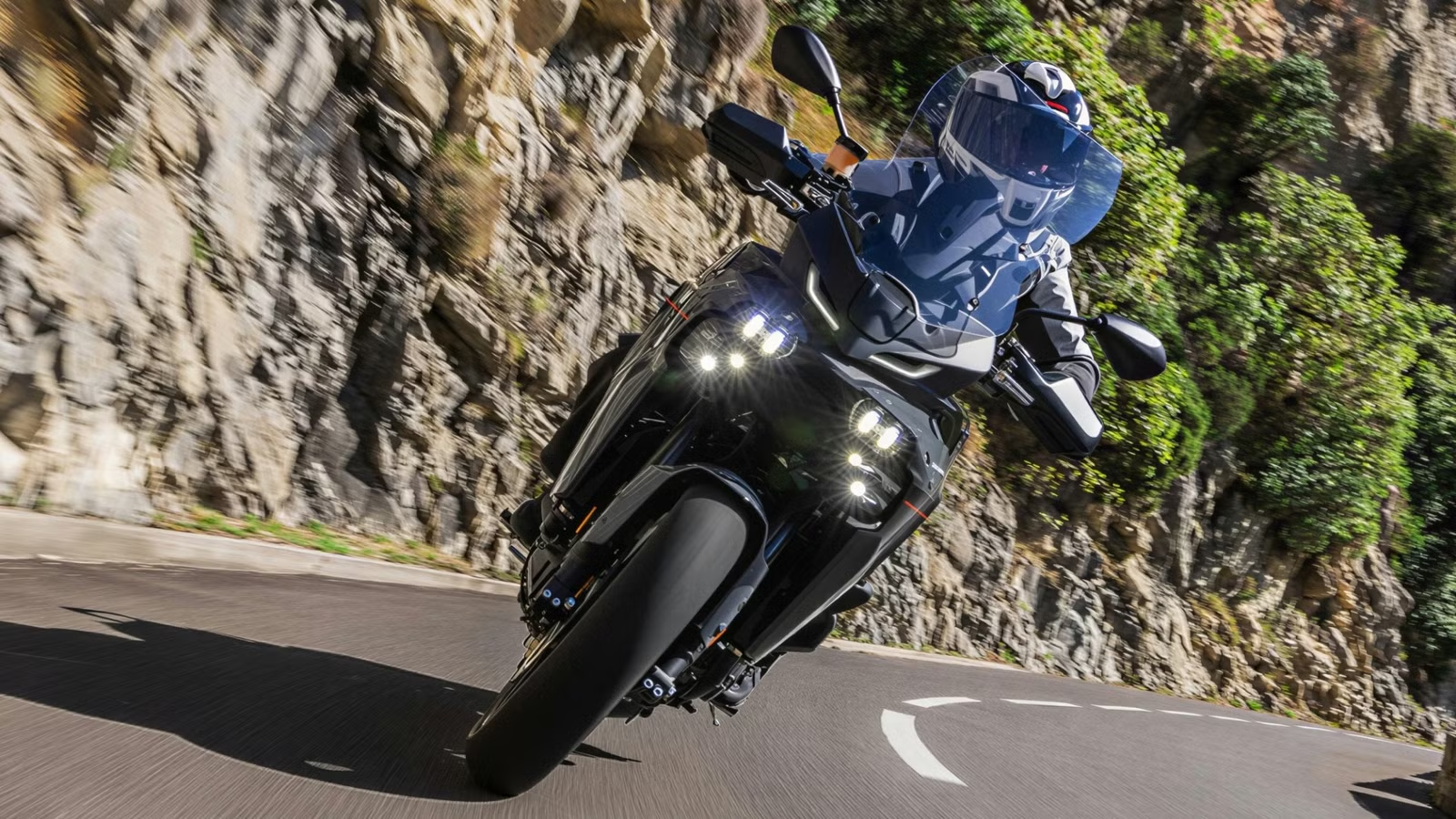
Motorcycles have become increasingly specialized these days. Some are built to chase lap times, others to cross continents, while plenty are designed simply to make every city ride more entertaining. But for many riders, buying multiple motorcycles is not feasible at all. That is where versatility and value become an important part of a motorcycle’s overall appeal. A bike that can commute during the week, carve through a mountain road on Saturday, and cover highway miles on Sunday can arguably deliver more usable capability than a machine designed for just one purpose. Yamaha has spent years refining this formula, and one of its sport-touring motorcycles makes a particularly compelling case by blending do-it-all abilities with insane value.
How Yamaha Mastered The Balance Of Performance And Practicality On A Budget

Yamaha has a long history of building motorcycles that deliver excitement without becoming difficult to live with. That too, while being attainable for all. The MT-07 offers approachable parallel-twin performance in a lightweight roadster, while the MT-09 adds a more energetic three-cylinder character without losing its everyday usability. The Ténéré 700 takes the CP2 engine and places it in a chassis capable of handling long road journeys and genuine off-road riding.

The same philosophy extends to Yamaha’s sport bike range as well, with the YZF-R7 delivering an engaging riding experience without the price or uncompromising character of a liter-class supersport. The common thread is that Yamaha does not always force riders to choose between excitement and everyday usability. That balance becomes even more important in sport touring, where a motorcycle needs to satisfy riders seeking strong performance and agility while still offering comfort, luggage capacity, and dependable long-distance manners.
Yamaha’s Sport-Touring Formula Prioritizes Versatility

Sport-tourers occupy an interesting middle ground between aggressive sport bikes and upright ADVs. They borrow the performance-oriented chassis and engines of road-focused motorcycles, but add wind protection, more comfortable ergonomics, luggage capacity, and technology that makes long-distance riding easier. The result is a category that can make sense for riders who want a one-bike garage.

Yamaha’s approach to sport touring follows a similar path. The Japanese manufacturer combines a lively engine with a relatively lightweight chassis in its sport tourers, while practical equipment allows the same bike to transition from weekday commuting to weekend touring. That philosophy has evolved considerably since Yamaha introduced the first Tracer model in 2015, creating a platform that has steadily become more sophisticated over the years without abandoning its multi-role fun-to-ride character.
The Yamaha Tracer 9 Delivers Maximum Value Straight From The Showroom Floor
Starting MSRP: $12,599

The versatile sport touring motorcycle in context is the Yamaha Tracer 9. Originally introduced in 2015 as the FJ-09 in North America and MT-09 Tracer in other markets, before evolving into the modern Tracer 9 we know today globally, this motorcycle has consistently stood out as one of the most complete packages in middleweight sport-touring. For 2026, the Yamaha Tracer 9 is priced from $12,599, before destination charge and other taxes.
At this price point, the Tracer 9 sits at a sweet spot, undercutting many premium European competitors while delivering a package that matters in real-world conditions. What makes the Tracer 9 such a compelling value proposition is its ‘ready-to-ride’ nature straight from the showroom floor. While most manufacturers often list a low base price only to lock essential touring amenities behind expensive factory option packs, Yamaha includes standard touring hardware right out of the box.
The CP3 Engine Brings Serious Performance Without Superbike Pricing

Powering the Yamaha Tracer 9 is an 890cc liquid-cooled, DOHC, inline three-cylinder CP3 engine. It churns out 117 horsepower at 10,000 RPM and 68.6 pound-feet of peak torque at 7,000 RPM, paired with a six-speed manual gearbox. There is ride-by-wire throttle, assist & slipper clutch, and an optional quickshifter too. In select international markets, Yamaha also offers an automatic transmission option. The power figures of the Tracer 9 put it comfortably ahead of many middleweight twins, but the strong, linear torque across the low and mid-range is its real appeal.

Yamaha’s CP3 platform has also built a reputation for being a durable, widely used engine across several models. That broad application supports the sense that the Tracer 9’s powerplant has an established track record rather than a motor developed exclusively for a single motorcycle. It is a proven Yamaha formula adapted for sport touring.
Adjustable Suspension And A Lightweight Chassis Balance Agility And Stability

Complementing the engine is a lightweight Controlled Filling (CF) die-cast aluminum Deltabox frame with an extended aluminum swingarm and a long subframe designed to provide additional room for the rider and passenger. Suspension hardware consists of an adjustable 41mm KYB inverted fork with 5.1 inches of travel at the front and an adjustable KYB rear shock with 5.2 inches of travel. That adjustability allows riders to tailor the motorcycle for solo commuting, spirited riding, or two-up touring with luggage.
Braking duties are performed by dual 298mm front discs and a 267mm rear disc, both being hydraulic units and supported by a lean-sensitive cornering ABS. Its lightweight SpinForged 17-inch wheels with Bridgestone Battlax Sport Touring T32 tires further minimize unsprung weight. At 483 pounds wet, the Tracer 9 is not exceptionally light in absolute terms, though.
Touring Capability Comes Standard Instead Of As An Extra

One of the clearest ways the Tracer 9 makes a rider’s money work harder is through its standard equipment on offer. While many mid-capacity motorcycles skimp on long-distance usability, the Tracer 9 comes out of the box equipped for serious mileage. Color-matched hard side cases are fitted as standard from the factory, and they are spacious enough to accommodate a full-face helmet. The Tracer 9’s ergonomics are similarly tailored for long days in the saddle. It offers an upright riding stance, multi-position adjustable seat height (33.3 inches or 33.9 inches), and adjustable footpegs.
The Sophisticated Electronics Package Goes Well Beyond The Basics

Modern sport-touring demands smart electronic rider aids, and the Tracer 9 punches well above its price bracket in this department. Powered by a six-axis Inertial Measurement Unit (IMU), it gets traction control, slide control, front-wheel lift control, back-slip regulator, and a brake control system. Five riding modes are also present. It also gets a seven-inch full-color TFT display with smartphone connectivity and cruise control.
The Yamaha Tracer 9 Shows Why True Value Is About More Than The Sticker Price
In a market where fully-equipped adventure and touring motorcycles can easily exceed $15,000, the Yamaha Tracer 9 makes a compelling case for value. When compared against its other middleweight sport-touring rivals, the Tracer 9’s value-for-money appeal becomes even clearer. The Honda NT1100 DCT starts at $11,999, the BMW F 900 XR at $12,695, and the Triumph Tiger 900 GT at $14,995, while the Tracer 9 carries an MSRP of $12,599. Between them, Yamaha strikes an appealing balance between performance, everyday usability, and long-distance comfort while making every single dollar work harder for the rider.
Source: Yamaha

Related posts



Latest Post


No Comments