
Honda Monkey Buyer’s Guide & Everything You Need To Know
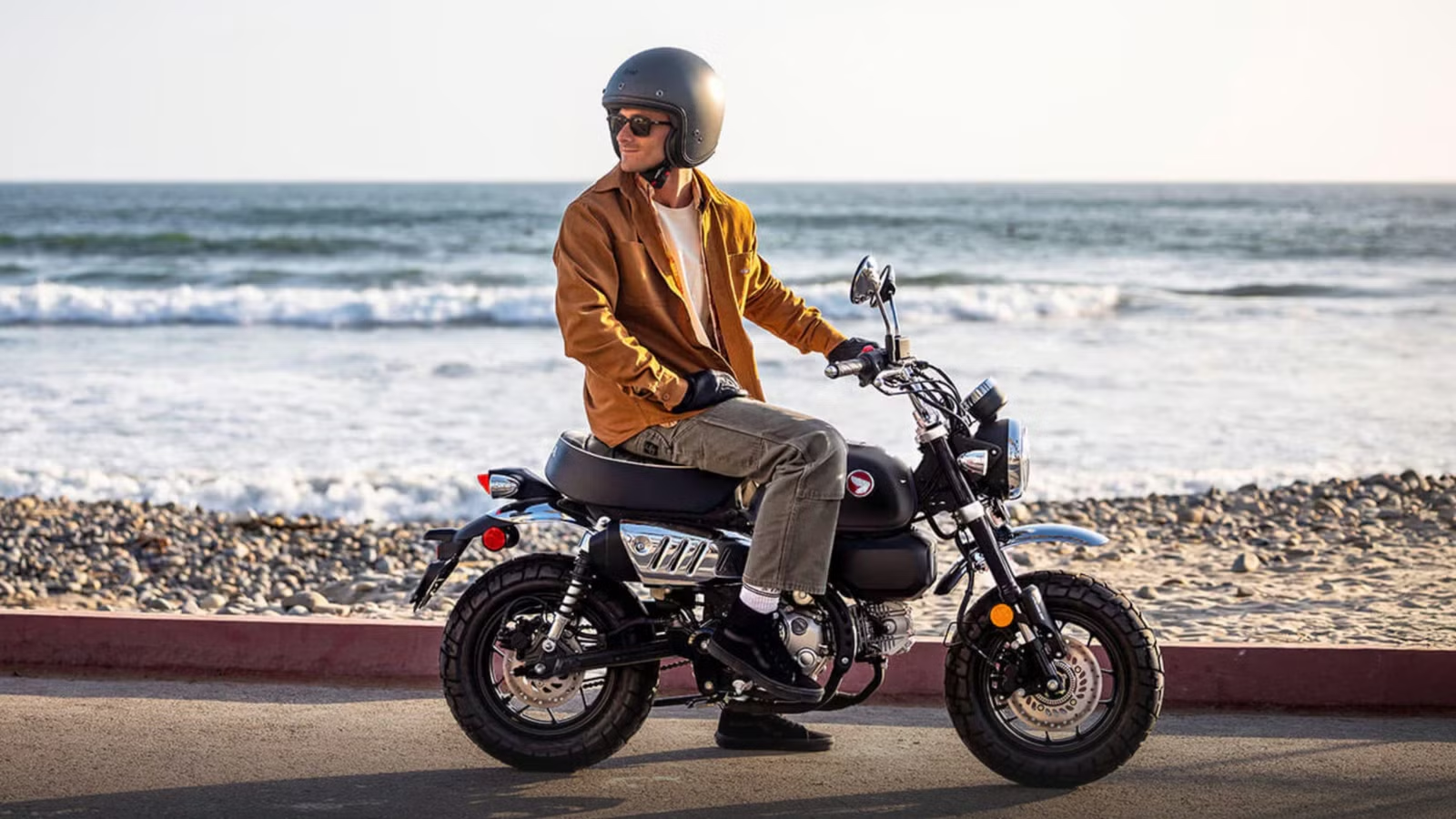
Few motorcycles have spent more than half a century refusing to grow up. What began as an almost comically small recreational machine eventually became a cult favorite, collector piece, urban runabout, and gateway into motorcycling, all while retaining proportions that make conventional motorcycles look enormous beside it. Today, the idea remains largely unchanged, but the motorcycle itself has evolved enough that buying one deserves more thought than its toy-like appearance suggests.
It Started As Something Much Smaller Than A Motorcycle

Honda’s miniature motorcycle story goes back to 1961, when the Z100 was created for the Tama Tech amusement park in Japan. An export-oriented CZ100 followed in 1963, while the 1967 Honda Z50M became the first Monkey offered to the Japanese public. Honda designed that early Honda mini bike around portability, giving it folding handlebars and a folding seat so owners could fit it into a car and take it along for recreational rides.
From The Honda Z50 To The Modern Monkey

The formula evolved quickly. The 1969 Z50A received larger 8-inch wheels and front suspension, while the Z50Z made the front end removable to make it easier to stuff the thing inside a car. By 1974, the Z50J added rear suspension and a larger fuel tank, pushing the Monkey beyond its original role as something transported to the riding area in a car. The 1978 redesign then established much of the visual language associated with the Monkey for decades.
The Current Honda Monkey Is A Proper Small Motorcycle


The current Honda Monkey 125 takes the proportions and visual cues of the old bike and wraps them around modern mini-motorcycle hardware. For 2026, there’s just one U.S.-market Monkey, finished in Matte Black Metallic and priced at $4,399. Honda has also made front-wheel ABS standard rather than dividing the range into ABS and non-ABS versions. The result remains unmistakably a Monkey, but there’s very little mechanically toy-like about it anymore.
The Engine Is Shared With The Grom

Power comes from a 124cc air-cooled, SOHC single-cylinder four-stroke with two valves per cylinder, a 50.0mm bore, 63.1mm stroke, and 10.0:1 compression ratio. Fuel injection feeds the engine through a 24mm throttle body, while a five-speed manual transmission sends power to the rear wheel through a chain final drive with 14/37 gearing.
|
Engine |
124cc air-cooled single-cylinder four-stroke; SOHC, 2 valves per cylinder; fuel injection with 24mm throttle body |
|
Output |
9.3 horsepower @ 6,750 rpm 8.1 pound-feet @ 5,500 rpm |
|
Transmission |
5-speed manual; chain final drive |
|
Seat Height |
30.5 inches |
|
Wet Weight |
231 pounds |
The chassis emphasizes simplicity just as much as the engine does. Up front is a 31mm inverted fork providing 4.3 inches of travel, paired with twin rear shocks offering 4.0 inches. A 220mm front disc gets ABS, while the rear uses a 190mm disc without it. Cast 12-inch wheels wear chunky 120/80 front and 130/80 rear tires, maintaining the visual proportions of the old Monkey while offering much more substantial running gear than the classic Honda mini bike ever had.
It’s Small Without Being Unusable

The Monkey’s 30.5-inch seat height and 231-pound curb weight make it easy to manage at parking-lot speeds, but Honda deliberately gives the bike a high-rise handlebar and upright riding position intended for adult riders. Its wheelbase stretches just 45.0 inches, with 25 degrees of rake and 3.2 inches of trail. Those dimensions explain why it changes direction so eagerly and why squeezing it into a garage, shed, or crowded urban parking spot requires little effort.
|
Frame |
Steel backbone frame |
|
Suspension |
31mm inverted fork, 4.3 inches travel; dual rear shocks, 4.0 inches travel |
|
Wheels and Tires |
12-inch cast wheels; 120/80-12 front, 130/80-12 rear |
|
Brakes |
Single 220mm front disc with ABS; single 190mm rear disc |
What Is The Honda Monkey Actually Like To Live With?

On paper, those numbers make the Honda Monkey one of the least intimidating motorcycles on sale. In practice, they also define where it works best. This is a machine built around urban speeds, short commutes, neighborhood errands, and backroad exploring rather than long-distance travel. Its light weight and tiny footprint reduce much of the physical effort associated with riding, while the manual clutch and conventional five-speed gearbox still teach the same fundamental controls as a larger motorcycle.
Around Town Is Where The Monkey Makes Sense

This is where the Monkey’s limitations become advantages. Twelve-inch wheels, a short wheelbase, low mass, and an upright seating position make it exceptionally easy to thread through slow-moving environments or turn around in confined spaces. Fuel consumption is tiny, parking is rarely a challenge, and the soft-looking seat and generous suspension travel give it more everyday usefulness than its dimensions suggest. For riders using one as a city motorcycle or short-distance commuter, outright speed matters less than how little effort the bike demands.
Honda Monkey Vs Honda Grom Comes Down To Priorities

The closest alternative sits in the same showroom. The Honda Grom uses the same basic 124cc air-cooled single and five-speed transmission, but starts at $3,599, with the Grom ABS priced at $3,799. That puts a $600 difference between the ABS-equipped Grom and the $4,399 Monkey. The Grom also uses a 31mm inverted fork, although its 3.9 inches of front travel are slightly shorter than the Monkey’s 4.3 inches.
The Grom is the easier choice if price and customization matter most. Its modern styling and removable bodywork have also helped make it one of the obvious platforms for riders interested in modifications. The Honda Monkey asks more money for the retro tank, chrome detailing, traditional silhouette, thicker-looking seat, and connection to decades of Honda history. Mechanically, there isn’t enough difference between them to make the decision about outright performance. You’re deciding which interpretation of the mini-motorcycle idea you actually want.
Buying A Honda Monkey Makes Sense For A Specific Type Of Rider

That distinction becomes even more important on the used market. The Monkey’s simplicity makes it an approachable secondhand purchase, but these bikes attract owners who like modifying them. Aftermarket exhausts and cosmetic parts aren’t automatically a concern, but intake changes, fuel controllers, big-bore conversions, lowered suspension, stretched swingarms, or improvised wiring deserve closer inspection. A clean stock bike with some mileage can be a better purchase than a barely ridden example carrying a long list of questionable modifications.
What To Check Before Buying Used

Start with the same wear points you’d inspect on any chain-driven motorcycle: chain and sprocket condition, tire age and damage, brake wear, fork seals, steering bearings, wheel condition, clutch operation, and evidence of fluid leaks. Check the ends of the handlebars, levers, engine cases, exhaust, and foot controls for signs of drops. Because the Monkey is light and approachable, don’t assume low mileage means it has never been crashed or used hard. Service records and sensible modifications matter more than an unusually clean odometer.
Older Honda Z50 models need a different approach. Once you’re shopping vintage Monkeys, originality, correct components, restoration quality, and model identification can matter as much as mechanical condition. Honda produced numerous versions and special editions over decades, and some have genuine collector appeal. Someone wanting cheap transportation should stay focused on the modern 125, while someone hunting an early Monkey is entering the classic-bike market rather than simply buying an older version of the same machine.
The Monkey Works Best When You Don’t Buy It By The Numbers
The strange part about the Monkey is that it’s difficult to justify using normal motorcycle math. For $4,399, there are larger machines with more power, greater highway ability, additional passenger space, and stronger all-around practicality. Even within Honda’s miniMOTO range, cheaper alternatives perform much of the same basic transportation role. Judged purely on displacement, speed, or capability per dollar, the Honda Monkey isn’t trying to win.
But that also explains why it has survived in one form or another for decades. A Monkey bike isn’t simply transportation scaled down to sub-125cc. It’s a deliberately compact motorcycle built around approachability, simplicity, economy, distinctive styling, and the fact that riding doesn’t always need to involve going faster or farther. If those qualities are exactly what you’re shopping for, the 2026 Honda Monkey remains one of the few motorcycles where choosing the smaller machine isn’t necessarily a compromise.
Source: Honda Powersports

Related posts

Latest Post


No Comments