
The Fast Sports Bike That Depreciated Into Entry-Level Commuter Money
Entry-level sport bikes are more powerful and more exciting than ever. But if you’re a hardcore enthusiast on a budget, none of these bikes will tickle your fancy or make sense in the long run. What you need then is something fast enough to tickle the senses with its performance and edginess. This is where used sport bikes come in. Thanks to depreciation, we have an exciting lineup of rampant liter-class options under $10,000. If we shop smartly, we can find iconic flagship sport bikes from the 2000s for less than a new Honda CBR500R.
Depreciation Unlocks An Exciting World Of Bygone Sport Bikes

Sport bikes are among the fastest-depreciating motorcycle types. They lose about 20 to 30 percent of market value in the first year alone. The main reason for this steep drop is rapidly evolving high-performance technology. Electronics and hardware can quickly become outdated. Plus, because engine internals wear out faster, any sport bikes with over 20,000 miles lose value even faster.

Most sport bikes are bought for leisure, while cruisers and adventure bikes are often kept longer for their practical uses. This gives sport bikes a niche market, since fewer buyers want aggressive riding ergonomics and high-maintenance mechanicals. Consumables and insurance are expensive on certain examples too. All of this fuels the drastic depreciation of sportbikes, whose value then flattens into a stable baseline about ten years later.
Some Iconic Bikes Are Affordable As Entry-Level Commuter Bikes

The first-gen Suzuki Hayabusa can be had for as low as $3,000. Despite this sportbike’s high mileage, its Japanese origin gives it an edge in refinement and reliability over used European and British counterparts. The 2008-2010 Honda VFR800 Interceptor can be had for as low as $4,000 today. This futuristic-looking Honda has a V4 heart.


Other examples of exciting sport bikes of yesteryear you can buy used today for under $6,000 include the 2006 Yamaha R6, the 2007 Aprilia RSV 1000 R, the 2008 Suzuki GSX-R750, the 2010 Kawasaki Ninja ZX-10R, and even the mighty 2000 Kawasaki Ninja ZX-12R. An array of early-2000s Ducatis, MV Agustas, and BMWs also fit this bill.

Some used models are notorious for underlying mechanical issues that can cost owners serious money to repair. A badly maintained used sportbike can sometimes cost nearly $3,000 to get back into shape. So, choosing a reliable sport bike is paramount. Balancing dirt-cheap prices, thrilling performance, and pocket-friendly yearly maintenance, even for a used sportbike, is a tough affair. But the early-2000s Yamaha R1 is proof that a highly depreciated sport bike will not put a hole in your wallet.
The 2004-2005 Yamaha YZF-R1 Can Be Had For Dirt Cheap Today
Typical Listing Price Via KBB — $5,710

When new, the 2004 Yamaha YZF-R1 cost $10,699. Adjusting for inflation, that would cost nearly $19,000 in 2026. But today, you can find a used 2004 Yamaha R1 for under $6,000 today. What makes it special is that it was a landmark generation that introduced many new features to the nameplate. It was the first R1 to achieve the legendary 1:1 power-to-weight ratio.

Elsewhere, it featured the final and most powerful iteration of Yamaha’s 20-valve four-cylinder engine. The mill layout was tweaked for better weight distribution, and it was also the first model to get the Ram Air induction system. The Deltabox chassis was redesigned, and the gearbox tweaked. Riding dynamics were sharpened, and this year it also introduced its iconic under-seat exhausts. Hardware also got a boost with superior braking. All of these bits made the 2004 R1 a pivotal model in the nameplate’s history.
Powered By A Glorious Inline-Four Engine

The 2004 Yamaha R1 packs a high-revving 998 cc liquid-cooled transverse four-cylinder engine. This is a DOHC setup with five valves per cylinder. This was the last iteration of Yamaha’s 20-valve layout before retiring it in favor of a 16-valve layout in 2007. It has a short-stroke design and a 12.1:1 compression ratio to produce 171.3 horsepower at 12,500 RPM and 78.9 pound-feet of torque at 10,500 RPM. The Ram Air intake system bumped power to 180 horsepower.

Compared to the 2003 model, Yamaha gave the 2004 R1’s engine a serious glow-up. Notable updates included new cylinder heads, bigger intake and exhaust valves, new camshafts, and revised combustion chambers for a higher compression ratio. The engine was also tilted forward by an additional 10 degrees for better weight distribution. Power is sent to the rear wheel via a six-speed manual gearbox coupled to a redesigned clutch basket that was 5 percent lighter than the 2003 version.
Sharp Handling Characteristics Courtesy Of Grin-Worthy Underpinnings

The 2004 Yamaha R1 sits on the famed Deltabox aluminum chassis, redesigned from earlier iterations to increase vertical and torsional rigidity while keeping the motorcycle narrow. The engine’s forward lean greatly contributes to the chassis’ added strength. This layout also allows a slimmer fuel tank, which creates a more comfortable and aerodynamic riding position. Complementing the main frame is an aluminum truss-type swingarm, also newly designed for the 2004 model.

Suspension duties are taken care of by 43 mm Kayaba inverted front forks, with full adjustability and 4.7 inches of travel. The rear monoshock is also fully adjustable and offers 5.1 inches of travel. Braking comes from dual 320 mm discs paired with radially mounted four-piston calipers. The rear gets a single 220 mm disc coupled to a four-piston caliper. The 2004 R1 gets 120-section front and 190-section rear tires wrapped around lightweight 17-inch alloy wheels at both ends.
No Sophisticated Technological Intervention Here

The 2004 Yamaha YZF-R1 is from an era of no assist features, with a mechanical setup that offers a raw, unadulterated connection between rider and machine. It lacks traction control, ride modes, and even ABS. If we dig deeper, the most electronics this used Yamaha R1 gets include fuel injection, a digital TCI ignition system, an analog-digital instrument cluster, and a factory immobilizer.
Drool-Worthy Design That Looks Exciting Even After 20 Years

The 2004 Yamaha R1 also got a major visual overhaul. It introduced an aggressive, razor-sharp, slim silhouette that reduces weight, helping the R1 reach a 1:1 power-to-weight ratio. This comes from blending race-grid aesthetics with functional aerodynamics and weight distribution, translating to a dry weight of 379 pounds and a wet weight of 407.8 pounds. The coolest visual cue is its under-seat dual titanium exhaust system. Beyond weight savings, it also offers a cleaner look by eliminating the bulky side-mounted exhaust canister of older models.
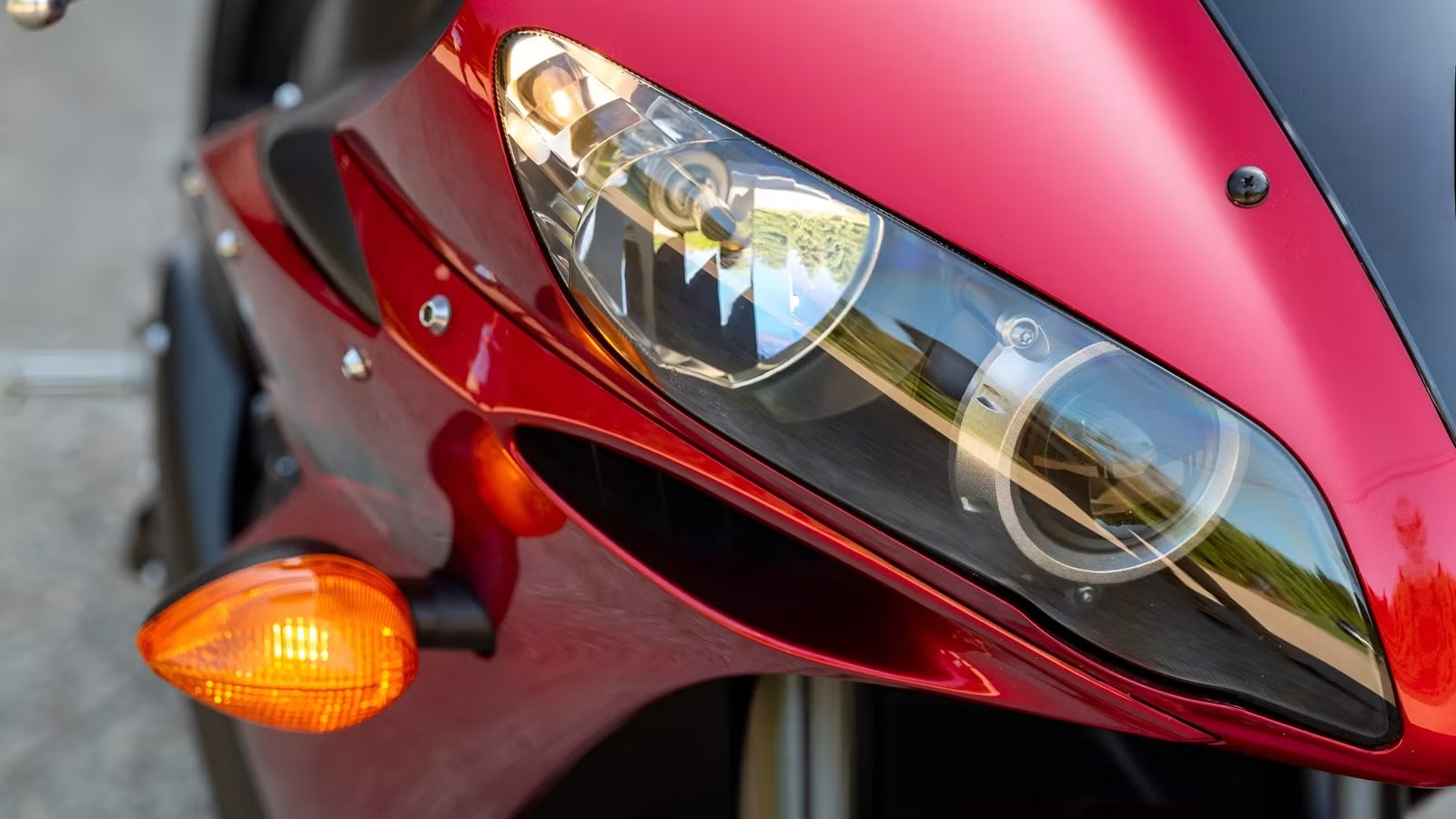
Another iconic visual element is its ‘four-beam’ projector headlamp design. This highly recognizable layout offers a sinister, hyper-aggressive “stare” that looks meaner and more futuristic than its predecessors. It further neatly integrates dual Ram-Air intakes directly into the front nose. Its slim 4.7-gallon fuel tank and narrower waistline, thanks to the refreshed Deltabox chassis, give it a compact yet sculpted look.
Sources: Yamaha Motorsports and Archives.

Related posts



Latest Post


No Comments