
5 Vintage Honda Sports Bikes That Are Worth More Than A Modern Superbike
Honda has always had a reputation for building motorcycles that are economical, dependable, and nearly impossible to kill. But reliability alone doesn’t explain why certain Hondas command prices that leave Italian exotica in the dust. Every so often, the engineers in Minami-Aoyama have produced something so technically audacious, so deeply connected to motorsport, that the market has rewarded it with ever-climbing values — turning a handful of production Hondas into genuine collector trophies.

Some of these machines now sell for sums that dwarf the cost of a current CBR1000RR Fireblade, and a few have eclipsed the prestige of celebrated Italian rivals while still carrying Honda’s hallmark reliability. What are these models, and what made them so valuable? We’ve picked five glorious Winged Wonders that you’re unlikely to encounter outside a collector’s garage — or the auction block.
Honda CBX1000
Price: $20,000+
Today, we know BMW as the manufacturer with the straight-six engine in its lineup, both for cars as well as motorcycles. But in the late 1970s, Honda produced the CBX with an inline-six configuration — the first inline-six production motorcycle ever made. It featured six carburetors, 24 valves, and double overhead camshafts. The result was a headline-grabbing power figure for the era: 105 horsepower.

That output was somewhat blunted by a 600-pound kerb weight, but the sports bikes of the era prioritized acceleration above all else — handling and braking were secondary concerns. The CBX’s extra cylinders and complexity made it considerably more expensive than its Japanese rivals, though Honda believed that the smoothness of the six and that big horsepower number would justify the premium for buyers. The market thought otherwise.
|
Engine Type |
Air-cooled inline six, six carburetors |
|
Displacement |
1047 cc |
|
Max Power |
105 HP @ 9,000 RPM |
|
Max Torque |
52.27 LB-FT @ 6,500 RPM |
|
Top Speed |
136 MPH |
Germany’s law banning imports of over 100 crank horsepower hurt the CBX’s European prospects, and the fear that similar legislation might spread across the continent made it a costly gamble. In 1983, Honda’s own CB1100F offered better performance at a significantly lower price, effectively sounding the death knell for the CBX. Its poor sales have translated directly into rarity today, and CBXs in good condition regularly sell for more than $20,000 at auction. You won’t get cutting-edge performance or striking looks, but you will get something genuinely unusual: a rare Honda halo model that history has been kinder to than the buying public ever was.
Honda CBR900RR Fireblade First Gen
Price: $20,000+

There’s not much we can say that hasn’t already been said about this motorcycle, but let’s go through some of it again. Before the CBR900RR, halo sports bikes were large, heavy machines that didn’t care much for handling or stopping. Tadao Baba, the brains behind the Fireblade (pictured), wanted to build something that valued lightness and handling as much as outright acceleration — much in the same way that Colin Chapman chased performance. To put it into perspective, the nearest competitor in terms of weight tipped the scales a sizable 76 pounds heavier. The CBR900RR fundamentally changed our expectations of what a supersport motorcycle should be, and decades on, everyone is still pursuing the same goals set by Tadao-san and his team for their liter-class machines.
|
Engine Type |
Liquid-cooled inline four, DOHC |
|
Displacement |
893 cc |
|
Max Power |
122 HP @ 10,500 RPM |
|
Max Torque |
64.9 LB-FT @ 10,000 RPM |
|
Top Speed |
164 MPH |
Prices for the CBR900RR start from $20,000 upward, with examples in superb condition exceeding $30,000. It’s worth noting that the premium applies to the first-generation CBR900RR only — the one with the two round headlamps cut into the fairing. Also known as the SC28, it was manufactured for just two years before the second generation arrived with radically different styling, most noticeably a single clear headlamp cover over dual reflectors. While the Fireblade remained its reliable self throughout its production life, no subsequent generation has matched the original’s collectability or its hold on values.
Honda VTR 1000 RC51 SP2
Price: $20,000+

The Honda RC51’s official name was VTR 1000, or RVT1000R in the US market. It was Honda’s answer to cracking the World Superbike Championship after its 750 cc V4 proved unable to match Ducati’s twins. Honda adopted a similar twin-cylinder format, and the strategy paid off: Colin Edwards took the WSBK title twice in three seasons, which is also why RC51s in Castrol livery stir such nostalgia in anyone who witnessed those epic battles between Edwards and Bayliss.
|
Engine Type |
Liquid-cooled 90 degree V twin |
|
Displacement |
996 cc |
|
Max Power |
136 HP @ 9,500 RPM |
|
Max Torque |
77.4 LB-FT @ 8,000 RPM |
|
Top Speed |
168 MPH |
Closer to home, Nicky Hayden also won the AMA Superbike title aboard an RC51. Look hard enough and you’ll find Nicky Hayden special-edition examples on the used market, where they sell quickly whenever they surface. It is this rich history, and the RC51’s association with American legends such as Edwards and Hayden, that keeps demand strong today.
There are two distinct RC51 variants; the first generation is the SP1 and the second — no prizes for guessing — is the SP2. The SP2 differed from the SP1 in several meaningful ways: it received a stronger, stiffer chassis and swingarm derived directly from Honda’s WSBK race machine. The engine was also revised to produce four additional horsepower, and overall weight dropped by 11 pounds. It is the SP2, therefore, that commands the higher price, with figures north of $20,000 being commonplace.
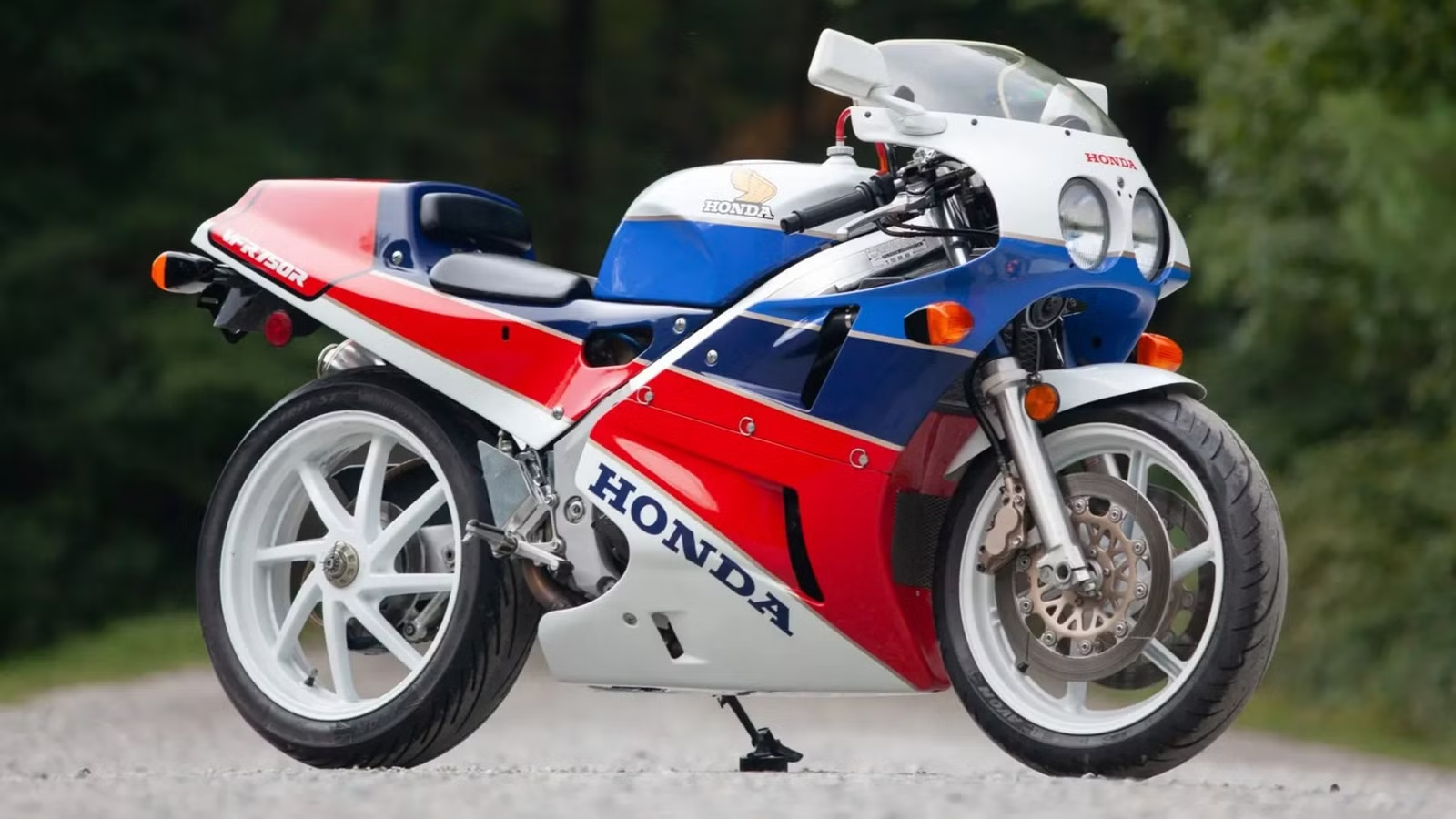
Honda VFR750R RC30
Price: $30,000+

The VFR750R, more commonly known by its factory code name ‘RC30’, was the last of Honda’s 750 cc competition machines before the company shifted focus to 1000 cc V-twins and inline fours. On paper, the spec sheet may not seem remarkable by modern standards. But there are things that today’s faster, more sophisticated supersports simply cannot offer.
The RC30 is historic because it was developed under homologation rules that required race bikes to be based on production models available to the public. Honda therefore built just 3,000 units worldwide, and the model didn’t reach US shores until three years after its Japanese debut. Each example sold for roughly twice the equivalent price of a Fireblade at the time — a figure that was head and shoulders above anything else on the market.
|
Engine Type |
Liquid-cooled 90-degree V4 |
|
Displacement |
748 cc |
|
Max Power |
102 HP @ 9,500 RPM |
|
Max Torque |
56.4 LB-FT @ 8,500 RPM |
|
Top Speed |
148 MPH |
It was well worth it, however, because what buyers received was essentially the race bike with only the changes necessary to make it road-legal. A factory race upgrade kit was all that stood between the RC30 and blistering track times. And unlike many homologation specials, the RC30 was a well-mannered road bike — reliable, predictable, and approachable, as a Honda tends to be. It is this duality of road civility and race pedigree, combined with extreme rarity, that makes the RC30 so coveted by collectors worldwide. Expect to pay at least as much as a Ducati Panigale V4 S for a good one today.
Honda RVF750 RC45
Price: $30,000+

The RVF750, or RC45, had enormous shoes to fill — those of the RC30. Honda went a step further this time, developing it primarily as a race machine and dialing it back only slightly for public consumption. The most significant mechanical change over its predecessor was the switch from carburetors to fuel injection. But the RC45 was never as forgiving as the RC30 on the road; it demanded to be ridden hard before it truly came alive. The proof is in the numbers: peak power arrives at 12,000 RPM and peak torque at 10,000 RPM, compared to the RC30’s more accessible 9,500 and 8,500 RPM respectively. The RC45 was also hampered by a lack of traction out of corners during the first half of its race career, which limited its championship success.
|
Engine Type |
Liquid-cooled 90-degree V4 |
|
Displacement |
749 cc |
|
Max Power |
119 HP @ 12,000 RPM |
|
Max Torque |
56 LB-FT @ 10,000 RPM |
|
Top Speed |
160 MPH |
Even though the RC45 never endeared itself to road riders of the era — being so emphatically a race bike wearing road-legal clothing — and never replicated the RC30’s championship record, it is a deeply coveted piece of Honda history today. Ironically, the very characteristics that made it too extreme for its original audience are precisely what makes it so appealing now, when analog, high-revving track weapons are exactly what enthusiasts crave. Prices are typically in line with the RC30, but an exceptional, well-preserved example can command over $50,000 — and a low-mileage investment-grade RC45 has been known to approach six figures.
Sources: Visordown.com, Motorcycle.com, Motorcyclenews.com, Cycleworld.com, Kelly Blue Book, Mecum Auctions, Bring A Trailer, and Iconic Motorbike Auctions

Related posts
Latest Post


No Comments