
The Honda Motorcycle That Still Sets The Reliability Benchmark
Japanese motorcycles are arguably the most reliable. This is primarily due to a calculated combination of rigorous manufacturing philosophies, iterative engineering, and a focus on practical, real-world usability. Guided by the philosophies of Kaizen and Monozukuri, Japanese manufacturers take pride in refining every motorcycle component.

This results in lower R&D expenditure, superior refinement levels, and most importantly, affordable pricing of motorcycles, another stronghold of Japanese bike makers. Among the Big Four Japanese manufacturers, Honda stands out by applying its famed reliability beyond conservative offerings. Track-ready supersport, luxury tourers, and go-anywhere ADVs score equally high in reliability ratings. Today, however, we focus on a timeless Honda cruiser bike that sets the reliability benchmark.
Honda’s Secret Is Knowing When Not To Change
Like its Japanese counterparts, Honda motorcycles score high on reliability because of understressed, seasoned engine designs, consistent updates over decades, robust internal components, and strict quality control. The chassis and hardware are also deliberately kept simpler than rivals to lower costs and make repairs easier. Honda tunes engines more conservatively, which reduces stress.

Couple this with solid cooling systems, and the engines last longer with less wear and tear, even on high-revving sportbikes. The focus on refining components rather than redesigning them is a risky move, especially when the competition redesigns with every update. This can make Honda bikes seem outdated compared to rivals. Still, on the flip side, they offer superior refinement and reliability, which matter more for many motorcyclists in the long run.

This approach of retaining the core chassis and engine design for decades makes Honda motorcycles more familiar to mechanics and keeps parts more affordable and widely available. Prime examples of Honda motorcycles that still define reliability include the CBR600R sportbike, the Africa Twin ADV, the Gold Wing luxury tourer, and the neo-retro Honda Rebel 1100 cruiser bike. But the Honda Shadow sets the benchmark for reliability because its engine-and-chassis combination has proven its durability since the 1990s. It also has not lost desirability, since it is a timeless, custom, American-inspired V-twin cruiser.
The Honda Shadow Phantom Is Designed To Outlive Its Owner

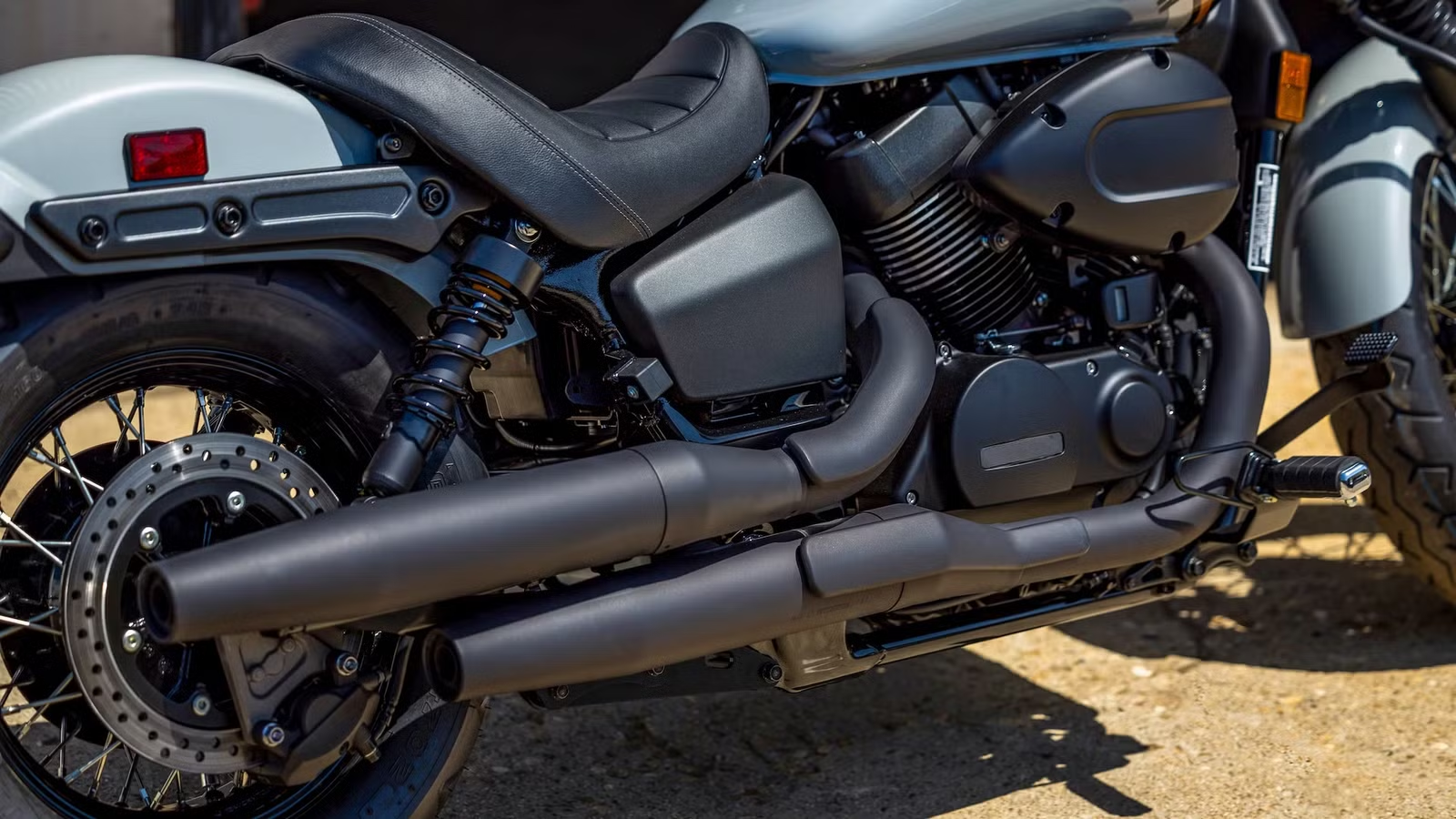
Every component on this metric cruiser is designed for longevity. The engine has a simple construction. The chassis and suspension hardware are technologically dated but still deliver a comfortable, predictable riding experience. With most components refined over decades and few upgrades, the Shadow Phantom has very little that can go wrong. This consistency has also made it a very accessible motorcycle worldwide, with reliable, affordable spare parts and an array of third-party custom parts and services to spice things up.

Many ownerson various forums report the Honda Shadow is stress-free. They say that repairs on the Shadow are fairly simple and seldom go beyond basic yearly services. A simplified architecture is the secret here. Major items like valve inspections are only required at longer intervals, and liquid cooling on an already understressed engine reduces long-term stress and mechanical wear. It also gets a final shaft drive, which is virtually maintenance-free, and upholds its longevity.
How Honda Made A $8,699 Bike Look Like A Bespoke Bobber

This is one of the few Japanese cruiser bikes today that fuses custom cruiser bike styling with old-school charm. It follows a proven formula: a low-slung, stretched-out chassis, a V-twin, and a timeless design. As a Japanese bike, it’s affordable too, starting at $8,699. Its competitive price also comes from the fact that the Shadow Phantom takes things slow and does not rush to pack the latest and greatest in technology and performance. Despite its slow-and-steady approach, the Shadow Phantom is never dull, thanks to its custom styling cues.

In fact, the current-generation model features a ten-year-old design. But it is spiced up with blacked-out components all around and a cool-looking dual-tone paint job on the teardrop fuel tank. Other custom-inspired cues include a minimal circular headlamp enclosure, a scooped solo seat, and bobber-inspired chopped fenders. It’s easy to mistake it for an American V-twin cruiser, as Honda seems to have taken a lot of inspiration from the 1950s Indian Chief.
The 745cc Engine That Honda Has Been Perfecting Since 1997

The Shadow Phantom packs a seasoned 745 cc V-twin that started life on the 1997 VT750C Shadow ACE. Over the years, the engine got subtle updates like higher compression ratios and better tuning for more torque at low and mid RPMs. Otherwise, the core structure remains unchanged today.

Refinement and ironing out the smallest issues over the years have made this engine one of the most reliable V-twins ever made. This liquid-cooled mill produces 44.9 horsepower at 5,500 RPM and 47.9 pound-feet of torque at 3,500 RPM. Power reaches the rear wheel through a five-speed manual gearbox. Features like electronic fuel injection and a 34 mm throttle body help deliver smooth, refined power across a range of riding temperatures.
Simple Underpinnings Keep The Mechanic Happy And The Parts Cost Low

The Shadow Phantom’s V-twin sits cocooned in a simple, robust double-cradle steel frame. Its low-slung design helps with riding stability. The chassis is suspended on 41 mm telescopic forks up front with 5.5 inches of travel. The rear gets preload-adjustable twin shocks with 3.5 inches of travel.

The suspension is well tuned to help this cruiser bike instill confidence even through winding corners. Braking duties are handled by a 296 mm disc coupled to a two-piston caliper up front. The rear gets a 276 mm disc coupled to a single-piston caliper. Grip comes from fairly chunky 120-section and 160-section tires wrapped around 17-inch front and 15-inch rear laced wheels, respectively.
A 25.6-Inch Seat Height That Makes It One Of The Most Accessible Cruisers On Sale

Honda has kept the Shadow Phantom relatively compact while still capturing the quintessential low-slung, stretched-out cruiser stance. It has a 64.5-inch wheelbase, a 34-degree rake angle, a 6.3-inch trail, and a curb weight of 553 pounds. At 25.6 inches, its seat height is one of the lowest on cruiser bikes today. This adds to its easy accessibility.
Coupled with its manageable dimensions and weight, the Shadow Phantom is one stylish beginner bike to admire. The rider triangle is relaxed with the slightly forward-set footpegs and an upright torso position. Long saddle hours on the Shadow are breezy. The optional pillion seat is also commendable for short city rides.
Minimal Electronics Have Helped It Age Like Fine Wine

Technology-wise, it’s as bare-bones as it can get. In fact, the only highlighted feature is dual-channel ABS, introduced with the 2012 model. The Shadow Phantom’s bare-bones nature is actually a benefit for staying relevant for years to come. Because this cruiser lacks the fast-fashion electronics common today, it will remain relevant for years to come. The instrument cluster is an old-school analog setup with a tiny integrated LCD. The large dial is the speedometer, and the small display shows key details like trip distance.
Why Sub-$9,000 Buys You More Riding Satisfaction Than Most Big Twins

This cruiser bike, with its focus on reliability and refinement, offers a relaxing riding experience. In fact, it makes even the shortest daily city commute feel therapeutic. This is thanks to its easy-going V-twin, a relaxed and comfortable seating posture, and accessible dimensions. The absence of complex electronics also helps declutter the rider’s view and mind. This is one of the last remaining affordable metric cruiser bikes that reminds us of how beautiful an analog riding experience is. Finally, its sub-$9,000 price tag will tempt American big-twin shoppers.
Source: Honda Powersports

Related posts



Latest Post


No Comments