
Why The Same Engine Can Feel Completely Different In Two Cars
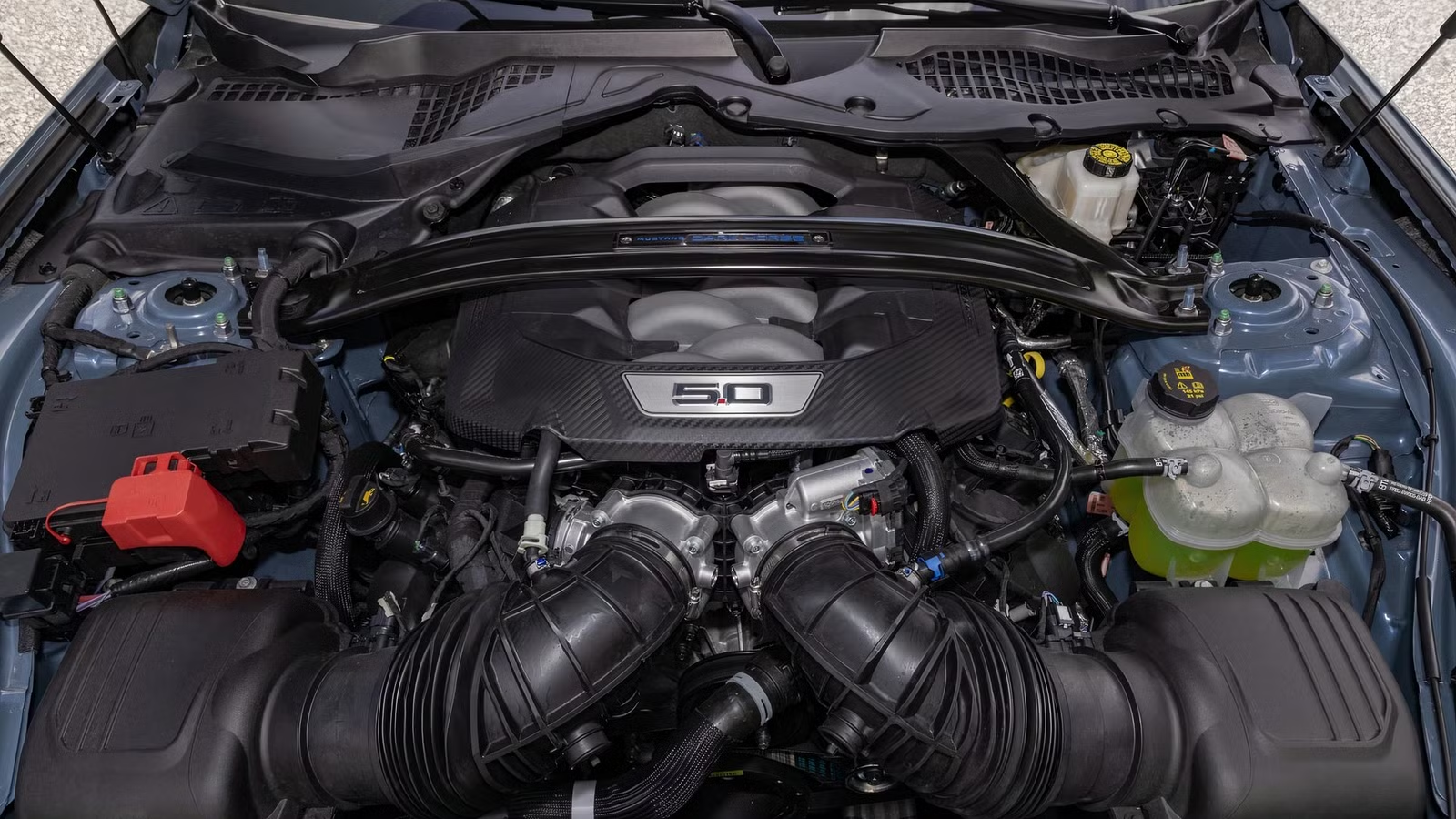
Automakers love turning engine names into brands, but that branding can create a misleading expectation. If two vehicles have the same engine, they should deliver roughly the same experience, right? The 2026 Ford Mustang GT and Ford F-150 prove otherwise. Both are available with Ford’s 5.0-liter Coyote V8, yet one wants you to chase the tachometer while the other is built to pull a trailer. The difference starts with engine tuning, but it extends much further. Transmissions, gearing, weight, throttle mapping, tires, sound, and even seating position help determine what an engine feels like from behind the wheel.
Sharing An Engine Does Not Guarantee The Same Experience
Shared Architecture Still Leaves Plenty Of Room For Change

When Ford says the Mustang GT and F-150 use a 5.0-liter Coyote V8, that does not mean the company installs two completely identical engines in different bodies. They share a common architecture, including their displacement, aluminum construction, dual-overhead-camshaft layout, four valves per cylinder, and twin independent variable camshaft timing.
That shared foundation gives Ford a starting point. Engineers can then alter the intake, exhaust, cooling, oiling, accessories, and engine-management software around it. Camshaft timing can be adjusted to favor different portions of the power curve, while changes to airflow and exhaust restriction influence how effectively the engine breathes at high RPM.
Even packaging matters. A sports car and a full-size pickup do not provide the same space for intake runners, exhaust routing, cooling equipment, or accessory placement. The name on the engine may remain the same, but the installation does not.
Every Version Is Calibrated Around A Different Mission

The Mustang GT is expected to sound exciting, respond quickly, and continue pulling as the tachometer climbs. The F-150 must move more weight, carry a payload, pull a trailer, and remain manageable on loose or slippery surfaces. Those jobs require different priorities. Engine calibration determines ignition timing, fuel delivery, throttle response, camshaft operation, and numerous protective strategies. Ford can use those controls to emphasize high-RPM horsepower in the Mustang while giving the F-150 a predictable response and accessible torque.
That is why the specifications tell two different stories. The Mustang GT produces 480 horsepower and 415 pound-feet, while the F-150’s 5.0-liter V8 makes 400 horsepower and 410 pound-feet. The truck delivers 80 fewer horsepower but only five pound-feet less torque. That alone suggests Ford did not simply detune the Coyote across its entire operating range. It reshaped the engine around a different job.
The Mustang GT And F-150 Give Ford’s Coyote V8 Two Personalities
The Mustang’s 5.0-Liter V8 Wants You To Chase The Tachometer

The Mustang’s version of the Coyote saves much of its excitement for the upper end of the tachometer. Its standard 480 horsepower arrives at 7,150 RPM, while peak torque does not arrive until 4,900 RPM. With the available active-valve performance exhaust, output rises to 486 horsepower at 7,250 RPM and 418 pound-feet.
Those figures tell you how the engine wants to be driven. It can move the Mustang at lower speeds without difficulty, but its real character appears when you let it rev. The engine continues to build power after many truck engines would already have upshifted. That rising acceleration, combined with the increasing intake and exhaust noise, makes the Mustang’s Coyote feel energetic and theatrical.
You can pair it with a six-speed manual or a 10-speed automatic. The manual lets you decide exactly when to access the upper portion of the power curve. The automatic can reach the same area more efficiently by selecting from a set of closely spaced ratios. Either way, the Mustang encourages you to use more of the engine.
The F-150’s Coyote Concentrates Its Strength Lower In The Rev Range

The F-150’s 5.0-liter V8 produces 400 horsepower and 410 pound-feet. Peak torque arrives at 4,250 RPM, which is 650 RPM earlier than in the standard Mustang GT. Its horsepower peak also arrives considerably sooner than the Mustang’s 7,150-RPM maximum.
That does not mean the F-150 always has more torque at every low engine speed. It means its calibration and supporting hardware are designed to deliver useful power without requiring you to chase the Mustang’s upper-RPM excitement. Predictability becomes particularly important when easing away with a trailer or controlling wheelspin on an unpaved surface.
The F-150’s version must also tolerate sustained loads. A brief full-throttle run in a Mustang is different from pulling thousands of pounds up a long grade in hot weather. Cooling, engine protection, transmission behavior, and durability under load become essential parts of the truck’s personality. Ford rates a properly configured 5.0-liter F-150 to tow up to 12,800 pounds. The Mustang makes substantially more horsepower, but it was never engineered to perform that job.
Transmission And Gearing Decide How Much Power You Actually Feel
Gear Ratios Can Make The Same Output Feel Urgent Or Relaxed

An engine produces torque at the crankshaft, but the transmission and final-drive ratio determine how that torque reaches the tires. Shorter gearing provides greater torque multiplication, helping the vehicle accelerate harder at a given engine speed. Taller gearing lowers cruising RPM and can support quieter operation and better fuel economy.
The Mustang GT’s available ratios reflect its performance purpose. The automatic GT comes standard with a 3.15:1 limited-slip rear axle, while Ford offers more aggressive alternatives. Performance-oriented configurations can use a 3.55:1 ratio with the automatic or a 3.73:1 Torsen differential with the manual.
The F-150 offers different axle ratios depending on its configuration and intended capability. Truck buyers may select gearing based on towing, payload, fuel economy, or off-road use. Its larger tires also affect the overall ratio between the engine and pavement. Consequently, two engines producing similar torque can create noticeably different acceleration. The engine is only one component in the multiplication process.
Shift Programming Changes The Engine’s Personality

Both vehicles can use a 10-speed automatic, but sharing a transmission model does not guarantee identical behavior. The control software decides when to upshift, how quickly to downshift, when to lock the torque converter, and how long to hold a lower gear.
Under aggressive driving, the Mustang can keep the Coyote closer to its horsepower peak. It can downshift decisively and hold gears as the engine approaches the upper end of the tachometer. That behavior makes the V8 feel alert and eager.
The F-150 must consider additional variables, including payload, trailer weight, road grade, traction, and powertrain temperature. Tow/haul mode can delay shifts and increase engine braking, but its purpose is control rather than theater. Early upshifts can make an engine feel relaxed even when plenty of power remains available. A fast downshift can make the same engine feel dramatically stronger. What you interpret as engine response may actually be transmission behavior.
Weight, Throttle Mapping, And Traction Change The Result
The Engine Must Accelerate The Entire Vehicle

Horsepower does not move through the world without resistance. It must accelerate the vehicle’s body, passengers, fuel, cargo, wheels, tires, and drivetrain components. Ford lists the manual Mustang GT fastback at approximately 3,731 pounds. The F-150 curb weight varies considerably depending on the cab, bed, drivetrain, and equipment, but many configurations weigh well over 4,500 pounds. A four-door 4WD truck can carry a substantial weight disadvantage before anyone adds cargo or connects a trailer.
The Mustang, therefore, combines more horsepower with less mass. Using its approximate curb weight and 480-horsepower rating produces a power-to-weight figure of about 7.8 pounds per horsepower. A 5,000-pound F-150 with 400 horsepower would carry roughly 12.5 pounds per horsepower. That calculation does not predict every aspect of acceleration, but it explains why the Mustang feels much more urgent. The F-150’s engine is not merely making less peak power. It is being asked to move considerably more vehicle.

Modern accelerator pedals do not directly open the throttle with a mechanical cable. They send a request to the powertrain computer, which determines how the engine should respond. A manufacturer can make the first portion of pedal travel open the throttle more aggressively, creating an immediate sensation of power. A more progressive map makes it easier to control the vehicle smoothly. That restraint can be useful when towing, driving off-road, or trying to avoid wheelspin in a lightly loaded pickup.
Drive modes can change that relationship without adding any horsepower. Sport mode may sharpen accelerator response and encourage downshifts, while tow/haul programming focuses on load management. Traction control can also reduce throttle input or apply the brakes when the tires begin to slip.
Fuel quality, air temperature, coolant temperature, and knock detection introduce additional variables. The engine computer can adjust ignition timing or limit performance to protect the powertrain. The advertised rating remains unchanged, but the response you experience can vary with conditions.
The Mustang Feels Better For Speed, While The F-150 Feels Better Under Load
Sound, Seating Position, And Chassis Response Favor The Mustang

The Mustang does not merely accelerate faster. It is designed to make that acceleration feel more dramatic. You sit lower, closer to the road, with a better sense of speed. Its suspension limits excess body movement, its steering responds more directly, and its performance tires transmit changes in direction more quickly.
Sound reinforces the experience. The Mustang’s intake and exhaust allow more of the V8’s personality into the cabin, especially with the active-valve exhaust in its louder settings. As the engine climbs toward its horsepower peak, the increasing noise tells you that something exciting is happening.
The F-150 uses the same basic engine, with a taller body, a longer wheelbase, larger tires, and a cabin designed to remain comfortable during daily driving and long trips. Those qualities can make the powertrain feel smoother and more distant. If speed and driver involvement define “better,” the Mustang GT is the clear winner. Its version of the Coyote feels sharper because the entire car helps it.
The Better-Feeling Coyote Depends On What You Ask It To Do
The F-150 provides its own kind of satisfaction. Its controlled response, earlier torque peak, 10-speed automatic, and available 4WD make the Coyote easier to use when moving weight or managing poor traction. It may not encourage you to chase the tachometer, but that is not a failure. It is evidence that Ford calibrated the engine for the truck surrounding it.
The Mustang GT offers a more exciting experience on an empty road. The F-150 delivers a more appropriate experience when towing a trailer. Neither vehicle would improve by blindly adopting the other’s calibration.
That is the direct answer to why the same engine can feel completely different in two cars: you never experience an engine by itself. You experience its power curve through a transmission, final-drive ratio, throttle map, chassis, tires, exhaust, and thousands of pounds of vehicle. The Coyote supplies the foundation, but the Mustang GT and F-150 determine what that foundation becomes.
Sources: Ford, Car and Driver, Edmunds, MotorTrend, Kelley Blue Book

Related posts




Latest Post


No Comments