
The Motorcycle That Turns Long-Distance Riding Into The Easy Part
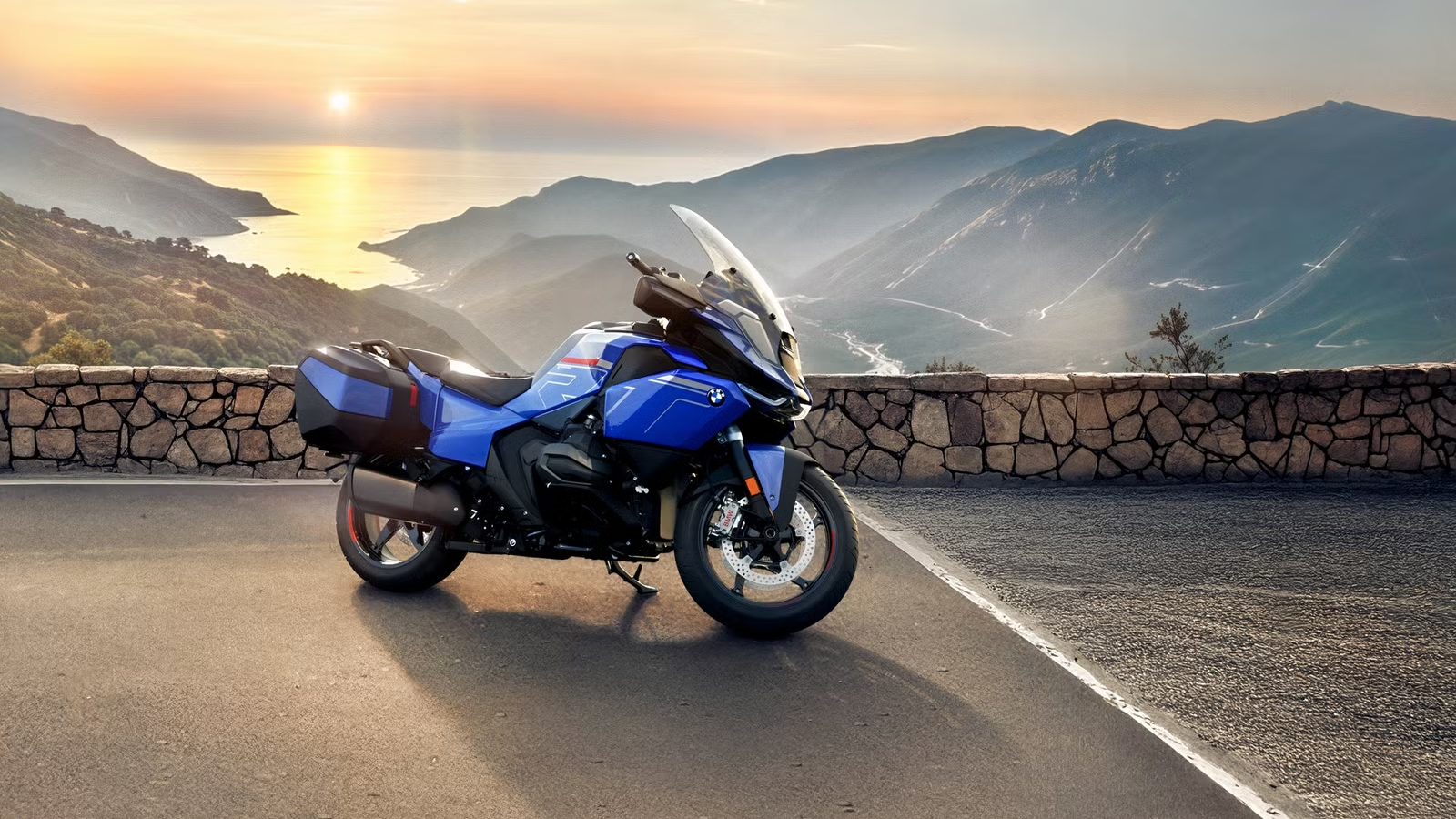
The traditional sport touring motorcycle has become an almost-extinct breed. Showroom floors and buyer attention have largely shifted toward crossovers: tall, long-travel road bikes that have pushed low-slung, dedicated haulers out of mainstream lineups. But real-world highway miles quickly expose that trend. Long-distance road riding is not merely about sitting tall with upright ergonomics; it demands clean airflow, engine tractability, and a chassis that stays dead flat. While riders default to whatever the market heavily promotes, one dedicated road platform has survived by doing the actual job far better.
Tall Wind-Catching Crossovers And Clumsy Luxury Tanks Are The Current Touring Options

The modern tarmac touring market leaves road riders caught between two types of tourers. On one side are the crossovers. They offer wide handlebars and roomy legroom, but their height and wide frontal area act like sails in turbulent highway air, creating punishing helmet buffeting and making side winds exhausting. On the other side sit traditional heavyweight luxury barges.
These motorcycles block the weather well, but they weigh well over 800 pounds, steer like freight trains at slow speeds, and wallow clumsily through mountain sweepers. Riders are left to choose between fighting wind and tall-bike top-heaviness on a crossover, or wrestling a massive anchor every time they stop for fuel.
Decoupling Suspension Stroke From Braking Loads Keeps The Chassis Flat And Predictable

Fixing this problem requires keeping the bike low to the ground and separating braking forces from suspension action. Standard telescopic forks dive hard when you grab the front brake. That compresses your available fork travel, steepens the steering angle, and makes the front end nervous and twitchy right when you need it to be dead stable.

BMW Motorrad recognized this problem decades ago and developed its own solutions to eliminate front-end dive and keep the chassis balanced. The brand established a solution that lets a full-sized tourer stay stable without beating up the rider.
The BMW R 1300 RT Is The Long-Haul Benchmark

The BMW R 1300 RT solves this touring compromise by engineering out rider fatigue entirely. Paired with its 1,300cc ShiftCam boxer engine, the new automated transmission completely removes the physical chore of clutch work and manual foot shifts in heavy traffic or sudden highway overtakes.
The bike also has electronic suspension as standard, which actively reads the road surface and adjusts damping and spring stiffness in real time to keep the chassis composed regardless of luggage or passenger loads. Combined with an electric windshield that eliminates turbulence, it is fast, comfortable, and surprisingly practical. It turns long-distance riding into the easy part of the trip.
A $22,745 Base MSRP Escalates To $30,000 With The Automated Shift Assistant

The R 1300 RT is one of the most premium sport-touring motorcycles and the only one of its kind from Europe. It has a base price of $22,745, but if you specify the automatic gearbox, you have to add at least one of the optional packages to it, and that takes the price straight to $30,000. This then makes it compete with the only other sport-touring motorcycle at this price point, but when you consider the fact that this BMW is available with an automatic gearbox, it quietly sets the benchmark.
ShiftCam Tech Delivers Instant Low-RPM Punch And 145-Horsepower Reach

This is a 1,300 cc boxer-twin engine with a DOHC head, liquid cooling, and variable valve timing on the intake valves that BMW calls ShiftCam. It runs a compression ratio of 13.3:1 and produces 145 horsepower at 7,750 RPM and 110 pound-feet of torque at 6,500 RPM. It is placed longitudinally in the chassis, which is why a shaft drive makes a lot of sense. This is a torquey engine thanks to the variable valve timing, and yet the 145 horsepower gives it a surprising turn of pace when pushed hard.
Clutchless Automation Removes Stop-And-Go Grind While Retaining Manual Shift Control

The default transmission for the R 1300 RT is a six-speed manual with an assist-and-slipper clutch; a two-way quickshifter is also on the options list. However, also on the menu is what BMW calls the Automated Shift Assistant that makes it the ultimate touring bike for real-world riding. In theory, this is an automated manual that can shift gears when left to its own devices, but in the real world, it functions as an automatic gearbox like any other.
The nice thing is that you can turn off the shift assistant and shift gears manually if you want to. The automatic gearbox elevates the touring experience, making the R 1300 RT a lot easier to ride in the city, and it eliminates the need to manually downshift for quick overtakes on the highway.
Active Ride-Height Tweaks Keep The All-New Chassis Stable

BMW put major changes into the R 1250 RT’s chassis for the R 1300 RT, making it easy to ride and trust. It now has a design that resembles a twin-spar frame and uses the engine as a stressed member; the rear subframe is bolted on. BMW chooses to use its well-known Evo Telelever and Evo Paralever suspension. This is a double-wishbone front setup with a single central shock absorber, and a link-type single shock paired with a single-sided swingarm at the rear. The suspension travel available is 5.8 inches at the front and 6.2 inches at the rear.

Dual 310 mm brake discs do duty at the front, paired with radial four-piston fixed calipers. At the rear, there is a 285 mm disc with a two-piston floating caliper. The brakes are linked, and the bike rides on 17-inch alloy wheels with radial tubeless tires. On the surface, the R 1300 RT does not offer anything special, but equip it with the Dynamic Chassis Adaptation and it gets to a different level of comfort and control.
620 Pounds That Ride Like 500, Thanks To The Low-Slung Boxer Layout

The R 1300 RT is a motorcycle that makes luxury feel practical. It is nearly 88 inches long, over 38 inches wide, and has a 59-inch wheelbase. The seat height is 32.2 inches high, the fuel tank can hold 6.3 gallons, and it weighs 620 pounds with a full tank of fuel. That might seem like a lot of weight, but it is carried down low thanks to the boxer-twin engine and gearbox. Its ergonomics are middle-of-the-road for a sport-tourer, so it can do everything from commuting to touring without putting strain on your wrists, back, and neck.
A 10.25-Inch TFT Cockpit And Radar Collision Warning Lead The Tech Suite

The R 1300 RT’s features list is an intersection of logic and luxury. It is a mile long, in keeping with its premium positioning. It has one of the biggest TFT screens in the business at 10.25 inches. Standard features include Bluetooth, navigation, keyless ignition, TPMS, heated grips, electronic suspension, cruise control, and a charging port.
The wind protection is extremely good because of the large windscreen. There are also new cylinder trim panels that protect your shoes and ankles from road spray. You can also get the optional variable slipstream deflectors, which can maximize either ventilation or weather protection. The options list has an equally long list of features: the comfort passenger package, for example, adds a more comfortable pillion seat, backrest heating, and larger footpegs.
The electronics package is truly mind-boggling. Of course, it has a by-wire throttle and a six-axis IMU. You get ride modes, lean-sensitive ABS, traction control, and engine brake control. The options list is where things get truly impressive: there is front collision warning, an adaptive headlamp, lane-change warning, adaptive cruise control, Dynamic Suspension Adjustment, and Dynamic Chassis Adaptation.
The DSA offers electronic control over damping so it is comfortable at both low and high speeds; you can also manually choose between a plush ride and one that offers a lot of feedback. The DCA, on the other hand, adjusts the ride height of the rear and therefore the suspension geometry of the front. As a result, the R 1300 RT can morph into either an ultra-stable highway touring machine or a light-on-its-feet sport-tourer that allows you to steer with less effort.
Supercharged Japanese Fury Competes With BMW’s Effortless Automated Miles

The US market has only one true rival to the BMW, and that is the Kawasaki Ninja H2 SX SE, which still makes sense in 2026. It retails for $1 less than the BMW at $29,999. It does not offer an automatic gearbox, but it does have a two-way quickshifter, electronic suspension, a supercharged engine, and things like launch control and self-healing paint. While it is a lot faster than the BMW, it is not necessarily more comfortable. However, it definitely feels like a less laid-back and more involving motorcycle than the automatic R 1300 RT.
Source: BMW USA

Related posts


Latest Post


No Comments