First Drive: The 2027 Volkswagen Atlas Is Fighting For VW’s Life
8 minutes reading
Tuesday, 6 Oct 2026 13:00 0 7 autotech
Volkswagen isn’t the cute Beetle maker of yore. At a presentation ahead of the drive of the all-new, seven-passenger, 2027 Volkswagen Atlas, VW officials touted that eight out of 10 of its sales in the U.S. are SUVs. And the new Atlas adds a lot of standard features to take on rivals like the excellent Hyundai Palisade and Kia Telluride. The starting stickers ($41,610 for the front-wheel-drive Atlas and $43,610 for AWD) are also very competitive. This is a good car that got better. The problem is that the revamped Kia and Hyundai three-row SUVs were also just completely renewed. And there’s one glaring weakness that, with escalating gas prices, will be very hard for Volkswagen to handle.
If the outgoing Atlas had sins, they were largely of omission. Meaning, the beast drove big. Volkswagen’s chief legacy has been to make cars that are properly German. Even if all Volkswagens aren’t sporty, they’ve steered and handled with a bit of verve and confidence. But the outgoing Atlas drove a bit like it had a head cold — its reflexes were there somewhere beneath the fog, but you weren’t exactly itching to find its limits.
The new Atlas once again drives like a Volkswagen. It may be made in Chattanooga, but its DNA is properly Germanic. I won’t stretch that to say it’s sporty, but on twists and turns you can get the tires howling and trust in the light-but-tight steering and just-taut-enough suspension. That’s despite growing two inches in length, and riding on a wheelbase that’s just a hair longer than the Toyota Grand Highlander’s.
A Strong Engine And Transmission
2027 Volkswagen Atlas front shot drivingVolkswagen
In addition to adding specific low-traction modes to the transmission, the better for tackling snow or dirt, Volkswagen has made its venerable two-liter engine just a hair more powerful. The EA888 now delivers 13 more horsepower (282 horsepower in total) and 258 pound-feet of torque at 1,900 RPM. The latter data is really what to focus on, because peak tug arrives quickly.
2027 VW Atlas close-up shot of the engineVolkswagen
That isn’t to say rivals don’t offer more potency. All three of Volkswagen’s comparison group deliver greater torque, and in the case of the Grand Highlander, its 310 pound-feet at just 1,700 RPM gives it a significant advantage. That said, the Atlas feels quicker than before, with snappy shifts in sport mode and enough muscle to get you where you need to go.
Roomier Than Kia And Hyundai
With all seats in place, the Volkswagen Atlas’s 21.2 cubic feet of cargo room just nips the Highlander. But there are a meaningful two cubic feet more of space in the way back vs. the rival Palisade. And when you start stowing seats, the Atlas mostly pulls ahead. With the last row folded, capacity for the Volkswagen jumps to 55.9 cubic feet, which is basically the maximum cargo volume of a Subaru Crosstrek.
Only the Grand Highlander’s 57.9 cubic feet beats the VW, and the 48.7 cubes in the Telluride and 46.3 in the Palisade significantly trail both the Volkswagen and Toyota. For families who often treat the third row as a place to squeeze a toddler while they put a car seat or two in the second row, having that added capacity really makes a difference. Also, the VW’s 95.4-cubic feet of maximum cargo capacity outstrips both of those Korean options, and only the Grand Highlander’s 97.5 cubic feet tops the Atlas.
Analog-Only Seat Folding
2027 VW Atlas rear seatingVW
All that said, Volkswagen doesn’t power the folding process for any of the rows at any price tier. Further, 37.6 inches of second-row legroom comes up way short (ahem) vs. both the Palisade and Telluride (43 inches for both) and the Toyota, with 39.5 inches. It hardly feels cramped in the second row of the Atlas — that’s just about average legroom for a mid-sized sedan — but for some duties like mounting child seats, it’s handy to have a little more elbow room.
The $41K Base Trim Comes With Features Rivals Lock Behind Premium Packages
2027 Volkswagen Atlas dashVW
Volkswagen officials touted the base SE as a value-packed base car, and they’re not wrong about that. The base car gets dual wireless phone charging up front, heated and cooled front seats, wood trim, a heated steering wheel, parking sensors, rear sunshades, seven USB-C ports, and a power liftgate. A lot of these features, such as seat cooling, wood trim, parking sensors, and rear sunshades, either aren’t available at the base price for any of the peer cars (often they’re locked into premium packages at higher tiers) or they’re not available at all. Volkswagen will have to get prospective buyers to know the value they’re offering, but it is a very strong play at the SE, intro-level price.
The One UX Mistake That Undercuts An Otherwise Strong Cabin
If there’s a pain point, it’s in Volkswagen deciding to embed too much in the central touchscreen display. Climate controls can be partially adjusted via a touch-sensitive slider at the base of that display, and there’s a handy swipe-down-from-the-top shortcut to navigate to more controls. But a lot of this system feels like it was envisioned way back when VW decided to twin all four window up/down switches in the ID.4 into two toggles, requiring the driver to first tap a REAR button to put that glass into motion. Not good.
A semi-hack arrives in the form of a rotary dial nested between the driver and front passenger seat. Rotate that (or tap the top) “Experience Dial” to change drive modes, access ambient cabin lighting, or pull up preset templates that fuse the sound system equalizer presets to the ambient lighting. Or just tap fervently on that screen to find the function you’re after. It’s not terrible, but I prefer automakers to retain physical controls.
R-Line Is Packed — But Tougher To Justify
2027 Volkswagen Atlas dashTopSpeed | Michael Frank
The top-tier Atlas SEL Premium R-Line gets an exceptional, 14-speaker Harman Kardon sound system. It’s one of the cleanest-sounding setups I’ve experienced in any car this year, and only systems in the luxury and ultra-luxury segments sound remotely as good or better.
That said, Volkswagen’s only putting this within reach of a buyer willing to spend $58,000. When the base car runs $43,135, that’s a nearly $15,000 tariff to get the SEL Premium R-Line.
Sunroof, 21-Inch Wheels, And Puddle Lights: Nice, But Worth $15,000 More?
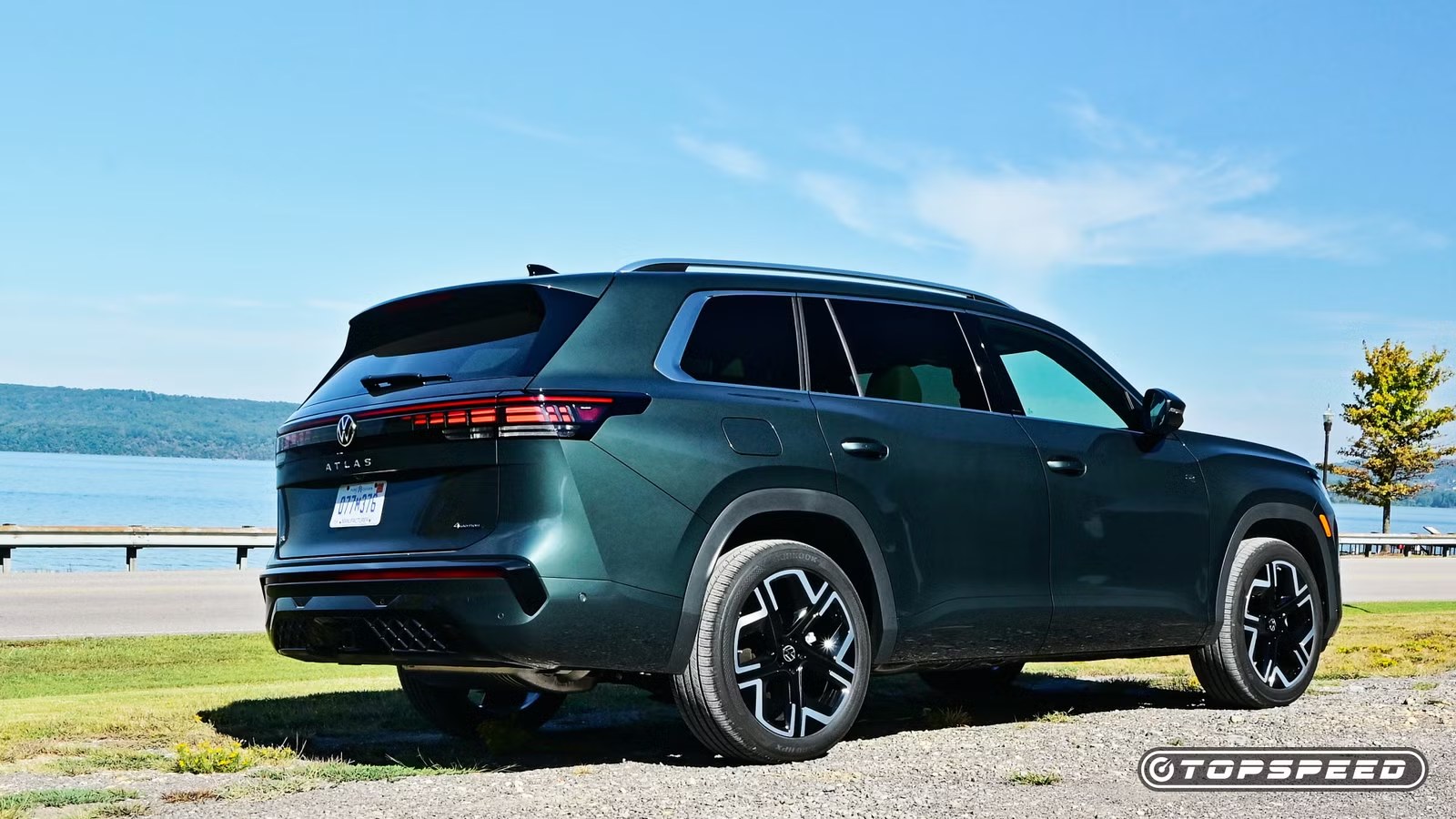
2027 Volkswagen Atlas side shotTopSpeed | Michael Frank
Sure, VW bakes in more than just a stellar sound system. The SEL R-Line includes dual-projector headlamps, a power sunroof, and 21-inch wheels. But a bunch of what comes toward the upper tier may not matter enough for buyers to suck up extra-expensive payments. Okay, 30-color-vs.-10-color ambient lighting and puddle lighting looks sweet. But the higher-grade Varenna leather seating, vs. what seems to me to be a perfectly adequate faux leather at the cheaper SE tier, is hard to justify.
TopSpeed’s Take
2027 Volkswagen Atlas front 3.4 shotTopSpeed | Michael Frank
Trust me — you’ll weep when you visit a nearby Volkswagen dealer and hear the HK sound system in the SEL Premium R-Line. But the nine-speaker system in the SE is still pretty good, and bests the standard six-speaker stock systems in rival Grand Highlander, Kia Telluride and Hyundai Palisade. And one hazard for VW is that all of those automakers charge less to make the jump to premium audio, ranging from $7,500 for the Toyota to $11,990 in the Kia. That’s still a lot, but it’s not $15,000.
The One Weakness That Could Cost VW The Three-Row Market
2027 Volkswagen Atlas side shotTopSpeed | Michael Frank
Volkswagen’s biggest hazard isn’t the value of this vehicle, which is very strong. It’s that Kia, Hyundai, and Toyota will happily sell you a hybrid version of their three-row crossover for between $46-$48,000. The payback period vs. a base Atlas (again, at $41,610-$43,610) will still be a few years, even with high gas prices. But Americans are fleeing to hybrid models just as Volkswagen’s sales tanked last year due to a lack of the right product mix. Atlas has held its own and Volkswagen leaders put a positive spin on the carmaker’s 80 percent SUV sales mix. But they’re going to need more than a very good Atlas to shore up the rest of VW’s portfolio.











No Comments