
This Driveway-Built 1967 Chevy C10 Took 5 Years, Now It Out-Powers A 2015 Camaro SS
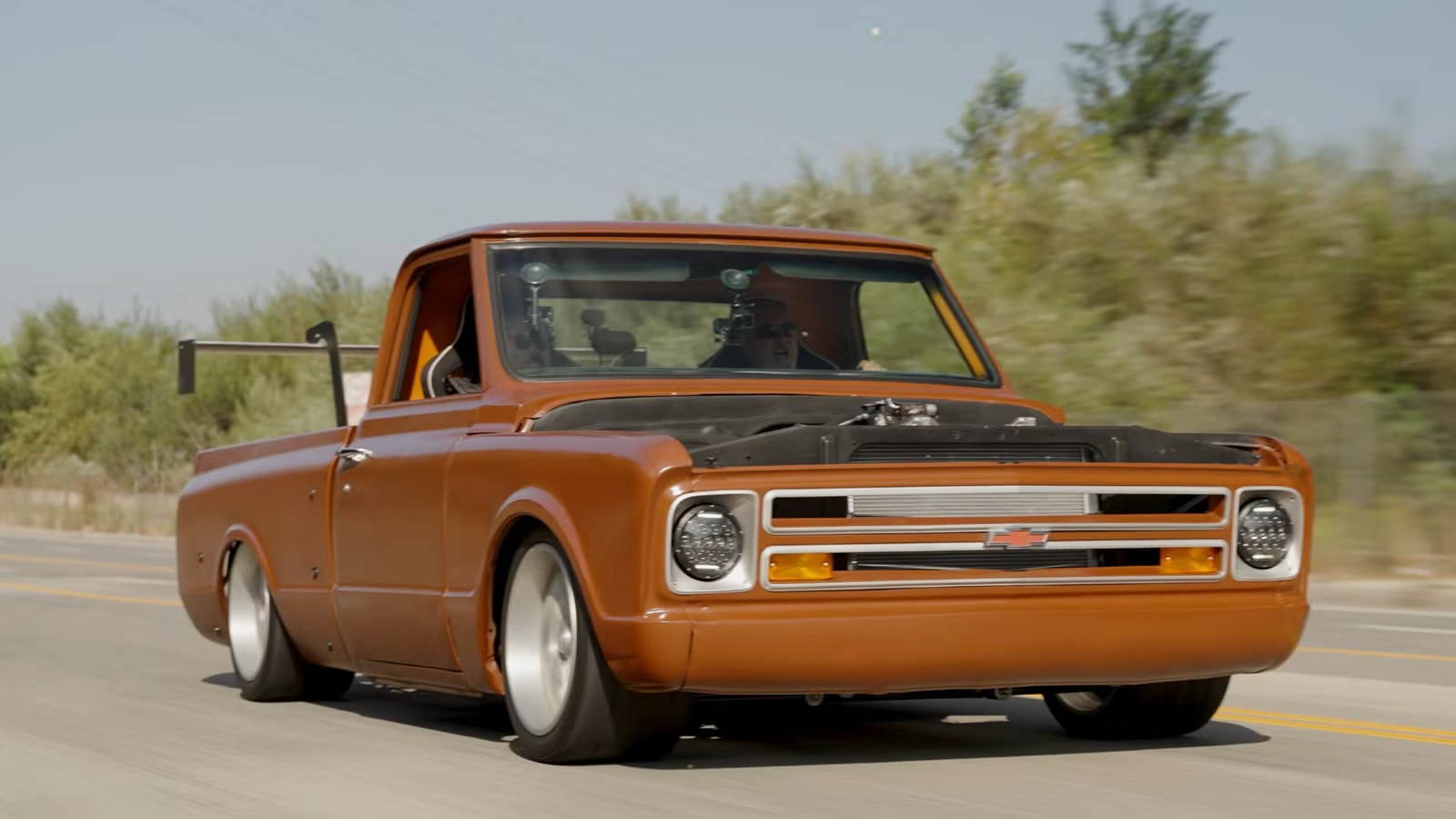
The 1967 Chevy C10 began life as a working pickup, but a good short-bed example with the optional 327 V8 now is valued at around $21,100. Its appeal comes from simple mechanicals, clean Action Line styling, and plenty of room for upgrades.

The 2015 Camaro SS sits at the other end of Chevrolet’s history, with a 426 hp V8 and the brakes and suspension to match. On paper, the two have nothing in common, but one owner spent five years in his dad’s driveway turning the old truck into the more powerful of the pair.
The 1967 Chevy C10 And 2015 Camaro SS Started Out Worlds Apart
Chevy launched the second-generation C/K, nicknamed the Action Line, for the 1967 model year, and it stayed in production through 1972. Buyers could choose from 250 and 292 inline-sixes or 283 and 327 small-block V8s, with the 327 topping the range at 220 hp. Most trucks left the factory with a three-speed manual and either the 250 six or the 283 V8.
Most 10- and 20-series trucks also used a coil-spring trailing-arm rear suspension. It rode far better than the leaf springs found on older pickups and gives builders a better starting point today.

The 2015 Camaro SS manual used a 6.2-liter LS3 V8 rated at 426 hp and 420 lb-ft, while the automatic got the 400 hp L99. That’s nearly double the output of the strongest 1967 C10, and the SS added several upgrades like sport suspension, Brembo brakes, and a limited-slip differential to handle it.
This Driveway-Built C10 Beats The Camaro SS With Its Own LS3
Austin’s 1967 C10, featured on the Autotopia LA YouTube channel, runs the LS3 V8 and TR6060 six-speed manual from a 2015 Camaro, so it beats the Camaro SS using that car’s own drivetrain. He has owned the truck for eight years and spent five of them building it in his dad’s driveway. It was his first build, and he learned most of what he needed from YouTube.

The LS3 V8 engine now wears AFR cylinder heads, a Holley Hi-Ram intake, and a long list of Holley bolt-ons. Before the heads went on, the truck made 490 hp at the wheels on a dyno, and AFR told him the new heads should add around 80 hp. Austin estimates it now puts down around 520 hp at the wheels, though he hasn’t run it back on the dyno to confirm that number.
Even the lower dyno figure beats the Camaro SS’s 426 hp, which is measured at the crank before drivetrain losses. Austin guesses the truck weighs close to 3,000 lbs, while a 2015 Camaro SS coupe weighs roughly 3,700 to 3,850 lbs, depending on its spec. He hasn’t put the C10 on a scale yet, so that figure remains an estimate.

The chassis uses a TCI front clip, and Austin boxed and reinforced the original 1967 frame with new cross members and a 4-inch C-notch at the rear. Wilwood brakes with 14-inch rotors up front and 13-inch rotors in the rear handle stopping duties through a manual setup with carbon ceramic pads. The truck sits on 18×12 US Mags billet wheels wrapped in 315-section tires at all four corners.
Why This C10 Puts Its Power Down Better Than Bigger Builds

Austin geared the C10 toward top-end power because the light truck doesn’t need much low-end grunt. That setup lets him pull away without spinning the tires or feathering the throttle. The Autotopia LA host praised how well it puts its power down, and Austin pointed out that a 900 hp car spinning its tires may only be putting down 400 to 500 hp.
He also tried several spring setups to stop the truck from oversteering in corners. It feels planted on smooth pavement, though Austin admits it gets unsettled over potholes and uneven roads. The stripped-down, open layout is there to cut weight, which suits the way he drives it.

Austin built the roll cage and interior himself, while Gabe Franco handled the exhaust and installed the Nine Lives Racing wing. The host said the truck clearly has real money in it, but not “house money.” Austin believes anyone could build something similar with enough time and dedication, and his C10, finished in a driveway rather than a professional shop, makes a strong case for that.
Source: Autotopia LA via YouTube

Related posts


Latest Post


No Comments