
The Japanese Adventure Bike With The Highest Overall Riding Range
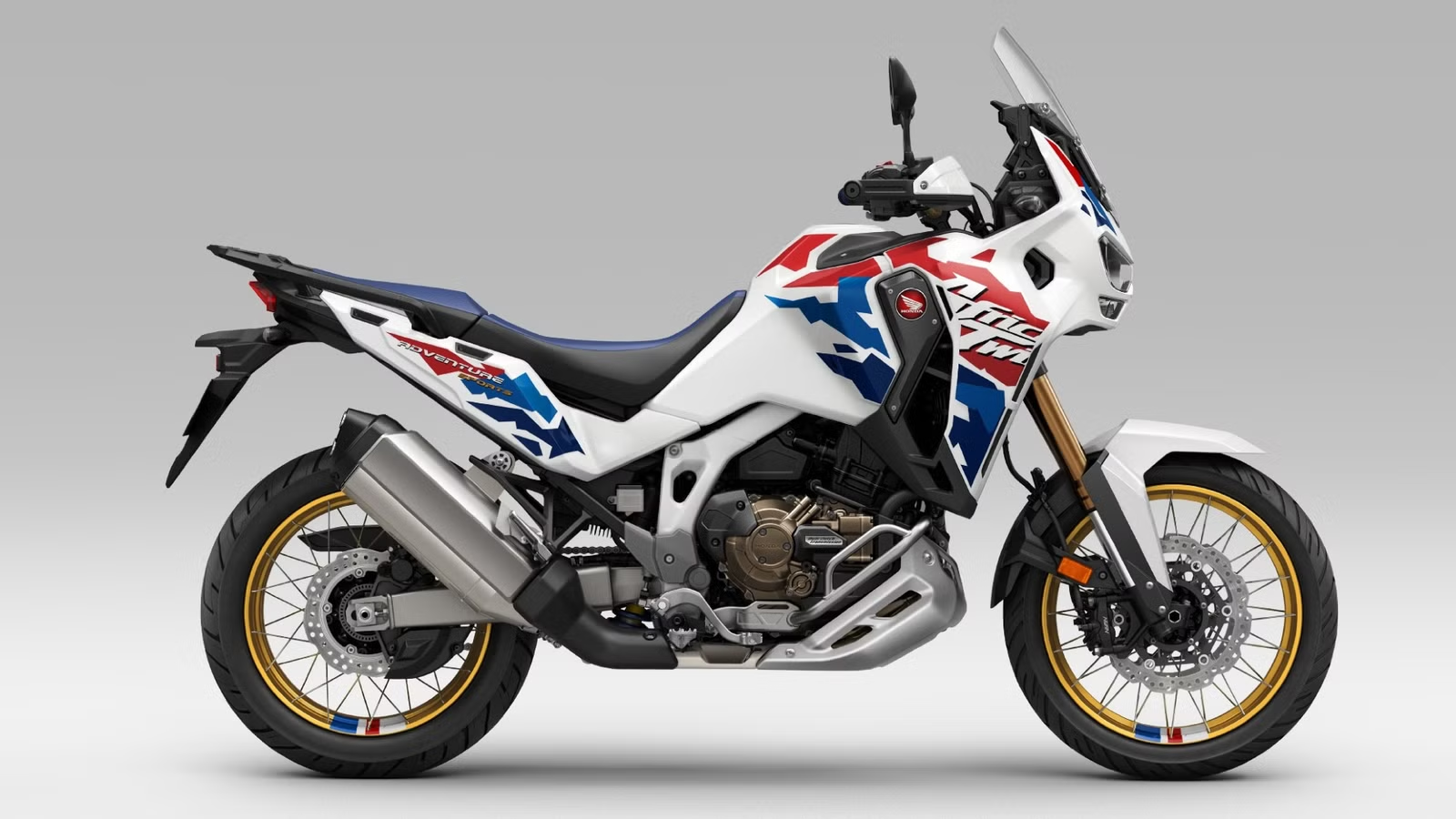
In a segment defined by headline-grabbing horsepower figures, radar cruise control, and aggressive styling wars, the Honda Africa Twin quietly does something most of its rivals can’t match: it goes further on a tank than any other Japanese adventure bike on sale. No, it won’t win a dyno shootout, and it won’t turn heads the way a Ducati DesertX does. But if your idea of adventure is measured in miles rather than megawatts, the Africa Twin — and especially the Adventure Sports variant — deserves a serious look.

Of course, it isn’t as though Honda lacks the engineering chops to fit it with variable valve timing or radar-assisted cruise control. Honda simply chooses not to overcomplicate things. The Africa Twin occupies a rare space in the industry where a flagship model also represents exceptional value for money. The Adventure Sports variant takes that philosophy further still, pairing a larger tank and impressive fuel efficiency to deliver the longest overall riding range of any Japanese adventure bike. With a more tarmac-focused character — taller windscreen, less suspension travel, and a 6.55-gallon tank — it’s built for the long haul.
The Honda Africa Twin Adventure Sports Can Travel 377 Miles On a Full Tank Of Fuel
The Africa Twin Adventure Sports is not a new variant, but it continues to be refined with each update. It features a smaller 19-inch front rim, suspension with less travel and an electronic option, a taller windscreen for highway comfort, and — crucially — a 6.55-gallon fuel tank, which is 1.55 gallons larger than the standard Africa Twin. Combined with Honda’s claimed fuel economy of 57.6 MPG, that translates to a riding range of 377 miles.

Another point worth noting is that the Africa Twin Adventure Sports is available with a six-speed dual-clutch automatic gearbox. This DCT has been in Honda’s lineup long enough to be thoroughly refined, and it doesn’t concede any ground to the manual transmission in terms of fuel efficiency. Whichever version you choose, you can expect similarly impressive fuel consumption.
Honda Africa Twin Adventure Sports Engine Specs
|
Engine Configuration |
270 degree parallel twin, Unicam SOHC, 4 valves per cylinder, liquid cooled |
|
Displacement |
1,084 cc |
|
Bore x Stroke |
92.0 x 81.5 mm |
|
Compression Ratio |
10.5:1 |
|
Power |
100.5 HP @ 7,500 RPM |
|
Torque |
82.6 LB-FT @ 5,500 RPM |
|
Fuel System |
PGM-FI electronic fuel injection |
|
Transmission |
6 speed manual/automatic DCT transmission |
|
Final Drive |
Chain drive |
How Fast Is The Africa Twin Adventure Sports?
Top Speed: 124 MPH
With the Africa Twin displacing nearly 1,100 cc, you might expect it to trade blows with the big-bore adventure bikes generating 140-plus horsepower. Honda, however, has always prioritized usable power over peak numbers — which is why it has held to its 100-horsepower figure through four major updates since the nameplate was revived in 2015. The most recent update did bring a meaningful improvement: peak torque now arrives 750 RPM earlier, broadening the powerband for real-world riding.
The top speed remains capped at 124 MPH. That might sound modest, but reframing the Africa Twin as a value-oriented large-displacement bike — rather than a direct rival to the most powerful ADVs — puts things in perspective. It punches well above its weight when you factor in the available automatic transmission and the overall package price.
Think of it like the old saying about a Toyota being the one vehicle that always gets you home. The Africa Twin’s unstressed engine and accessible real-world performance are about how far you can go, not how fast. That ethos makes up for the lack of headline figures — unless top-speed runs are on your itinerary, in which case you’ll need to look elsewhere, and spend considerably more to get there.
Here’s What Makes This Japanese Adventure Bike Suited For Long Rides
Focus On Tarmac Touring For The Adventure Sports

When Honda split the Africa Twin into two distinct variants, the Adventure Sports was conceived as the mile-muncher, while the base Africa Twin leans toward off-road capability. For the purposes of this article, we’re focusing on the Adventure Sports. Its smaller 19-inch front rim with a wider tire improves confidence and cornering feel on pavement, and the reduced suspension travel — whether you opt for conventional or electronically adjustable damping — suits a more road-biased riding style.
The seat carries more padding to match the larger tank, since Honda expects Adventure Sports riders to spend longer stretches in the saddle between stops. The Showa electronic suspension is a particular highlight for long-distance touring: it reads changing road conditions and adjusts automatically, taking one more variable out of the rider’s hands. It is now available as an option on both versions of the Africa Twin.

The DCT automatic gearbox is another option worth highlighting. Honda remains the only manufacturer to offer a true dual-clutch automatic on a motorcycle — everyone else uses an automated manual transmission. The Africa Twin’s six-speed DCT has been progressively refined over the years. It now includes a mode that allows the clutch to slip more for low-speed maneuvers, while the standard mode firms up clutch engagement so you can break the rear loose on dirt under power.
A foot-operated lever is available as an option for DCT-equipped bikes, making manual gear changes feel more intuitive, while a quickshifter is on the options list for the manual gearbox. Cruise control comes standard on every Africa Twin, regardless of variant. For the hardware specifications below, we are referencing the top-spec Africa Twin Adventure Sports ES with electronically adjustable suspension.
Honda Africa Twin Adventure Sports ES Hardware Specs
|
Front Suspension |
Showa 45 mm inverted forks, 8.3 inches travel, electronic control and adjustability |
|
Rear Suspension |
Showa Pro-link monoshock, electronically adjustable, 7.9 inches travel |
|
Front Tire And Wheel |
110/80 R19 M/C |
|
Rear Tire And Wheel |
150/70 R18 M/C |
|
Front Brakes |
Two 310 mm wave discs, four-piston radially mounted fixed caliper |
|
Rear Brakes |
256 mm disc with two-piston floating caliper |
|
Curb Weight |
535.7 LBs manual/557.8 LBs DCT |
|
Tank Capacity |
6.5 Gallons |
An Understated Look For Its Understated Performance
The Africa Twin Chooses To Fly Under The Radar, But Has A Distinctive Look

The Africa Twin shares something with the Ducati DesertX: both draw design inspiration from iconic Dakar Rally machines. Honda’s reference point is the XRV750 Africa Twin, and the modern bike updates those classic design cues for contemporary tastes. The most recent styling revision sharpened the overall look considerably, with the base Africa Twin in particular gaining a noticeably more aggressive presence. The Adventure Sports retains those distinctive gold spoke rims, though in the US market it is offered only in Pearl White.
The standard Africa Twin, by contrast, is available only in black for the US market. Honda has also tied the electronic suspension exclusively to the Adventure Sports trim here — you cannot mix and match. In other markets, both models are available with electronic suspension, and a striking red color scheme that Honda has chosen not to bring stateside. The auxiliary lamps mounted below the main headlight are cornering lights, a feature introduced with the latest update.

Honda also persists with its unique two-part instrument cluster, which looks unusual at first glance but is genuinely practical. A TFT color screen sits on top, with a conventional LCD screen below. Should the color display fail, the LCD provides enough essential information to keep riding comfortably — no trip needs to be cut short for a screen repair. One other detail worth noting is the uncommon 19/18-inch wheel diameter combination, a pairing you’ll rarely encounter on any other motorcycle.
Notable Design Features
- Understated look
- Design reminiscent of old Honda XRV750 Africa Twin
- Adjustable seat height with optional low seat
- Color display has both Android Auto and Apple CarPlay
Honda Africa Twin Adventure Sports Dimensions
|
Length |
90.7 inches |
|
Wheelbase |
61.8 inches |
|
Rake |
27.5 degrees |
|
Trail |
4.2 inches |
|
Seat Height |
32.9 – 33.7 inches |
|
Ground Clearance |
8.7 inches |
Top Japanese Adventure Motorcycles With The Highest Overall Riding Range
The Honda Has Competition, From Hondas, Mostly
European adventure bikes like BMW’s R 1300 GS Adventure carry enormous fuel tanks, so even with higher power outputs and worse fuel economy, they can match or exceed the Africa Twin’s range. Japan, however, doesn’t have a direct answer to the Adventure Sports’ combination of tank size and efficiency. Suzuki’s V-Strom 1050 DE is long in the tooth, the Kawasaki Versys 1100 and Yamaha Tracer 9 are naturally thirsty given their multi-cylinder layouts, and smaller Japanese ADVs like the V-Strom 650 carry much smaller tanks. At the other end of the scale, truly compact ADVs like the Versys-X 300 and Honda CRF300L Rally post impressive MPG figures but are held back by their small tanks — and realistically, few riders will push a 300 cc engine to its full range in a single sitting.
That leaves a handful of surprising contenders, including one of Honda’s own adventure bikes.

First, the Kawasaki Versys 650 is far from the most efficient option here at 45 MPG, but its surprisingly large 5.5-gallon tank delivers a range of around 247 miles. The Honda NC750X DCT is another strong contender: despite being an automatic, it returns 67.2 MPG and pairs that with a 3.7-gallon tank for a range of approximately 248 miles. The closest rival to the Africa Twin Adventure Sports, however, is another Honda — the NX500, whose 60 MPG and 4.6-gallon tank combine for a range of around 276 miles.
Sources: Honda Powersports

Related posts


Latest Post


No Comments