
The Parallel-Twin Cruiser That Makes Long Highway Days Surprisingly Comfortable
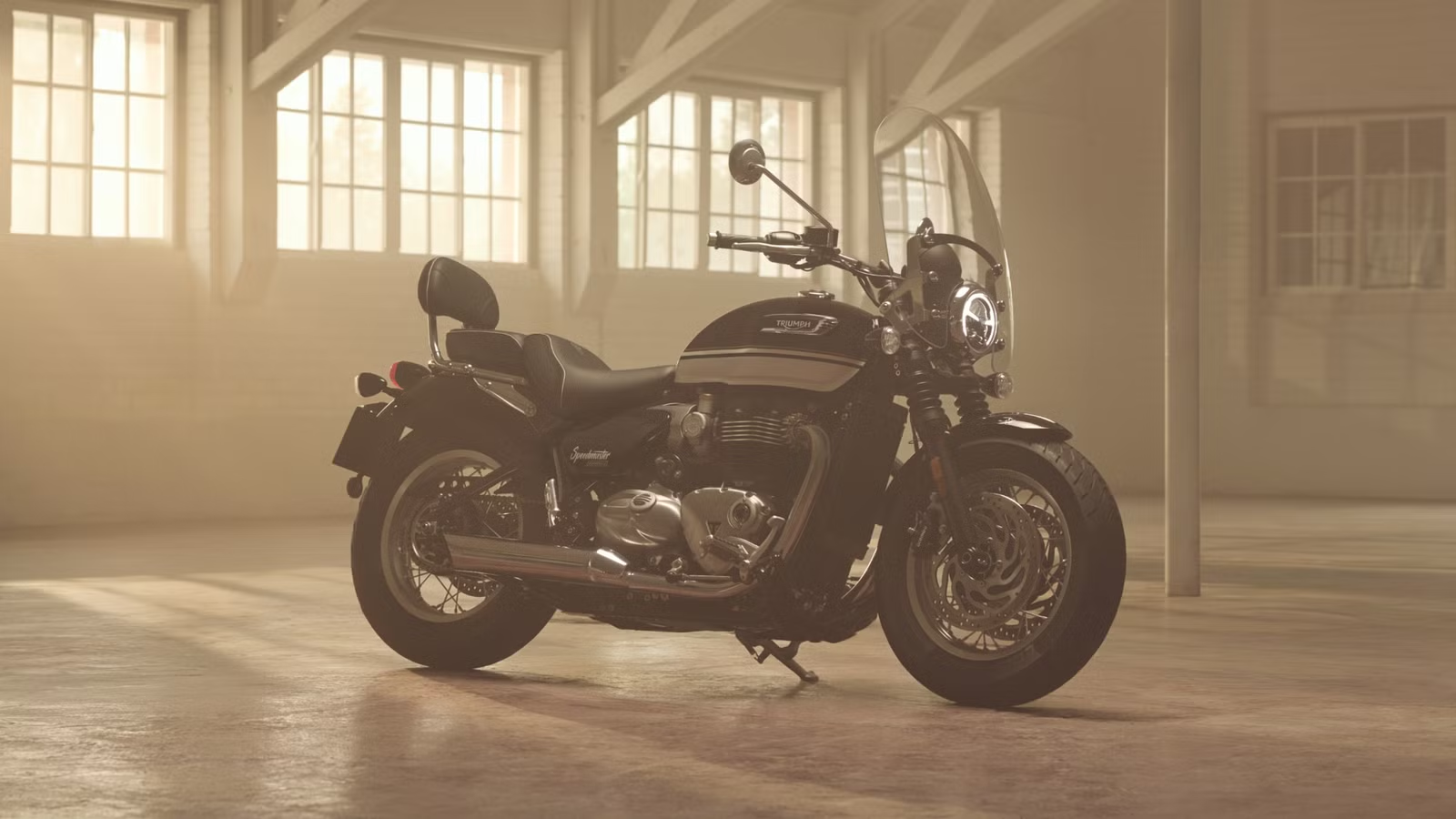
The cruiser motorcycle dream has always been about the open road. People getting into the segment assume that if you want all the highway comfort, you need a massive touring rig with giant fairings and all the features possible. They don’t look at smaller cruisers because a trade-off in ride quality or ergonomics is expected. However, when you do find a cruiser with a smaller engine that nevertheless feels genuinely great over hundreds of miles, it is such a pleasant surprise. There is one particular motorcycle that quietly offers an unexpectedly easy, fatigue-free experience for long hours on the highway.
Most Manufacturers Relegate Parallel Twins To Lightweight Budget Commuters

Highway cruisers are synonymous with big V-twin engines. Today’s V-twins are exceptionally refined; they offer smooth low-end torque, they’re great out on the highway, and their distinct exhaust note has defined cruiser motorcycles for over a century. There simply isn’t room for other formats like parallel twins. Most motorcycle manufacturers reserve the latter format for styles of motorcycle that are more cost-conscious or have more stringent packaging requirements. That makes finding a proper highway-capable parallel-twin cruiser surprisingly difficult. There are very few choices if you prefer the parallel-twin format.
Deceptive Roadster Proportions Conceal Genuine Cross-Country Ergonomics

The motorcycle in question is extremely interesting because it doesn’t look like a traditional stretched-out cruiser. It instead has the proportions, stance, and lines of a classic roadster. The way it looks will make you think it belongs on a city street or at the local coffee shop on Sunday morning rather than out on the highway. However, its styling is deceptive. Ride it on the highway, and it’ll turn out to be significantly more comfortable than many cruisers that claim to be good highway motorcycles. The ergonomics are relaxed and natural, the suspension absorbs imperfections well, and the engine has the poke to make a day in the saddle enjoyable.
Hinckley Bridges Custom Heritage And Interstate Endurance With The Speedmaster


That motorcycle is the Triumph Bonneville Speedmaster. It utilizes the timeless styling of the Bonneville family to great effect, and it pairs it with genuine long-distance capability. It is powered by a gem of an engine: Triumph’s 1,200 cc high-torque parallel twin, which offers effortless passing power and low-rev cruising. In 2026, it got a significant update, which made it a much better product overall. This is a classic British machine that looks like a custom roadster but delivers the kind of comfort that makes long highway days surprisingly enjoyable.
A Premium Price Tag Reflects Under-The-Skin Electronic Upgrades

For 2026, Triumph gave the Bonneville Speedmaster a significant update. It includes a six-axis IMU, a larger fuel tank, lighter aluminum wheels, a wider and therefore more comfortable seat, and the Euro 5 Plus engine tune. It has left the looks largely alone, which is a good thing; they are timeless. The Speedmaster was always the British motorcycle that owners rarely sell, but the fact that Triumph improved it anyway is very encouraging.
A 270-Degree Firing Order And Wide Powerband Eliminate Constant Gearshifts

The Speedmaster has the same engine as the Bonneville T120 but in a slightly different state of tune. This is a 270-degree parallel-twin engine with an SOHC head, four valves per cylinder, and liquid cooling, despite what looks like air-cooling fins on the cylinders. It displaces 1,200 cc, has a 10:1 compression ratio, and generates 77 horsepower at 6,000 RPM and 78.2 pound-feet of torque at 3,750 RPM.
Triumph has mated this with a six-speed gearbox with an assist-and-slip clutch and chain final drive. The engine is a large part of what makes the Speedmaster make long highway days feel short. The torque peak and power peak are separated by a full 2,250 RPM, which means you don’t have to shift gears very often. A twist of the wrist is all you need for overtaking or to pick up the pace. Also, its large displacement and high torque mean that it lopes along at relatively low revs on the highway.
Lighter Aluminum Spoke Rims Sharpen Ride Quality While Retaining Inner Tubes

The Bonneville Speedmaster shares its chassis with the Bonneville Bobber, and adds a subframe that can hold a pillion seat. This is a steel double-cradle frame and looks like a hardtail, but it has quality suspension at both ends that turn every evening ride into therapy. At the front, there are 47 mm Showa cartridge forks, and a linked monoshock with preload adjustment is hidden under the seat. The front brakes are provided by Brembo; there are twin 310 mm discs at the front with two-piston floating calipers and a single 255 mm disc with a Nissin single-piston caliper.

Visually, there is no difference in the wire-spoke rims on the 2026 Bonneville Speedmaster, but they have moved from steel to aluminum. This has made them significantly lighter, thus improving both ride and handling. One thing that hasn’t changed is the fact that they still need to use tubes with their tires. It was the correct decision to keep the looks the same while making improvements where it counted, although as a surprisingly good highway cruiser, tubeless rims would have made life on a Speedmaster infinitely better.
Subtle Ergonomic Widening Eliminates Long-Distance Pressure Points
The Speedmaster’s size hasn’t changed after the 2026 update. It still is 87.6 inches long, 35.5 inches wide, and has a 58.5-inch wheelbase. The seat height is still extremely low at 27.5 inches, and Triumph has made it a little wider for 2026. This change has been made for the pillion seat as well, and it genuinely helps increase comfort substantially for both rider and passenger—this is the perfect cruiser for couples.
Another small change that helps considerably is the increase in fuel tank size to 3.7 gallons, an increase of 0.4 gallons. The wet weight has gone up to 584.2 pounds. This is a small increase of just over four pounds, but that can be put down to the extra fuel and the added electronics. The weight is carried centrally and low, so the Speedmaster balances beautifully even in a parking lot.
Analog Gauge Simplicity Masks Cornering-Enabled Safety And Factory Cruise Control

The Speedmaster is a contradiction to the saying “beauty is only skin deep,” because under that attractive retro exterior lies a thoroughly modern motorcycle. Even in its features, Triumph has intentionally held back, giving it a retro single-pod analog speedometer with an LCD screen at the bottom that helps make every ride feel timeless. The screen provides a lot of information, including fuel level, odometer, and trip meters. Both seats have been widened this year for additional comfort, and the handlebars have also changed, which makes the rider triangle that much more comfortable.

The technology packed into it is thoroughly modern. With the by-wire throttle and six-axis IMU, it offers two ride modes, switchable traction control, ABS, and cruise control, with cornering functions for the traction control and ABS. You wouldn’t know it just by looking at it, though, because Triumph has been careful to dress it up as an old-fashioned motorcycle, complete with functional cooling fins, fake carburetor covers, and a radiator integrated into the design so seamlessly you won’t even notice it. Triumph offers 100 accessories at the dealer level, although it is available in only two colors.
The Honda Rebel 1100 And Kawasaki Vulcan S Challenge The Speedmaster’s Surprising Highway Comfort

The Bonneville Speedmaster’s natural enemies are American iron like the Harley-Davidson Super Glide and the Indian Chief, but since we are looking at parallel-twin cruisers that are surprisingly good at highway running, it leaves us with few options. The first of our options is not really that surprising if we’re honest with ourselves.
The Honda Rebel 1100 is the kind of cruiser that appeals to everyone from a beginner to a veteran rider, and delivers big-bike energy without the big-bike stress. It helps that it’s priced extremely reasonably at $9,699 for the manual and $10,399 for the six-speed DCT automatic. With its large-displacement engine and easygoing, torque-rich powerband, coupled with a five-inch TFT display featuring Bluetooth and navigation, it can be a very good highway companion.

The second parallel-twin cruiser is more of a surprise as a good highway companion; that is the $8,149 Kawasaki Vulcan S ABS. The Japanese mid-size cruiser rivals the Rebel 1100 at a lower price. It utilizes Kawasaki’s 649 cc parallel-twin engine, but unlike the 270-degree Rebel 1100, this is a 180-degree parallel twin, and it has an appetite for revs and corners unlike a lot of other cruisers. Still, if you can tolerate the slightly busy nature on the highway, it’s an extremely good companion, although all you have for safety is dual-channel ABS, and there is no TFT instrument cluster.
Source: Triumph Motorcycles USA

Related posts


Latest Post


No Comments