
Which £20k supermini is best? Corsa vs Ibiza vs Swift
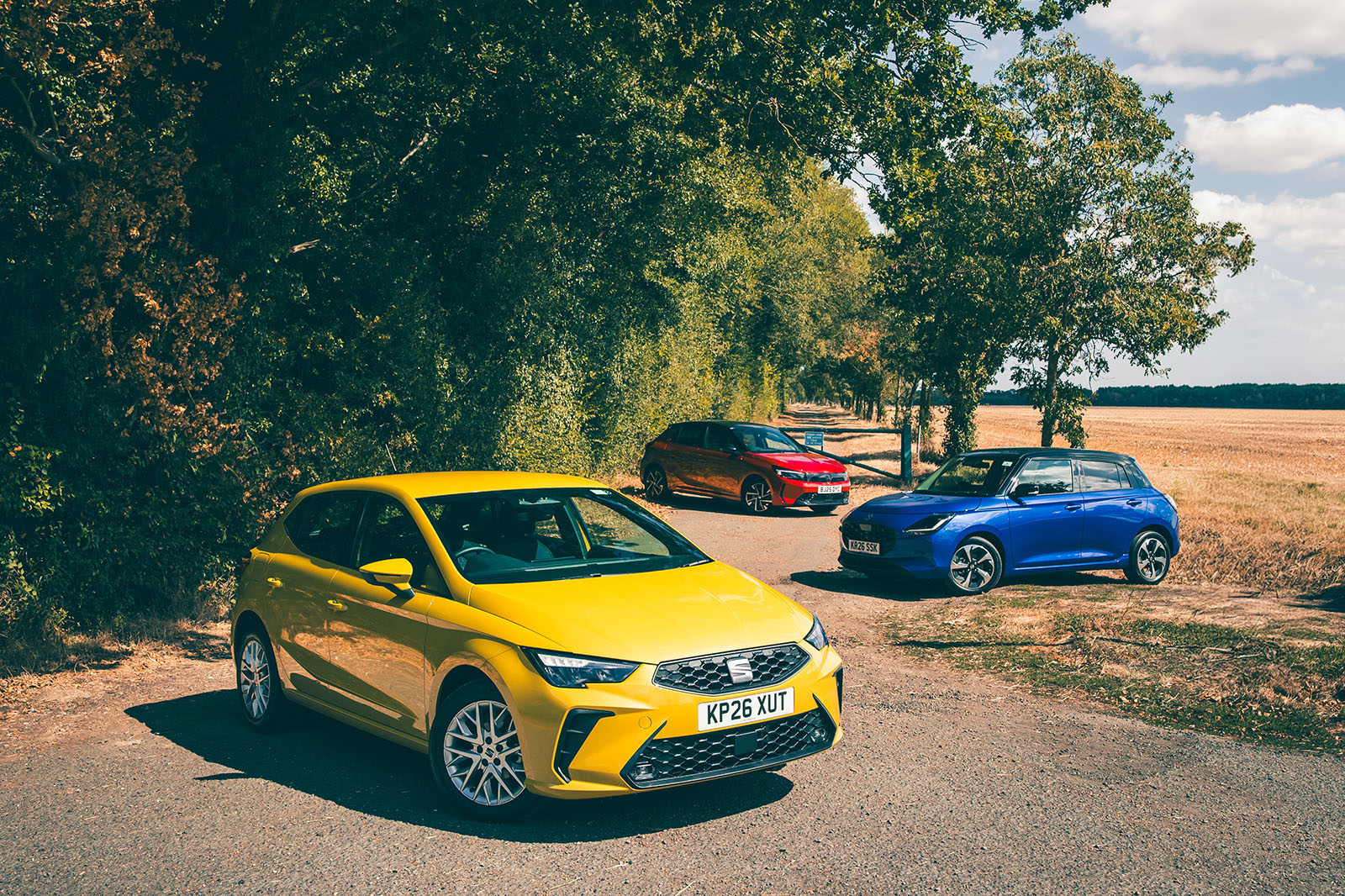
Few cars are cheerily coloured, cheaply priced or carefree any more. Here are three wonderful three-pedal exceptions
Primary colours feel apt for these cars: three 20-odd-grand, pure-of-heart, petrol manual superminis whose badges are a through-line right back to the ’90s heyday of affordable metal. Back when grey wasn’t the default choice. I’ve been looking forward to this one with a fervour usually reserved for a gathering of supercars.

Rewind two decades and my excitement would have seemed sarcastic at best, but it’s bred largely by the increasing scarcity of cars like these.
Each year more driving tests are taken for a pure automatic licence (the figure is 26% at present), perhaps partially explaining the rate at which manual options have tumbled out of showroom brochures. But this funky-looking, smartly priced little trio is proudly keeping a very modest dream alive, and at a time when EVs are beginning to virtually mimic their interaction as a selling point.
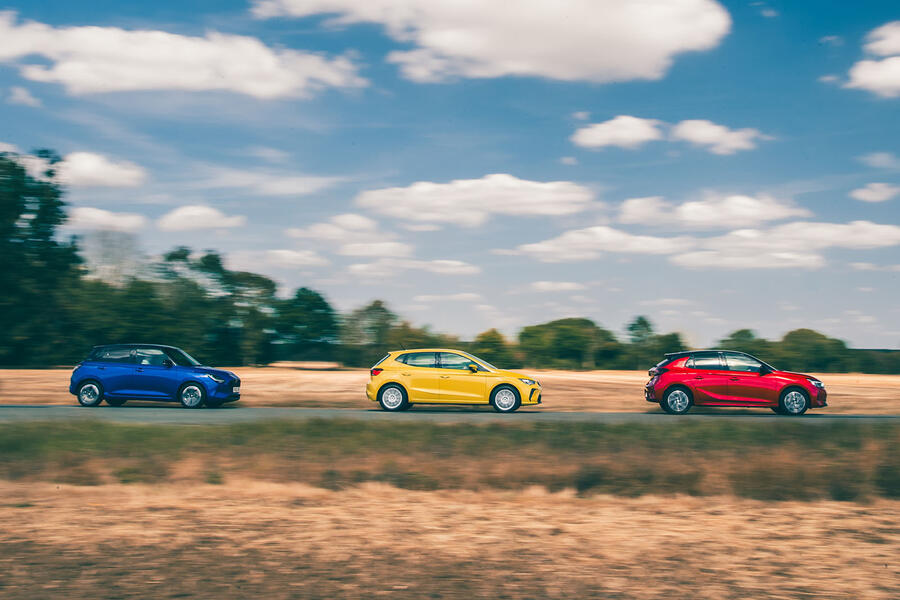

It’s the Seat Ibiza that sparked the idea for this little confab, thanks to its recent second facelift, undergone in an attempt to blip back onto buyers’ radars. Yet time moves fast: since photographer Jack packed away his camera gear and I drove home to type these words, the Volkswagen Group’s ‘Future Plan 2030’ appears to have rung the death knell for the Seat brand. Don’t tell this perky little Ibiza, though.
Dressed in Hypnotic Yellow, it looks every bit as fab as it did upon launch back in 2017, with its reshaped front grille, slimmed-down headlights and bold hue doing much to make it feel genuinely fresh. Let’s not kill its vibe.
There’s still a decent gaggle of cars to choose from in assembling rivals. The £20,590 Vauxhall Corsa is here not only for its infectiously optimistic Yes entry trim, but also because it’s a mainstay in the UK’s top 10 best-sellers, refusing to be bullied by the bunch of burly SUVs around it. It’s the most powerful here, tying a 99bhp 1.2-litre three-cylinder turbo engine to the only six-speed gearbox of our group for 0-62mph in 11.2sec.
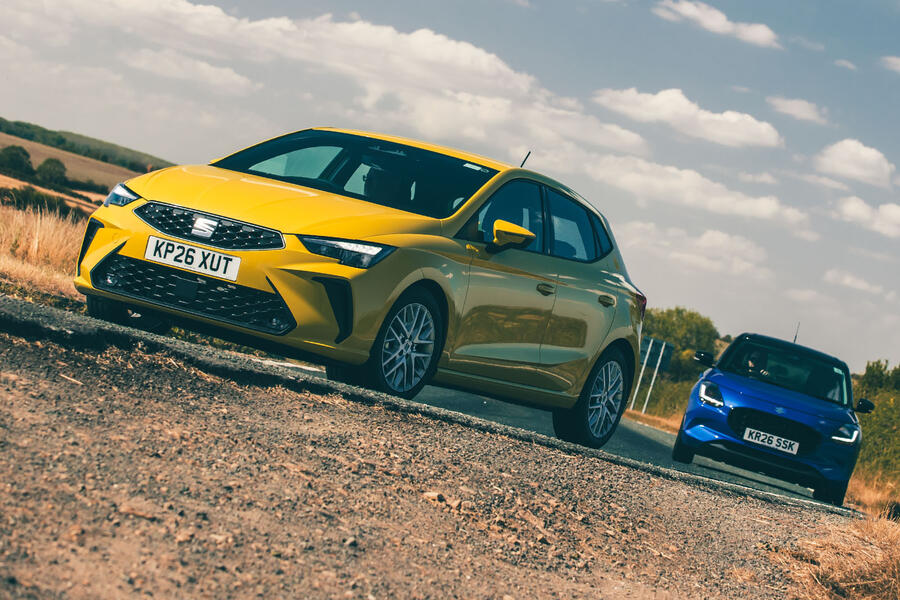
The Ibiza compares well beside it, starting at £21,610 in SE trim (although we have the better-equipped SE Technology here) and latching a 94bhp 1.0-litre turbo triple to a five-speeder for a slightly more rapid 11.0sec claim.
The Suzuki Swift is a firm Autocar favourite and the cheapest here, starting at £16,499 (or £17,599 in this fancier Ultra spec). It mates an 81bhp 1.2-litre three-cylinder engine with mild-hybrid assistance to a five-speed ‘box for 0-62mph in 12.5sec. Most crucially of all, it’s the lightest of our trio, weighing just 945kg.
Let’s start in yellow. It was a five-speed manual Ibiza – the pretty, Giugiaro-penned Mk2 – on which spent quite a large chunk of my student loan as a teenage runaround. While there’s now another 30-odd horsepower and a lot more finesse, it’s a real nostalgia trip to be hustling this Mk5 along.
Its engine and transmission aren’t an instantly effervescent pairing and its gears are long, but the total control you’re given over its trajectory ensures you barrel into corners with more speed and a bigger smile than any automatic Ibiza can elicit. It’s good, clean fun.
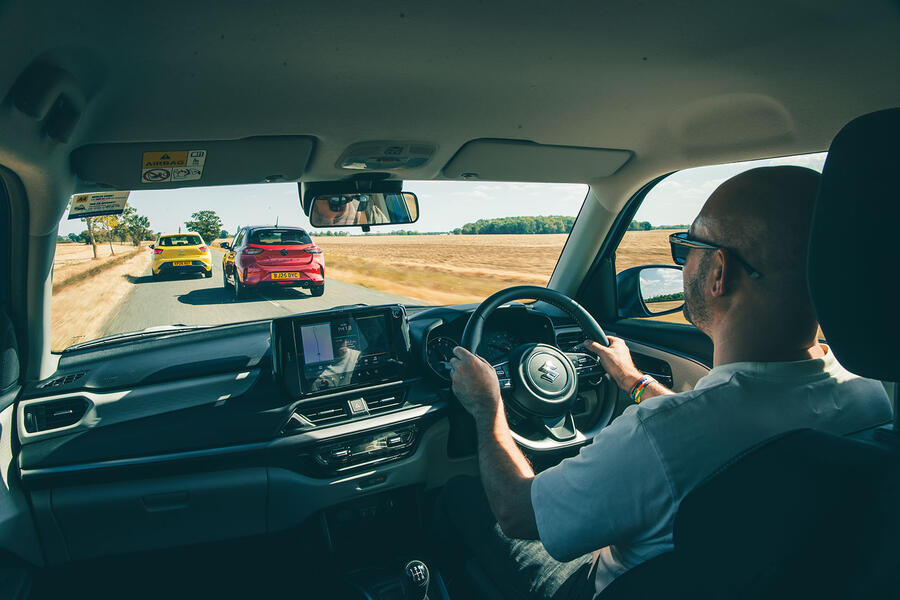
The gearknob has a traditional round top with a pleasantly rubberised lip and is neat to hold. The shift has a pleasing weight and resistance, although it’s very unlikely you’ll shuffle it around for the sheer heck of it, because you’ll probably banish yourself from its torque band in doing so. It has a light, friendly clutch and a brake pedal more intuitive than that of its DSG equivalent.
Its handling is very neatly balanced, if a little prescriptive, and its ride can get a little crashy with sustained speed on especially bumpy roads.
I do keep attempting to grab sixth gear, though, and anyone genuinely buying into this car for driving thrills would do well to eke out more budget for the £25k, 114bhp Ibiza FR with its extra ratio (and performance). If only Cupra still worked its magic on superminis…
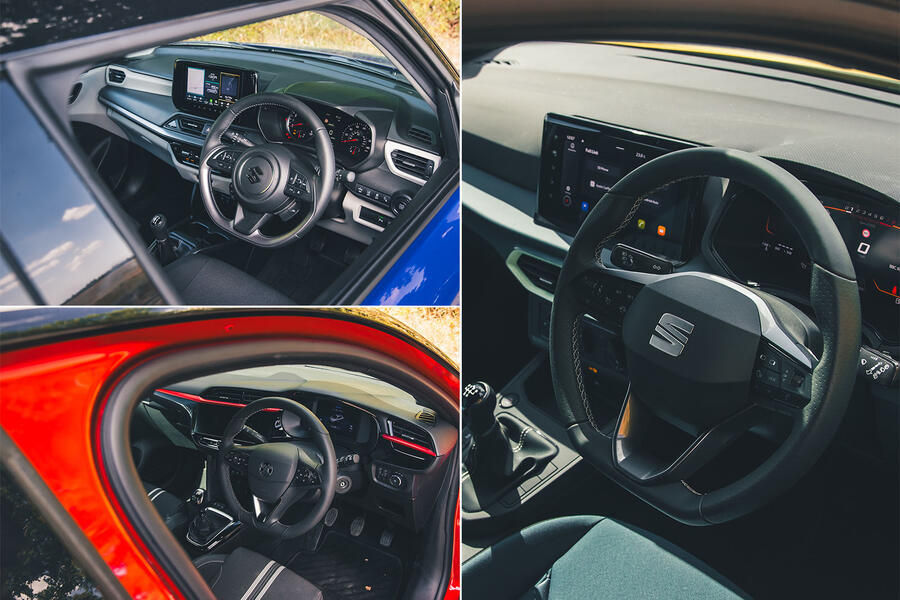
As for the rest of the car? There’s reasonable room in the back, even if the cabin feels dim in lieu of its rivals’ contrasting coloured accents. At least its mixture of soft-touch materials and harder-wearing door bins feels keenly judged for its asking price. I like its angular door mirrors, too, which trickle down a taste of premium design from a class or two above.
As does the Ibiza’s refinement. It can amble along below 3000rpm on a motorway, feeling thoroughly fuss-free to use. Its digital instruments are bigger and bolder than the Corsa’s, while the central touchscreen is right-sized, is well placed and allows you to disable the ADAS bongs easily – not that they are overly irritating if left on. You get physical air-con dials and this sub-FR trim doesn’t distract you with drive mode options. Simplicity is a virtue in here.
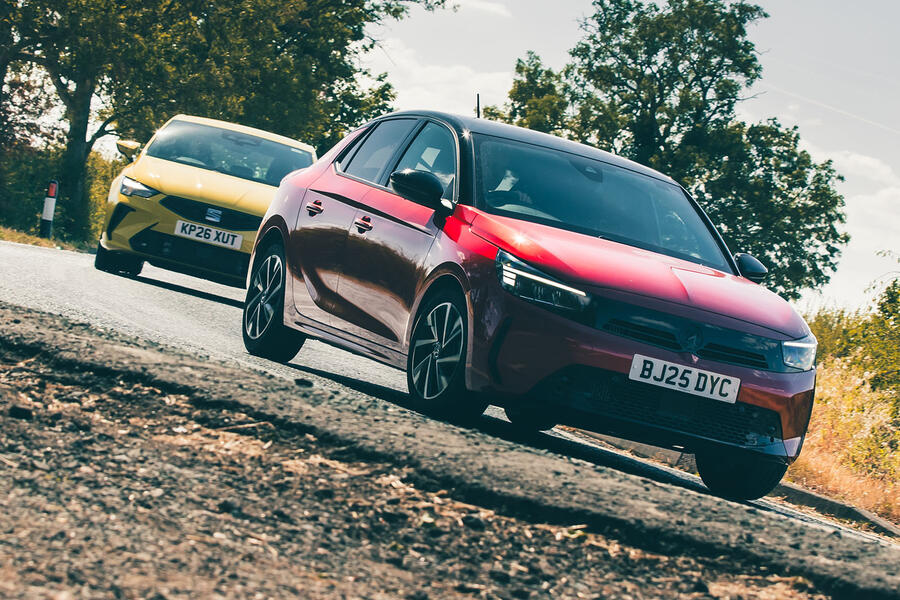
The Corsa is a step up in terms of equipment. It squeezes a heated wheel and seats into its 20-grand price tag and feels surprisingly classy, too, with piano black trim and vibrant striping across the cabin. Even the instruction manual is housed in a twee cloth wallet. For one of the cheapest and most ubiquitous cars on sale in the UK, it doesn’t come across as proletarian. Its material choices all feel considered.
Launched in 2019 and having received a sole facelift since, the Corsa now inevitably feels its age, but nowadays that’s often a blessing at least as much as a curse. Like in the other two cars here, it gives you physical climate controls and buttons on the steering wheel- not to mention a good old mechanical handbrake.
The steering itself feels loose and baggy after the tauter Ibiza (although you can stiffen it up via a Sport button) and the Corsa demonstrates a softer, less precise swagger down the road – soft enough that taking your left hand from the wheel to shift gear requires a more determined grip with your right. This is a car that can lollop around without full focus. It rides amiably and demonstrates an uplift in performance after the Seat, despite their similar on-paper stats. This will be a nicer motorway hack, its sixth gear and lower cruising revs helping no end.
The shape of its gearknob is undeniably more curious, however, and not especially natural in fun, fast driving, plus it moves more loosely. But the Corsa still possesses all the hallmarks of our earliest days of driving, audibly squealing from its front axle out of junctions and its rear as you tip it committedly into bends. It reacts keenly to a trailed brake, its less precise chassis easier to manipulate once you’re more keyed into its behaviour. It’s more on its tiptoes after the Ibiza.
More sensible stuff? Its front seats hold you well, but its rear quarters are oddly cramped. The Corsa is the only car here with an electric twin, not to mention a super-spicy variant – the 277bhp GSE elevating this chassis to new heights. Overall it makes a decent fist of being a likeable, easy car to rub along with for not much money. It’s typically Vauxhall in being most things to most people-and somewhat inevitably lacks that vital ‘want’ factor as a result.
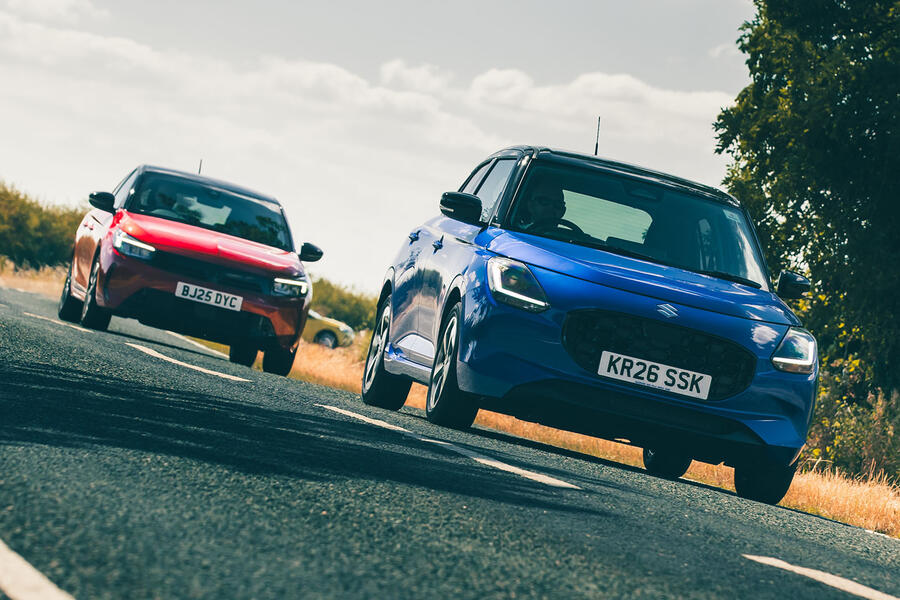
Jack ran a heavier, more potent Corsa Hybrid as a long-term test car and craved the simpler, lighter variant we have here. Yet he also ran this latest-gen Swift, launched in 2024, and turns misty-eyed as soon as he sees this blue example.
It’s easy to see why. The Swift is immediately a bubblier, bolder car to behold, whether in its aquatic aesthetic or bright and borderline-slapdash interior design, its touchscreen looking much more clumsily integrated than in the other cars. There’s even a banjo-strummed jingle as you prod its starter button to life.
The doors shut with a tinny clang and its seats place you taller and more upright than its rivals, priming you for a less dynamic driving experience. Its much slimmer weight (160kg less than the Corsa and a whole 194kg less than the Ibiza) disproves that impression by the first corner. It’s more alive than the Ibiza and more accurate than the Corsa.
It also invites interaction. There’s a pair of round analogue dials – a traditional tacho from zero to 8000 (even though it redlines at 6000) and a speedo that climbs in neat 20mph increments, each featuring a bold red needle. There’s no time wasted in choosing your favourite digital layout here. Nearby you will find a row of buttons for succinctly killing its individual ADAS (and even the ESP), righting one of the few wrongs Jack found in his many thousands of Swift miles.
The gearstick is pleasingly round-edged, with a more compact H pattern than the others, owing to reverse being a simple snick down from fifth. It has a short throw, albeit one not as tight or precise as the Ibiza’s, and you hear the rubbery, physical action of its movement.
Yet the least powerful car here doesn’t demonstrate a dramatic step down in performance or attitude, its lack of turbocharging more than compensated by its slick mild-hybrid system (which makes the engine stop/start system beautifully smooth) and a sub-tonne kerb weight.
You have to work the Swift’s gears hard on an undulating road, but crucially this is the most satisfying engine to rev out here, exhibiting a fun and assertive three-cylinder thrum under load. Although the effect of its brakes is decent, you get pretty poor feel through the pedal, yet this is ultimately a car where such matters border on the trivial. You rarely arrive at a corner needing to shed much speed before turning in.
“The Swift’s almost cocking a wheel!” squeals Jack once the cornering shots are done. It seems distinctly Japanese in how it prioritises analogue fun over a misplaced aspiration of luxury, with a spirit similar to the Mazda MX-5 or Toyota GR86. It also seems more single-minded than its Spanish and British rivals, which are ultimately limited in how individual they can be by their well-known group platform-sharing.
It’s slightly amusing to use a flat-bottomed steering wheel in an 81bhp Swift, but this is also rather emblematic of a car that isn’t taking life too seriously. Yet it can still comfortably accommodate tall adults in its back row while being far and away the most efficient of our trio, both on paper and in reality. The Swift’s eloquent active cruise control works surprisingly well, given it’s paired to a manual gearbox – a mature piece of tech that genuinely takes the sting out of motorway miles. Suzuki has an enviable track record in the What Car? Reliability Survey, too. The company has nailed the fundamentals while leaving plenty of room for fun.
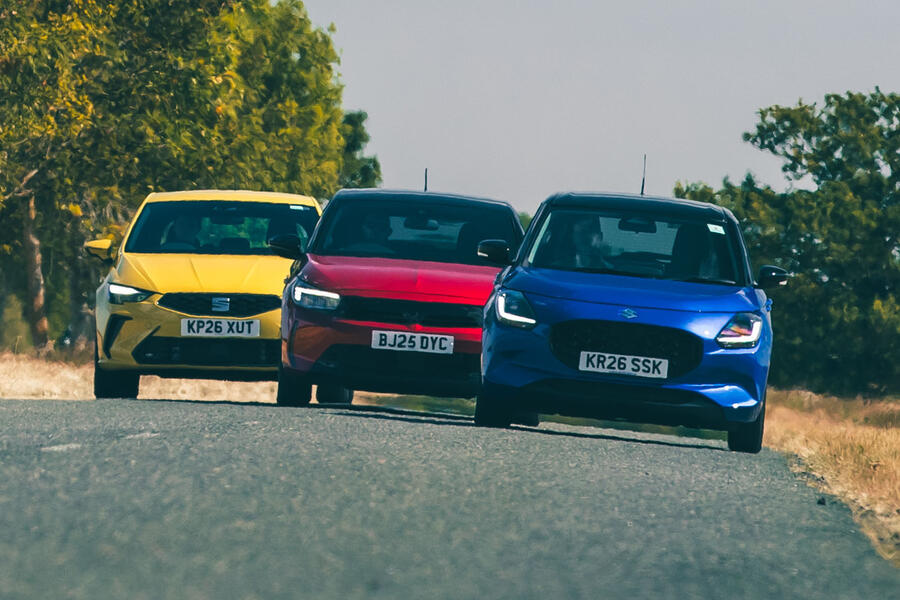
So, which car wins? If Ford had valiantly kept the Fiesta going, I reckon it could still stroll to victory in a comparison test like this: no member of this trio quite nails its lost blend of fun and frugality. But in our supergroup of household 90s names, Suzuki has clung to the decade’s hedonism most authentically. Whether you’re buying into a manual supermini in the pursuit of pure value for money or genuine dynamic sparkle, it’s the Swift you want most.
Verdict
1st, Suzuki Swift: The lightest and most agile, yet the Swift will seat four adults and beat 60mpg in daily use. More of an all-rounder than you might dare imagine.
2nd, Seat Ibiza: Looks better than ever and handles well too; stiffer than its rivals and more demure inside. A charmer, whatever the future holds for Seat.
3rd, Vauxhall Corsa: The quickest and most mature car here, the Corsa would slip into most lives the easiest. It simply lacks the others’ pizzazz.
| Feature | SUZUKI SWIFT 1.2 HYBRID ULTRA | SEAT IBIZA 1.0 TSI SE TECHNOLOGY | VAUXHALL CORSA 1.2 TURBO YES |
|---|---|---|---|
| Rating | Four stars out of five | Four stars out of five | Three and a half stars out of five |
| Price | £16,499 (£17,599 as tested) | £21,610 (£22,880 as tested) | £20,590 (£21,240 as tested) |
| Engine | 3 cyls in line, 1197cc, petrol, plus 12V ISG | 3 cyls in line, 999cc, turbocharged, petrol | 3 cyls in line, 1199cc, turbocharged, petrol |
| Power | 81bhp at 5700rpm | 94bhp at 5000-5500rpm | 99bhp at 5000rpm |
| Torque | 83lb ft at 4500rpm | 129lb ft at 1600-3500rpm | 151lb ft at 1750rpm |
| Gearbox | 5-spd manual, FWD | 5-spd manual, FWD | 6-spd manual, FWD |
| Kerb weight | 945kg | 1139kg | 1105kg |
| 0-62mph | 12.5sec | 11.0sec | 11.2sec |
| Top speed | 103mph | 118mph | 121mph |
| Economy | 64.2mpg | 55.4mpg | 54.3mpg |
| CO₂, tax band | 99g/km, 25% | 115g/km, 29% | 117g/km, 29% |

Related posts

Latest Post


No Comments