
Mazda MX-5 Miata: The Best Affordable Sports Car You Can Buy
Performance cars have become significantly quicker over the past three decades. They’ve also become larger, heavier, and considerably more expensive. A modern Ford Mustang GT produces nearly 500 horsepower. A Toyota Supra 3.0 makes 382 hp. Both weigh well over 3,400 pounds and cost substantially more than the sports cars that occupied the entry-level enthusiast segment in the 1990s.

One manufacturer largely ignored that trajectory. Since 1989, it has continued building a small rear-wheel-drive roadster around a formula borrowed from classic British sports cars: modest power, low mass, a manual gearbox, and balanced chassis tuning. Competitors came and went. The formula survived.
Most Performance Cars Chase Bigger Numbers: This One Doesn’t
The easiest way to make a sports car faster is to increase power output. The harder route is reducing weight. Mazda’s engineers have spent decades pursuing the second option. The current-generation roadster weighs roughly 2,350 pounds depending on specification. For context, a Toyota GR Supra 3.0 weighs around 3,400 pounds, while a Mustang GT approaches 4,000 pounds in some configurations.

That difference influences everything. Lighter cars require less tire, less braking, and less suspension to achieve similar levels of responsiveness. Steering effort stays lower. Direction changes happen with less inertia. Engineers don’t need to mask weight with increasingly complex electronics.
Road tests from the original 1989 model repeatedly highlighted the same characteristic: the car wasn’t especially quick, but drivers could use nearly all of its performance on ordinary roads. Three decades later, the same observation appears in reviews of the current model.
The Secret To Its Success Hasn’t Changed In More Than Three Decades

The project that became this roadster started in the early 1980s. Mazda product planner Bob Hall had argued for years that the industry had abandoned a category enthusiasts still wanted: lightweight, affordable sports cars. The company eventually approved development under the P729 program, and engineers benchmarked vehicles such as the Lotus Elan while developing the chassis.
Several layouts were considered, including front-wheel drive and a mid-engine configuration. Engineers ultimately chose a front-engine, rear-wheel-drive layout because it best delivered the balance and steering feel they were targeting. Mazda later adopted the phrase Jinba Ittai—horse and rider as one—to describe the concept. Beneath the marketing language sat a measurable engineering goal: minimizing the delay between driver input and vehicle response.
The remarkable part isn’t that the first-generation car followed this philosophy. It’s that Mazda largely resisted abandoning it. Across four generations, the formula remained intact even as rivals pursued turbocharging, all-wheel drive, dual-clutch transmissions, and escalating power figures.
Meet The Mazda MX-5 Miata

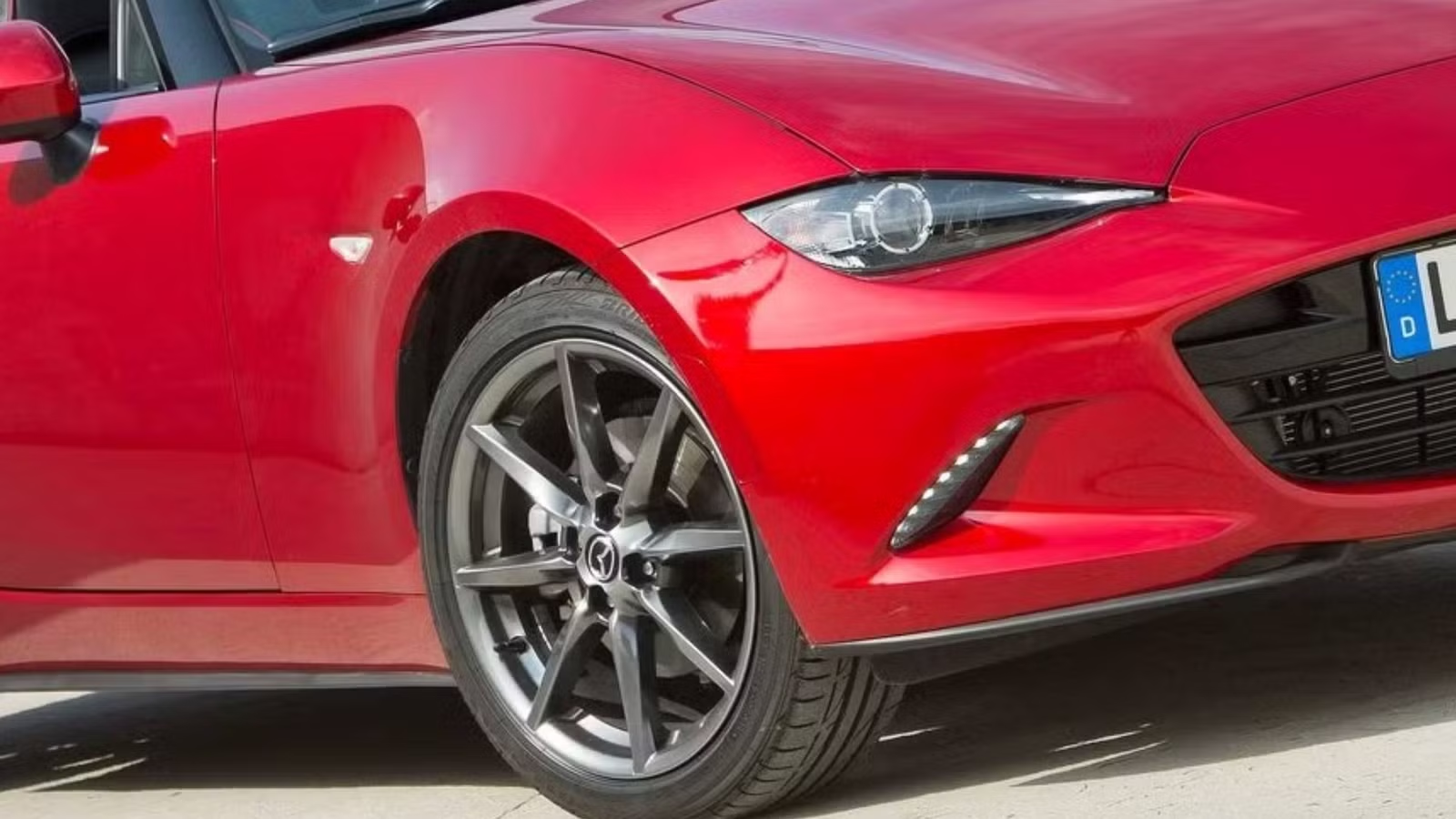
The car in question is none other than the Mazda MX-5 Miata. Introduced for the 1989 model year, the Miata arrived at a moment when traditional roadsters had almost disappeared from major markets. Mazda expected annual U.S. sales of roughly 5,000 units. Demand exceeded forecasts, and production struggled to keep pace during the car’s early years.
The original NA-generation model combined a 1.6-liter four-cylinder engine with a curb weight of roughly 2,100 pounds. The formula proved durable. The NB generation refined it. The NC generation added size, safety equipment, and refinement, drawing criticism from some owners who felt the car had drifted away from its roots. Mazda responded by making the ND generation smaller and lighter than its predecessor.
The sales numbers explain why the company kept investing in the concept. In 2016, Guinness World Records recognized the MX-5 as the world’s best-selling two-seat roadster, a title it continues to hold with production exceeding 1.2 million units globally.
Mazda MX-5 ND Key Specifications

|
Engine |
Power |
Torque |
Transmission |
Drivetrain |
|
2.0-liter Skyactiv-G naturally aspirated inline-four |
181 hp |
151 lb-ft |
6-speed manual or 6-speed automatic |
Rear-wheel drive |
The numbers look modest compared with modern performance-car standards. The ND’s advantage comes from low mass rather than output. A 181-hp engine moving roughly 2,350 pounds produces a very different driving experience than a 400-hp engine moving nearly two tons.
The six-speed manual transmission deserves separate mention. Few components receive more consistent praise across period road tests. Manufacturers routinely claim to prioritize driver involvement. Very few deliver a manual transmission that enthusiasts discuss as frequently as the MX-5’s.

Why The Next-Gen Mazda RX-9 Sports Car Will Be Worth Waiting For
Mazda’s reputation for sports cars is second to none, but this latest coupe should be one to rule them all!
It Delivers More Smiles Per Dollar Than Cars Twice The Price

Track-day budgets reveal strengths that specification sheets often miss. A Miata consumes less fuel, fewer tires, and less brake material than heavier performance cars. Owners running multiple track events per season often discover that operating costs differ far more dramatically than purchase prices suggest.
The aftermarket ecosystem contributes as well. More than three decades of continuous production created one of the largest enthusiast support networks in the industry. Suspension packages, engine upgrades, roll bars, restoration parts, and track-focused components are available from dozens of established suppliers.
The car’s appeal extends beyond economics. Many modern performance cars require speeds that attract unwanted attention before they begin to feel engaging. The MX-5 reaches its sweet spot much earlier. Drivers can work through the gearbox, explore the chassis balance, and use most of the available performance without immediately approaching triple-digit speeds. That characteristic explains why many experienced enthusiasts keep an MX-5 alongside substantially faster machinery rather than replacing it with something more powerful.

The Japanese Sports Car The Collector Market Forgot To Inflate
Thought you’d missed the boat when it comes to JDM classics? Think again.
Why The Miata Remains The Benchmark Affordable Sports Car

The list of affordable sports cars that once competed directly with the Miata is surprisingly short now. Honda ended S2000 production in 2009 after building roughly 110,000 examples worldwide. Fiat’s 124 Spider returned in 2016 using Miata underpinnings and disappeared from North America after the 2020 model year. Toyota ended MR2 production in 2007 and has never produced a direct successor. The affordable roadster segment that seemed viable in the 1990s largely evaporated.
The MX-5’s biggest advantage isn’t horsepower—it’s accessibility. A 2026 MX-5 Miata starts at $30,430 before destination charges. A 2026 Toyota GR Supra 3.0 starts at $58,300, while a 2026 Ford Mustang GT starts at $46,800. In other words, Mazda’s roadster undercuts the Supra by nearly $28,000 and the V8-powered Mustang GT by more than $16,000.
That price gap becomes even more interesting when viewed alongside curb weight. The Supra and Mustang offer substantially more power, but both carry roughly 1,000 pounds more mass than the MX-5. Buyers aren’t getting the quickest sports car for the money; they’re getting one of the few remaining rear-wheel-drive roadsters that still prioritizes low weight, a naturally aspirated engine, and a manual gearbox without requiring a luxury-car budget.
Mazda’s restraint may be the real story. The company had numerous opportunities to chase larger engines, forced induction, and greater complexity. Instead, it spent much of the ND program reducing weight and refining fundamentals that were already working. Finding a naturally aspirated, rear-wheel-drive convertible with a manual transmission is difficult enough in 2026. Finding one that remains genuinely attainable narrows the field even further.
Sources: Mazda, Toyota, Ford

Related posts






Latest Post


No Comments