
10 Factory Performance Packages That Made Sleepers
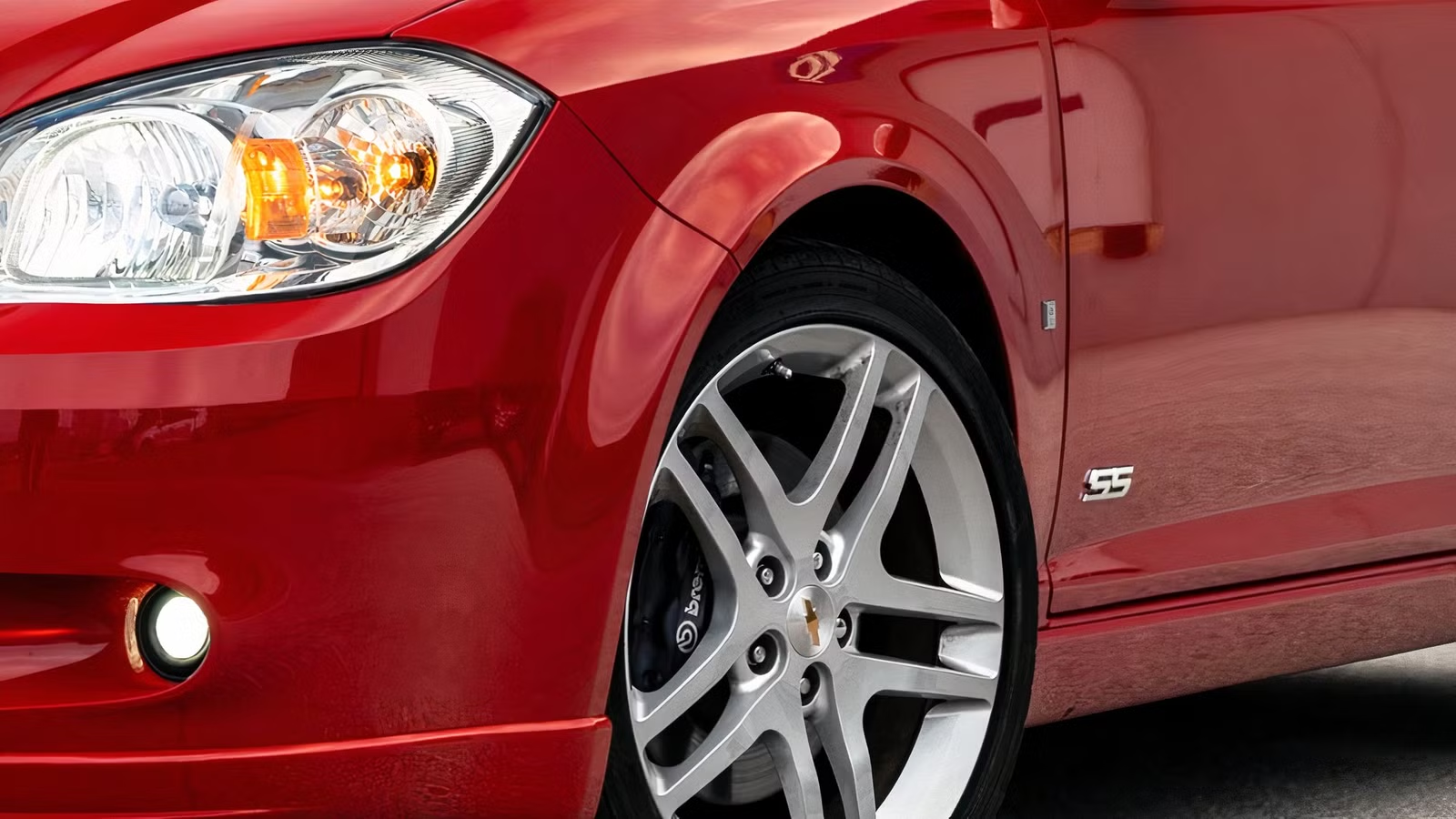
Factory performance packages were one of the sneakiest tricks in a carmaker’s playbook. Tick the right box on the order form, and a car that looked ordinary could leave the dealership with serious hardware underneath. Sometimes the recipe was as simple as stiffer suspension and stickier tires. Other times, it meant forced induction, shorter gearing, bigger brakes, extra cooling or a hotter version of the engine. The result was a commuter, family sedan or basic pony car that drove like something else entirely. Here are 10 factory sleepers worth knowing, from a dealer-installed Honda package to a 455-powered Oldsmobile.
10
Dodge Neon ACR
150 HP, 133 lb-ft

The Dodge Neon ACR might be the purest sleeper here, because it started life as an economy car. Dodge turned the first-generation Neon into a factory-ready club racer with stiffer struts, thicker sway bars, quick-ratio steering, four-wheel disc brakes and heavier front hubs built to handle road-racing loads. The ACR also got shorter gearing and a larger radiator to keep it alive during competition. Early cars were remarkably stripped down, with no air conditioning or radio offered. Visually, though, the Neon remained a Neon. That made the ACR far more interesting than its rental-car reputation suggested, and it backed that up by winning SCCA national titles in autocross and road racing.
9
2003 Acura RSX Type-S Factory Performance Package
200 HP, 142 lb-ft

The RSX Type-S was already the enthusiast’s pick in Acura’s compact lineup, thanks to a 200-hp, high-revving 2.0-liter four-cylinder. The Factory Performance package pushed the chassis further, adding track-tuned shocks and springs that dropped the car about an inch, lightweight 17×7.5-inch wheels, 225/45VR17 tires, slotted brake rotors and performance brake pads. A rear wing and underbody spoilers rounded it out. The hardware wasn’t just for show. Testers ran an FP car through a 600-foot slalom at 65.2 mph and stopped it from 60 mph in 118 feet. That’s a factory option that makes a car faster through a corner without making it look much faster.

8
Chevrolet Cobalt SS With Performance Package
205 HP, 200 lb-ft

The supercharged Chevrolet Cobalt SS already had a 205-hp 2.0-liter Ecotec four-cylinder, so the interesting factory option wasn’t another handful of horsepower. It was the G85 Performance Package, which added a Quaife automatic torque-biasing limited-slip differential and Recaro front seats on the earlier models. That differential mattered because the Cobalt sent all its power through the front wheels. Instead of letting the inside tire go up in smoke when the driver leaned on the throttle mid-corner, the Quaife could shuffle torque toward the tire with more grip. The Recaros kept the driver pinned in place, but the differential was the real mechanical prize, and nothing on the outside gave it away.
7
Ford Crown Victoria Handling and Performance Package
239 HP, 287 lb-ft

Few cars scream “anonymous transportation” quite like a Crown Victoria, which is exactly why Ford’s Handling and Performance Package is so entertaining. Available on the LX and LX Sport, it added revised springs and stabilizer bars, monotube shocks, rear air suspension, dual exhaust and a 3.27:1 axle ratio in place of the lazy 2.73 gearing on regular cars. The dual exhaust even added power, lifting a 2006 car from 224 hp to 239 hp. With a 4.6-liter V-8, a four-speed automatic and plenty of weight to haul around, the shorter final drive gave the big sedan noticeably more shove off the line. It wasn’t a Mustang in a tuxedo, but it was a much more purposeful Crown Vic, and to most people, it was still just a big Ford.
6
2003 Honda Accord Coupe Factory Performance Package
240 HP, 212 lb-ft

The 2003 Accord Coupe was hardly anyone’s idea of a performance car, but Honda had an official way to wake it up. The Factory Performance package was a dealer-installed option for any 2003 Accord V-6 coupe, adding shorter springs, performance-tuned shocks, 17-inch wheels and 215/50VR17 Yokohama tires. The springs dropped the car about an inch and lowered its roll center. Honda also added an underbody aero kit, rear spoiler and FP badging. The 240-hp V-6 got no extra horsepower, and that’s what makes the package interesting. Honda focused on making the Accord carry its speed rather than simply making more of it. An FP coupe could therefore have a far sharper chassis than the Accord idling beside it at a traffic light.
5
1990s Pontiac Grand Prix GTP
240 HP, 280 lb-ft

The Grand Prix GTP blurs the line between trim level and option package, but the hardware is what matters. For 1997, Pontiac bolted an Eaton supercharger onto the 3.8-liter 3800 Series II V-6, producing 240 hp and 280 lb-ft, with a heavy-duty 4T65-E four-speed automatic handling the load. Contemporary road tests put a 1997 GTP under seven seconds from 0 to 60 mph and around 15 seconds through the quarter-mile. That was genuinely quick for a front-wheel-drive family car with room for five and a trunk full of luggage. The GTP wasn’t completely anonymous, but its everyday Grand Prix shape made its supercharged engine easy to overlook.
4
Pontiac Firebird Formula With WS6 Performance Package
320 HP, 345 lb-ft

The Firebird Formula was the quieter alternative to the flamboyant Trans Am. Add the WS6 package, and that relatively restrained coupe became a serious performance machine. It brought Ram Air induction, a freer-flowing exhaust, stiffer springs and shocks, harder suspension bushings, a larger front anti-roll bar, an additional power steering cooler, and 17-inch wheels wrapped in fat 275/40ZR17 tires. On LS1-powered cars, Ram Air and the exhaust lifted the 5.7-liter V-8 from 305 hp to 320 hp, and period testing put the WS6 Formula at 60 mph in the low-5-second range, with mid-13-second quarter-miles at around 105 mph. It wasn’t invisible, but next to a screaming Trans Am, the Formula could still slip through traffic. Pontiac built just 631 WS6 Formulas from 1998 to 2000, which makes them even harder to spot today.
3
2020 Ford Mustang EcoBoost High Performance Package
330 HP, 350 lb-ft

The 2020 Mustang EcoBoost High Performance Package was clever because Ford didn’t just crank up the boost on the existing engine. Engineers developed a Mustang-specific version of the 2.3-liter turbocharged four-cylinder related to the Focus RS engine, with a 63-mm twin-scroll turbocharger, a larger radiator, and revised calibration. Output jumped to 330 hp and 350 lb-ft of torque. Ford then surrounded that engine with the hardware it needed to work. The package included GT-sourced front brakes, a 3.55:1 limited-slip rear axle, upgraded stabilizer bars, a strut-tower brace and 19-inch wheels on summer tires. From the curb, it still looked like any four-cylinder Mustang, which is exactly what a sleeper needs.
2
2013 Ford Taurus SHO Performance Package
365 HP, 350 lb-ft

The Taurus SHO was already a strange sleeper, a huge, conservative-looking sedan hiding a 365-hp twin-turbocharged 3.5-liter EcoBoost V-6 and all-wheel drive. Ford’s Performance Package went after the things that become problems when a roughly 4,400-pound sedan is driven hard. The package brought upgraded brakes, improved cooling, stiffer suspension tuning, recalibrated steering, a track mode for the stability control and a shorter 3.16:1 final drive. Tested at the time, it hit 60 mph in 5.2 seconds and ran a 13.7-second quarter-mile at 103.2 mph. That is an absurd amount of capability for something that can still disappear into a parking lot full of family sedans.
1
1970 Oldsmobile 4-4-2 W-30
370 HP, 500 lb-ft

The 1970 Oldsmobile 4-4-2 was already a formidable muscle car, so the W-30 wasn’t a secret option that turned a mundane Cutlass into a rocket. It was something more interesting: a factory package that pushed a strong car even further. The W-30 used a specially prepared 455-cubic-inch V-8 rated at 370 hp and a stump-pulling 500 lb-ft, with a performance-calibrated Quadrajet, special camshaft, cylinder heads, distributor and aluminum intake manifold. Its fiberglass hood fed cool air through functional scoops to a low-restriction air cleaner, while quirky weight-saving touches such as red plastic inner fenders helped offset some of the 4-4-2’s considerable mass. Quarter-mile times were entirely dependent on who was behind the wheel and what the weather was like.
Sources: Classic.com, Bring A Trailer, Mecum

Related posts


Latest Post


No Comments