
Chevy Kingswood: The 396-Powered Impala Wagon You Forgot
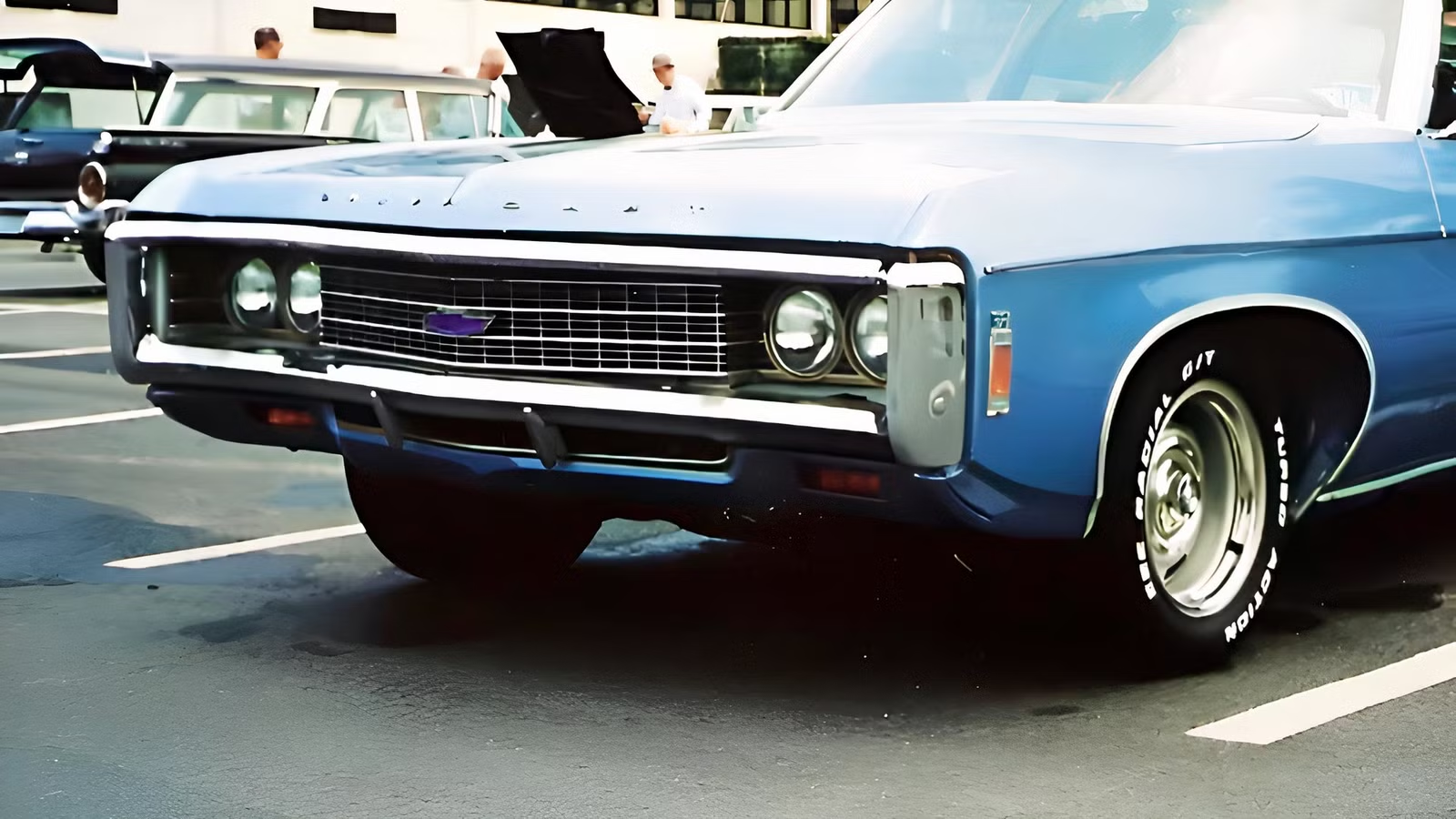
The muscle car wars of the 1960s were fought with big iron blocks and massive displacement. For the first and only time in automotive history, Americans bought their unique brand of sports car entirely with their hearts and not their brains, because practically anything else would’ve been better. Frankly, Americans could afford to forgo practicality back then. Yet, right alongside the muscle car years, a parallel and more understated market conflict was underway. One that had all the big V8s but enough space in the back for lots of people or lots of stuff. In what we’ll call the wagon wars, Chevrolet was a real heavy hitter.
The B Body: The Big Heavy Muscle Behind the A Body’s Muscle Car Machine

We often like to associate GMs intermediate A platform as being the beating heart and eternal soul behind its efforts in the muscle car wars. Admittedly, it supported most of the real highlights from the period. Your Chevelles, Malibus, GTOs, GSXs, Cutlasses, and 442s of the period all used the A body to great effect. With its agile 112 to 116-inch wheelbases, four-link rear suspension, and advanced perimeter frame, it was relatively easy to shove a peppy small block or a brutish big block V8 under its hood and make it go far faster than a ’60s car had any right to.
Yet, the larger B body had tons of latent muscle car potential within it, even if it wasn’t the focal point of GM’s efforts within that space. Ostensibly built to be more comfortable and roomy than A body cars, the post-1965 B body used a wider perimeter frame that hugged the car’s outer rocker panels while prominent welded torque boxes fused the sections further inward. It provided just enough lateral flexibility to absorb low-frequency vibrations and road harshness often associated with American cars of the period. With SLA (Short/Long Arm) double-wishbone front suspension and a triangulated four-link in the back, there was body roll, but not so much that it fell to pieces cornering.

Such stout underpinnings helped make cars like the Pontiac Catalina and Bonneville, the Oldsmobile 88 series, the Buick Wildcat, and the Chevy Caprice incredibly stout, capable vehicles. In the era when GM brands still used bespoke engine architectures for their own cars, the B body could accommodate 396s, 427s, 428s, 454s, and 455s with room to spare. The chassis was also tough enough to handle the immense amounts of torque these motors put to the rear tires with ease. Perhaps B body cars were a bit too big to be proper muscle cars, but they sure did put power down — you’d just never know it by looking at the skin alone. Still, one car stood out from the rest, and it turned out to be the perfect foundation for a great wagon as well.

The Impala: A World-Class Automobile and a Best Seller

The fourth-generation Chevy Impala was comprehensively redesigned in 1965, and was perhaps the biggest ambassador for the all-new B body platform revamped alongside it. The body was comprehensively refreshed by GM designer Irv Rybicki, the same man who’d go on to design the C4 Corvette and the Pontiac Fiero, among others. The Gen-IV Impala sported a sleeker angled windshield and sleeker curves, a trend that would continue during the mid-cycle refresh of 1969. There, a distinct loop front bumper that framed the grille behind it was added. Hardtop coupes were re-engineered with a notable notchback roofline, making them stand out immediately compared to models from years prior. With its flat, smooth, slightly squared-off body panels, front side vent window delete, and subtle wheel arches that rid the car of its old Coke-bottle curves, Impalas of these years were given the unceremonious nickname of “slabsides.” Honestly, there is a brutal honesty in the name that oddly makes it all the more endearing.
Given that 1969 was the arguable zenith of the first muscle car era, these Impalas could accommodate a who’s who of Chevrolet’s all-time great engines. The trusty 250-cubic-inch Turbo Thrift straight-six shored up the entry level, mostly for sedans in 1969, and a slew of small block V8s ranging from 307 to 350 cubic inches were what Americans of the time would describe as middle of the pack. A 235-horsepower 327-cubic-inch plant was available in 1969 only, and the 350 small block became the base motor starting in 1970. Yes, the 350 was the BASE motor back then. When old-timers tell you things used to be better way back when, one can only imagine this is what they were talking about.

Somehow, GM managed to bore the small block out to 400 cubic inches, using it in the Impala for 1970 only. That’s without mentioning big block options for 396, 427, and 454 cubic inches at various points before the next big model refresh in 1971. In the 1970 Impala 454, that motor made an eye-watering 390 gross horsepower and enough torque to tow a planet. As it turned out, the Impala of these years was a phenomenal foundation for a family wagon.
The Kingswood: Big Power for Big Families

On the very same foundation as the Impala, Chevrolet returned the seldom-used Kingswood wagon nameplate back from purgatory for three years between 1969 and 1972. Slotted between the Bel Air-based Townsman and Biscayne-based Brookwood at the lower end and the Caprice-based Kingswood Estate at the upper end, the standard Kingswood was a middle-of-the-road option on paper. Although, you should infer by now that the brochure was selling the car short just a little bit. Any unassuming nuclear family could waltz into a Chevy dealership, tick the box for the beloved L35-series, 396-cubic-inch V8, and drive home in a muscle car that could seat up to nine passengers in the back. Did we mention you could option a button that would spray ice-melt compound onto the tires? That’s somehow the coolest feature of the whole package.
You can’t even find a full-size SUV these days that seats that many, short of a Tahoe or Suburban with a front bench seat. Ironically, both of those are Chevys as well. That seems to be a theme of theirs. Fold both rows of seats down, and there was roughly 100 cubic feet of cargo storage, making good use of the wagon’s 119-inch wheelbase and 216-inch overall length. In the regular Impala hardtop coupe, the L35 396 helped the car sprint to 60 in the mid 7s and through a quarter mile in the mid-to-high 15s. For a car that large, that was pretty impressive, but with hundreds of pounds of extra metal and glass to lug around, it’s fair to say a Kingswood could rush to 60 in the mid 8s and through a mid-to-high 16-second quarter mile.

Is it a CTS-V Wagon or Audi RS6 Avant? No, not quite, although for the time, there really wasn’t much that got as close. In the late ‘60s and early ‘70s, Chevy sold millions of Impalas, including over 600,000 units in 1968, ‘69, and ‘70. By comparison, the Kingswood was a more niche vehicle, meaning not nearly as many of them survived to the present day. Somewhere in the vicinity of 50,000 Kingswoods were produced in 1970, compared to between 612,000 and 613,000 Impalas. Knowing this, the Kingswood is a bona fide rarity.
Real Rarity, Real Value, But Hardly Any Name Recognition

At any given time, there are hundreds of gen-V Impalas crawling around online auction sites and marketplaces, wildly varying in price depending on condition and powertrain. Knowing the equivalent Kingswood didn’t even see a tenth of the same production volume, seeing them pop up for sale isn’t anywhere near as common. When they do, they’re liable to have smaller engines like 350 small blocks under the hood, not big blocks, and that tends to skew sales prices down a little bit.
Even genuine big block 427 Kingswoods can sneak under the radar at $27,000 on sites like Bring a Trailer. Meanwhile, the equivalent Impala with the same engine and a three-speed automatic gearbox could easily fetch double that, and that’s before factoring in things like SS packages. In 1970, Chevy bored out that 396 motor to 402 cubic inches, making the ’69 Kingswood 396 a true rarity if you can find one. It just goes to show, the classic car market can get a massive case of tunnel vision on occasion, and when it does, that could mean big savings for people willing to drive a wagon instead of a coupe. For some people, the wagons are just more fun.
Source: Bring a Trailer, Mecum Auctions

Related posts


Latest Post



No Comments