The Lexus Sedan That Can Make A Used BMW 5 Series Look Risky
8 minutes reading
Wednesday, 30 Sep 2026 12:00 0 8 autotech
Lexus is Toyota’s luxury brand, so it isn’t surprising that its mother company’s reputation for reliability carries over. The first-generation Lexus LS was built with reliability in mind—so much so, that even how the leather, exterior trim, and other bits and pieces of the vehicle age was considered. This is peak Lexus, when nothing was shared with mainstream Toyota siblings, as the first-generation LS was built on its own platform and barely shared any parts with a Toyota.
Today, while most Lexus models are based on Toyota platforms, there are some models that stand out. One such model is the used Lexus sedan for today’s article. This Lexus is severely underrated, in my opinion, and when it came out, I even preferred it to the equivalent BMW 5 Series of its time. While it didn’t get enough attention as I would have liked, today this Lexus luxury sedan is finally in the spotlight among used car buyers. Not only is today’s Lexus luxury sedan more reliable than the BMW 5 Series, but its rarity adds a sense of novelty to its existence in 2026.
Today’s Lexus sedan has never caught up with the BMW 5 Series in terms of sales, so what makes the 5 Series the segment’s primary choice, even versus its other German rivals?
It’s The Segment’s Athlete
Front 3/4 shot of 2021 BMW 5 Series in blue parkedBMW
A vehicle that stands out is often one whose driving dynamics also stand out. The BMW 5 Series easily stood out among its peers, whether German or otherwise, for its athletic driving dynamics. I wouldn’t outright say the word “sporty” because, if I were being honest, the 5 Series had varying degrees of sportiness across various generations, with this new one having somewhat numb steering, as I’ve already driven the current G60 and the previous G30 as well. Nevertheless, all 5 Series generations were athletic next to their comfort-oriented rivals.
Yet, at the same time, the 5 Series didn’t compromise too much on comfort. Sure, older 5 Series generations had a stiffer suspension, but they were never considered uncomfortable for luxury sedan duty. Today, the 5 Series has gotten so comfortable that it’s more like a scaled-down 7 Series now instead of being a bigger 3 Series, and by having a degree of athleticism, it’s enough for its driving dynamics to stand out.
How ‘The Ultimate Driving Machine’ Tagline Crowded Out Every Japanese Rival
Low-angle front 3/4 shot of 2026 BMW 5 Series drivingBMW
Luxury sells heavily on emotion, and BMW’s marketing tagline of “The Ultimate Driving Machine” resonates extremely well with luxury buyers. Mercedes-Benz is a brand primarily known for comfort and prestige, which is why it’s defined by the S-Class, as opposed to BMW, whose brand identity is centered around its sportier, more agile models like the 3 Series and 5 Series. Unlike the full-size luxury sedan segment, where luxury and comfort become top priority, the midsize segment still has buyers looking for something that’s sporty and more entertaining to drive.
That’s the reason why there have only been a handful of full-size luxury sedans with performance intent, namely the V-12-powered Mercedes-Benz S 65 AMG and the BMW M760Li, both of which only lasted for one generation. Meanwhile, the compact and midsize luxury sedan segments have a ton of high-performance offerings from Germany, the UK, America, and at one point, even Japan. Speaking of which, the market value of the high-performance variant of the Lexus sedan in today’s article is starting to rise, reflecting how enthusiasts are finally recognizing its worthiness and how it was severely underrated when it was still sold.
Introducing The Lexus GS: Akio Toyoda’s Passion Project
2016 Lexus GS F Sport 450h Front 3/4Lexus
And with that, the used Lexus sedan I would choose in a heartbeat over a BMW 5 Series is the GS—particularly the final fourth-generation model (codenamed L10). Here’s why.
The GS Was Akio Toyoda’s Centerpiece
2013 Lexus GS 350 acceleratingLexus
Development of the fourth-generation Lexus GS began as far back as 2007, with its design being finalized around 2009, with then CEO Akio Toyoda steering the development of the GS into his desired direction. That’s because the GS was the centerpiece of Akio Toyoda’s vision to imbue a sense of passion into the Lexus brand. And indeed, they chose the perfect vehicle to become the brand’s centerpiece for its new, edgier image.
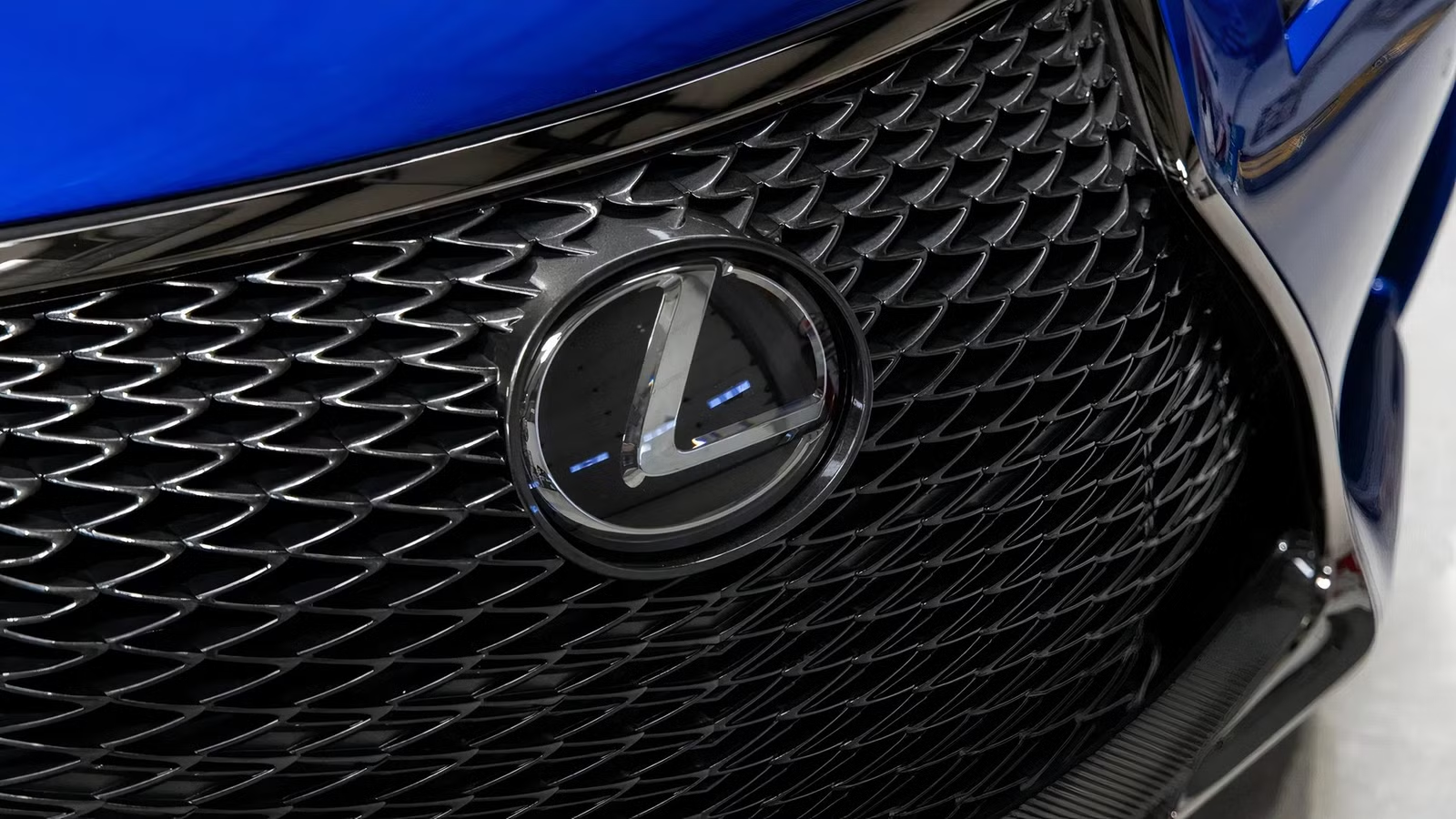
The GS is rear-wheel drive (RWD), and was styled with sportiness and distinction in mind. The L-Finesse design evolved to feature the now-iconic Spindle Grille, which, though controversial, was a far cry from the simpler, more straightforward designs of every Lexus before it. The GS was so different from any Lexus or Toyota model before it that it ditched the Japanese-market Crown’s N platform for the New N platform, and this platform was eventually inherited by the IS and RC.
The GS 350 Is 14x More Likely Than The BMW 5 Series To Reach 200,000 Miles
Shot of 2020 Lexus GS 350 interior showing cabinLexus
The fourth-generation Lexus GS was sold in two versions in the United States—a GS 350 in both all-wheel drive (AWD) and RWD and the rarer GS 450h performance hybrid. Both models got a 3.5-liter V-6, specifically, the ever-reliable 2GR-FSE or 2GR-FKS from 2015 onwards, or the hybrid-specific 2GR-FXS. These engines have been developed with performance and refinement in mind. These engines also feature D-4S direct and port injection, eliminating the carbon buildup of direct injection since the engine reverts to port injection under light loads.
A six-speed automatic was the standard transmission, but the RWD model got a newer eight-speed automatic in 2014. Opting for the F Sport also adds rear-wheel steering, which helps its handling agility, as well as Adaptive Variable Suspension. Critics immediately praised the GS 350 for being a tidy handler—one that truly offered a sporty and thrilling driving experience never before seen from the brand.
It is also reliable, with the GR V-6 engines already proven today to last extremely long. iSeeCars says that the GS 350 has an average lifespan of 165,888 miles, or about 15.4 years. With a 30.3 percent chance of lasting at least 200,000 miles, the GS is one of the longest-lasting cars you can buy. For reference, the BMW 5 Series has an average lifespan of 109,383 miles, or 10.2 years, and a minuscule 2.2 percent chance of reaching at least 200,000 miles. Data for the GS 450h, however, is a bit harder to find, especially since the hybrid version wasn’t sold in high numbers.
Why The GS Is Special In 2026
Front 3/4 action shot of 2020 Lexus GS 350 driving on roadLexus
Unfortunately, the fourth-generation Lexus GS ended production in 2020 with no successor ever planned. The ES is your only choice for a midsize luxury sedan from Lexus, but I think we can all agree that it just isn’t the same, nor as special, as the GS.
A 2020 Lexus GS Holds More Resale Value Than A 2020 BMW 5 Series — Here’s The Data
2013 Lexus GS 450hLexus
The BMW 5 Series handily outsold the Lexus GS, and with so much supply in the used market, the GS has a far higher resale value today than its German counterpart. The GS was sold from the 2012 to 2020 model years, and when compared to the two BMW 5 Series generations of its time, its German rival may have the technology and slight sportiness edge.
While the GS didn’t necessarily push the boundaries of tech, the mere fact that it had a distinct design while meeting the expectations of those wanting a sports luxury midsize sedan makes this a severely underrated option. If you want a used GS 350, Kelley Blue Book says that a final 2020 model year Lexus GS has an average value of $24,300, which is much higher than the $18,050 average value for a 2020 BMW 5 Series. Enthusiasts are finally realizing today just how great the GS sedan is, and this part couldn’t be any more true than with its high-performance GS F sibling.
The GS F Is A Possible Collector’s Item
But if you want something that has a chance of becoming a collector’s item in the future, then look no further than the Lexus GS F. This vehicle, in my opinion, is one of the most misunderstood high-performance midsize luxury sedans. It gets a naturally-aspirated 5.0-liter V-8 that pumps out 467 horsepower and 389 pound-feet of torque that’s sent through a Torque Vectoring Differential (TVD). These numbers are considerably lower than the BMW M5’s more than 500 horsepower with its twin-turbo V-8, but what it lacked in straight-line speed was more than made up for by its sheer character.
The V-8 sounded glorious, especially since it was naturally aspirated. Its handling may not be as sharp as an M5’s, but it was sharp enough to be entertaining on the road and on track. Since you had to make the 5.0-liter V-8 work harder, it was more satisfying to accelerate with, as power delivery was linear and not brutal enough to bring you to illegal speeds. Of course, it was also reliable—being the UR V-8 engine, it’s one of the most reliable engines, period. Today, a used Lexus GS F easily sells for more than $50,000, exceeding the $44,000 average resale value Kelley Blue Book has determined. Meanwhile, the BMW M5 had a much higher starting price than the Lexus GS F, yet its average resale value of $40,100 is the same or even lower than what the GS F commands today.













No Comments