The Japanese Hybrid SUV That Barely Needs A Gas Station
8 minutes reading
Wednesday, 30 Sep 2026 10:00 0 7 autotech
New car prices in the U.S. continue to climb in 2026, along with elevated fuel costs. Including long-term maintenance costs, Americans are struggling with the increased total cost of ownership. High interest rates increase monthly auto loan payments, placing heavy financial strain on household budgets.
In response, the market is showing a significant shift away from large SUVs and heavy trucks toward smaller crossovers and compact sedans that prioritize fuel efficiency. Japanese brands have mastered long-term dependability and low costs since arriving in the U.S. One specific compact SUV outclasses every other option when it comes to offering low fuel consumption.
Toyota maintains low long-term running costs in the U.S. through disciplined manufacturing and conservative engineering. This approach relies on the Toyota Production System, which is centered on continuous improvement. This system also ensures quality in the process by halting assembly whenever an abnormality occurs. Stopping defects at the production line prevents structural flaws from reaching the consumer, minimizing mechanical failures over decades of vehicle operation.
Toyota’s engineering choices prioritize proven durability over unvalidated innovation. Lower stress parameters on engines, over-engineered drivetrain elements, and conservative electronic integration, which reduces component wear. High parts commonality across product lines lowers replacement component pricing and simplifies independent maintenance.
This manufacturing predictability translates into minimal unexpected repair expenses, slow component degradation, and exceptional resale value. Consumers have built a high level of trust with Toyota, thanks to these consistent high mileage achievements.
The 2026 Toyota Corolla Cross Hybrid Aces Fuel Efficiency
Red 2026 Toyota Corolla Cross driving on an open roadToyota
The 2026 Toyota Corolla Cross range offers distinct fuel economy metrics across its gas front-wheel drive, gas all-wheel drive, and hybrid AWD configurations. Front-wheel-drive gas models feature a 2.0-liter four-cylinder engine paired with a continuously variable transmission, delivering an EPA-estimated 31/33/32 MPG in the city/highway/combined cycle. Opting for the gas all-wheel-drive variant slightly reduces overall efficiency to 29/31/30 MPG. The Corolla Cross Hybrid is the model that you want to consider if fuel efficiency is your priority. This model pairs a 2.0-liter engine with electric drive motors to achieve an impressive EPA-estimated 46/39/42 MPG.
Long-term financial savings heavily favor the hybrid powertrain over standard non-hybrid crossovers. Over a five-year ownership cycle driving 15,000 miles annually, official EPA calculations estimate that the Corolla Cross Hybrid saves owners $3,750 in total fuel costs compared to the average new 2026 vehicle.
Rear 3/4 shot of 2026 Toyota Corolla Cross Hybrid XSE parkedAmee Reehal | TopSpeed
Standard gas models also yield long-term savings in relation to all new cars currently being sold in the U.S. The EPA estimates that owners will save $1,500 with front-wheel drive and $750 with all-wheel drive over five years. Choosing the hybrid model over the base gas AWD model saves $600 annually in fuel alone, allowing buyers to offset the higher upfront purchase price through lower operational expenses.
Annual fuel costs total an estimated $1,900 for the gas FWD model, $2,050 for the gas AWD model, and $1,450 for the hybrid AWD model. Despite utilizing the smallest fuel tank in the lineup at 10.6 gallons, the hybrid model delivers the longest single-tank driving range at approximately 445 miles. By comparison, the gas FWD trim uses a 12.4-gallon tank for a total range of 397 miles, while the gas AWD model utilizes a 13.2-gallon tank to achieve a 396-mile total range. Individual fill-ups average roughly $43 for the hybrid, $51 for the gas FWD, and $54 for the gas AWD.
Overall Running Costs Are Impressively Low
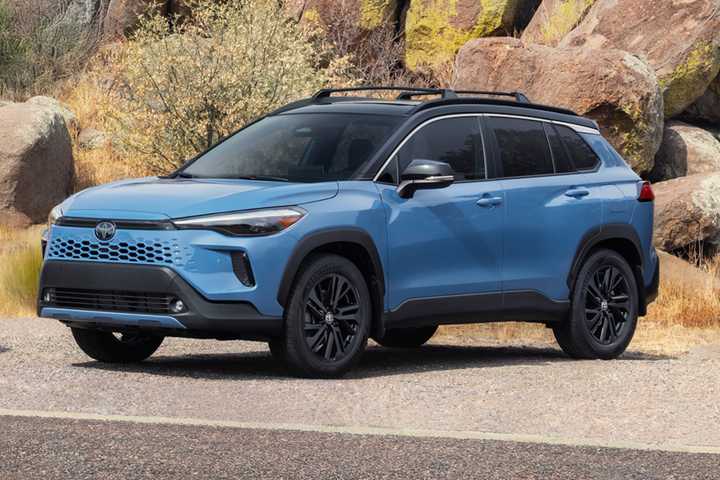
2026 Toyota Corolla CrossToyota
The 2026 Toyota Corolla Cross is a prime example of how this manufacturing process works. The target audience encompasses budget-conscious daily commuters, small families, and first-time crossover buyers who prioritize everyday utility, standard safety suites, and predictable operational economy over high-performance metrics.
CarEdge calculates an estimated five-year ownership cost of approximately $35,174 based on 15,000 miles driven annually. Depreciation constitutes $8,597 of that loss, representing 24 percent of the overall cost profile. Maintenance and expected repairs remain exceptionally low at $1,852 total over five years, representing just five percent of overall ownership expenditures.
Edmunds True Cost to Own data shows cumulative five-year ownership costs starting around $43,196 for base entry-level trim configurations, scaling up based on options and local tax factors. Their detailed tracking projects total maintenance expenses at $4,192, alongside unscheduled repair costs of $773 over a 75,000-mile cumulative period. Depreciation on base models totals $9,103 over five years, with loss rates flattening significantly after the initial 12-month period.
The Corolla Cross Proves Its Worth In Long-Term Reliability
2026 Toyota Corolla Cross EngineToyota
Market evaluations from iSeeCars reinforce strong long-term value retention for the 2026 Toyota Corolla Cross, placing it second among small SUVs and third overall among all crossover SUVs for resale value. The platform scores its retained value at 8.9 out of 10, projecting a five-year depreciation rate of 32.9 percent, which equals an estimated $8,107 in total value loss. This outcome beats the broader compact SUV segment average depreciation rate of 45.2 percent by a wide margin. Used market pricing trends reflect this slow value loss, with three-year-old models maintaining average transaction prices around $25,326.
J.D. Power gives the 2026 Corolla Cross range a consumer rating score of 80/100. Across individual evaluation categories, the crossover earns 88/100 for resale, 76/100 for dealership experience, and 73/100 for driving experience. The vehicle’s quality and reliability score stands out at 82/100. This specific rating measures the incidence of factory defects, mechanical malfunctions, and design flaws across all major systems, ranging from the engine and drivetrain to the onboard electronics. That high reliability rating directly supports low long-term running costs, confirming that owner repairs remain infrequent throughout standard operational life cycles.
A Comprehensive Warranty Adds Peace Of Mind
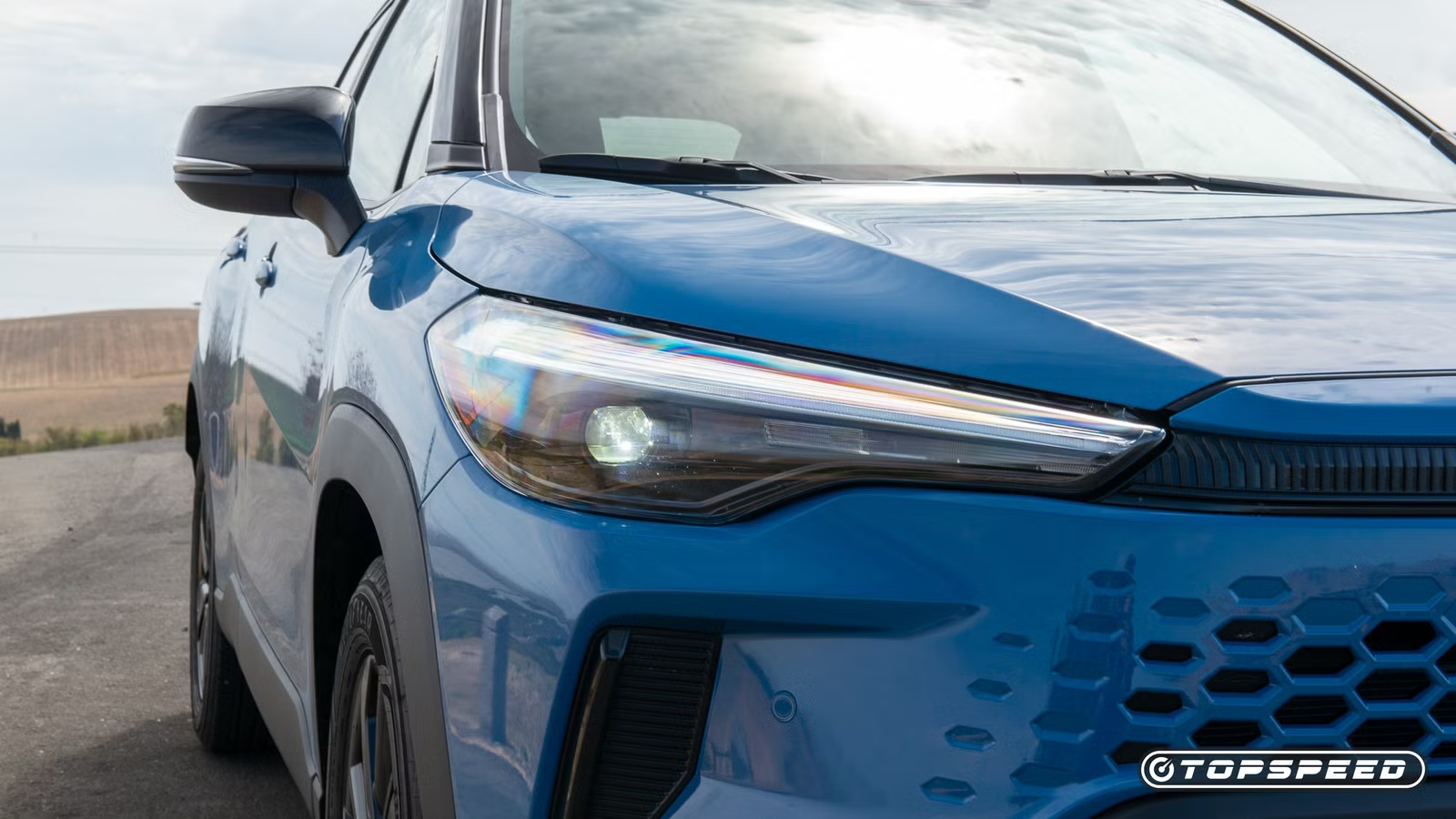
Front 3/4 shot of 2026 Toyota Corolla Cross Hybrid XSE parked on roadAmee Reehal | TopSpeed
The 2026 Toyota Corolla Cross comes standard with Toyota’s factory coverage suite. This includes a three-year or 36,000-mile comprehensive bumper-to-bumper warranty along with a five-year or 60,000-mile powertrain warranty. Perforation and corrosion protection extends for five years with unlimited mileage. Hybrid variants gain extra coverage for electrified components, featuring an eight-year or 100,000-mile hybrid-related component warranty alongside a 10-year or 150,000-mile hybrid battery warranty. New purchases also include ToyotaCare’s plan that covers factory-recommended maintenance and 24-hour roadside assistance for two years or 25,000 miles, whichever occurs first.
Scheduled maintenance follows fixed six-month or 5,000-mile service intervals. Minor service visits occur in 5,000-mile increments, focusing on tire rotations, brake system inspections, wiper blade replacements, and fluid level checks. Major maintenance visits occur every 10,000 miles or 12 months, adding engine oil and filter changes, cabin air filter replacements, and full multipoint mechanical inspections. Spark plug replacements occur at 120,000-mile intervals, while engine coolant flushes happen at 100,000 miles.
The Corolla Cross Requires Minimal Maintenance
Profile shot of red 2026 Toyota Corolla Cross parked in front of a houseToyota
Routine servicing costs remain low due to initial ToyotaCare coverage, which eliminates routine service expenses for the first two years or 25,000 miles. Out-of-pocket costs begin at the 30,000-mile mark, with minor tire rotation and inspection services averaging between $50 and $100. Standard oil change service visits range from $100 to $180 depending on local shop rates and air filter requirements. Larger milestone services at 30,000, 60,000, and 90,000 miles average between $250 and $450. Aggregate maintenance data projects average annual routine upkeep costs around $300 to $500 during early ownership years, scaling up to roughly $800 to $1,000 annually as the vehicle reaches higher mileage intervals where wear items like tires and brakes require replacement.
Safety recall histories for the Corolla Cross platform reflect minor production issues addressed by factory campaigns. Early model years faced a safety recall regarding front passenger airbag deployment issues caused by manufacturing defects in the instrument panel soft trim. A separate recall affected select units for potential steering column assembly defects, where an incorrectly manufactured steering shaft could decouple. Additionally, certain hybrid models required software updates to fix electronic stability control and brake actuation module software errors. The 2026 model year benefits from these early production corrections, keeping open recall counts low as manufacturing updates carry over into current assembly workflows.
A Competitive Pricing Strategy Further Improves Appeal
2026 Toyota Corolla Cross Driver’s Seat and DashboardToyota
The 2026 Toyota Corolla Cross model line features six trim options across standard gas and hybrid powertrains. The entry-level gas L trim starts at $25,335 in front-wheel drive and $26,635 with all-wheel drive. The mid-grade gas LE trim opens at $27,665 for FWD and $28,965 for AWD.
The range-topping gas XLE trim demands $30,260 in FWD and $31,710 in AWD. Hybrid derivatives come standard with all-wheel drive, starting with the Hybrid S grade at $29,795. The mid-tier Hybrid SE starts at $31,115, while the top-spec Hybrid XSE commands $33,830. Every trim in the lineup incurs a mandatory $1,450 delivery, processing, and handling fee added to the base retail price.
Base Trim Engine
2.0L Inline 4
Base Trim Transmission
CVT
Base Trim Drivetrain
Front-Wheel Drive
Base Trim Horsepower
169 HP @6600 RPM
Base Trim Torque
151 lb.-ft. @ 4400 RPM
Make
Toyota
Model
Corolla Cross
Segment
Subcompact SUV
Sources: Toyota, Edmunds, CarEdge, iSeeCars, J.D. Power, and the EPA.









No Comments