
The Motorcycle That Makes Every Corner Feel Like The Reason You Ride
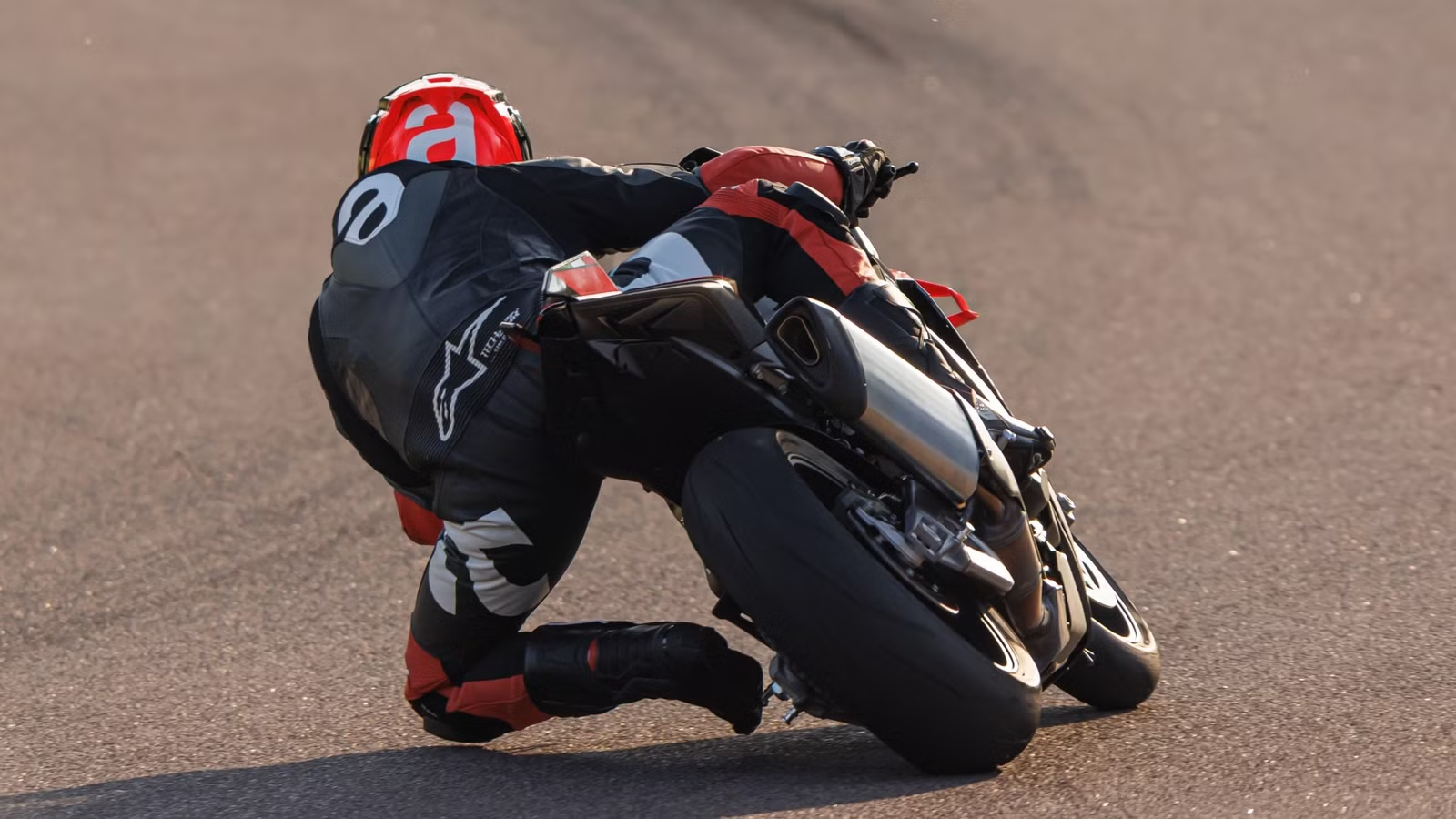
Everybody loves a straight open road. This is the place you can let out the true potential of your bike’s engine. But what about the overall capability of the bike itself? For that, you need curves. Cornering capability decides how good your bike is at keeping the speed up when the road becomes far too bendy to stay upright. Sport bikes are masters of the twists. They get stiff suspension, leaned-over riding positions, and engines that love hitting the redline at every exit. But not all sport bikes enjoy the corners the same. This one particular bike, however, makes you feel like the apex is the entire point of riding.
When The Road Becomes The Playground, Sports Bikes Come Out To Play

Superbikes have always occupied an unusual place in the motorcycle world. They are road-legal machines developed with technology and engineering that make far more sense when there is a circuit underneath their tires. On public roads, their potential is mostly waiting in reserve. On a track, that reserve suddenly has somewhere to go. The track exposes what makes them special. Braking later becomes meaningful because the chassis is designed to remain composed. Carrying more speed into a corner becomes possible because the suspension, tires, and geometry work together. Even something as simple as changing direction takes precision that is built into the bike.
From Track Days To Mountain Passes

Street-legal sport bikes come from what companies learn at the track. But this kind of motorcycle also makes sense on a good mountain road. Mountain passes do not offer runoff areas, perfect pavement, or the predictable environment of a racetrack, so it demands restraint. But the rhythm of climbing through a sequence of bends, positioning the motorcycle, getting the braking right, and feeling the chassis settle into a corner is one of motorcycling’s great pleasures.

Modern superbikes have become remarkably sophisticated now. The Ducati Panigale V4 R, BMW S 1000 RR, Yamaha YZF-R1 and Honda CBR1000RR-R Fireblade all approach the same challenge differently. They combine immense power with electronics capable of managing increasingly ambitious riders. They aren’t simply fast, and in the wrong hands, they can be downright dangerous. Enter our pick for this article: The Aprilia RSV4.

The Aprilia RSV4 Wants To Attack Corners

The RSV4 earns its place in this discussion because Aprilia has consistently treated handling as seriously as outright performance. The company has spent years developing the RSV4 around the relationship between its engine, chassis, aerodynamics, and electronics. While the engine itself is a fire-breathing mechanical marvel, everything from riding position, chassis geometry, suspension tuning, braking hardware, and electronics has all been integrated into the bike in a manner that makes taking the next corner just as fun as speeding along a straightaway.
The V4 Sits At The Center Of Everything

At the heart of the RSV4 sits the 65-degree V4, a configuration that gives the motorcycle its distinctive character. The engine displaces 1,099 cc and uses an 81 x 53.32 mm bore and stroke. Aprilia quotes 220 horsepower coming in at 13,000 rpm and 93.6 pound-feet of torque peaking at 10,800 rpm. These numbers should tell you that the Aprilia is a high-revving motorcycle, as all sport bikes are. But just the numbers don’t make complete sense in a corner.

The bike needs to feel predictable when leaned over, and the drive needs to be controlled. Aprilia’s engine management system gives the rider several ways to tailor that behavior. Engine Map and Engine Brake settings are integrated into the wider electronics package, allowing the V4’s response to be adjusted according to the rider, the riding style, and wider environmental conditions.
The Sachs Suspension Provides Stability

The RSV4 uses a twin-spar aluminum frame, suspended on a Sachs 43mm upside-down fork at the front with 5 inches of travel at the front and a Sachs monoshock with 5.1 inches of travel at the rear. Both are, of course, fully adjustable and tuned by Aprilia to provide the best kind of stability in the corners. The chassis itself, Aprilia says, coupled with the aerodynamic design, allows for “exceptional stability and pinpoint precision.” An extra bit of stability is added by the Sachs steering damper. Regardless of the track or mountain, give this bike a nice curvy road, and it will make any rider smile.
Braking Hardware That Goes Hard

Stopping power comes from twin 330mm floating discs at the front and a 220 mm disc at the rear, both bitten down by Brembo, while the front uses their HYPURE calipers that are 10 percent lighter than normal. Cornering ABS adds another layer of control, but there are three maps to help with stopping, and you can set it to your preference. The brakes create that confidence when entering a corner, and the suspension helps with holding the line. Now the wheelbase measures 56.5 inches, and there are 17-inch wheels at both ends. Put all of this together and what you have is not just a machine that’s agile, but one that can feel stable even when leaned over.
The RSV4’s Technology Helps With The Experience

As far as tech goes, you get a six-axis IMU that works with Aprilia’s a-PRC (Aprilia Performance Ride Control) system. It includes traction control, wheelie control, cornering ABS, engine mapping, and engine braking. Three customizable riding modes and a bidirectional quickshifter come as standard. Information is displayed through a 5-inch full-color TFT dashboard and controlled through backlit handlebar buttons.

Now, we agree that not everyone is going to go super hard into a corner all day and night when riding their bikes, but for riders who visit the track fairly regularly, Aprilia offers an optional Race Pack and Track Pack. This expands the bike’s capabilities with GPS-based lap timing, telemetry, track-specific riding modes, launch control, pit limiter, and slide control. If you decide to pick the RSV4 Factory variant, these packages come standard.
The Aprilia RSV4’s Form Follows Speed
Price: $19,699

As far as design goes, the RSV4 is extensively wind-tunnel sculpted. It gets integrated wing elements, a double-layer fairing, and a spoiler on the upper fairing to manage airflow. The winglets aren’t merely decoration and provide downforce to improve front-end grip. The rest of the bodywork is also designed to slice through the air and reduce turbulence. Almost every surface has a function. The fairing controls the air, the tank allows the rider to anchor themselves in, and the riding position is shaped around the demands of aggressive cornering.

The Aprilia RSV4 belongs to a generation of superbikes where the distinction between road motorcycle and track machine becomes extremely thin. The appeal, though, is not found in the biggest number on the spec sheet, but in the way the bike handles itself. Straight-line speed is impressive, no doubt about that. But its ability to turn into a corner just after braking hard, hold a line with supreme stability thanks to the suspension, and then finally exit because of tremendous acceleration is what makes the RSV4 a bike that truly reminds you of the joy of cornering.
Source: Aprilia

Related posts

Latest Post


No Comments