
The Cruiser That Delivers Big-Bike Features Without Big-Bike Price
Cruiser bikes, especially the flagship models, stand out for their sheer size. American offerings further emphasize this with low-slung, stretched-out wheelbases and huge V-twin engines. Underpinnings also match the size appeal with chunky components and heft. However, these big-bike features also come with a premium price tag.

This is evident from the fact that the most affordable American big-twin cruiser bikes are priced well over $11,000. However, Honda’s sub-$10,000 flagship cruiser bike is an exception, packing big-bike features in a middleweight form factor. It further stands out with unique powertrain and technology features not offered on most other “huge” cruiser bikes.
Cruisers Are Famed For Their Larger-Than-Life Character
The main contributors to a cruiser bike’s larger-than-life appeal include its stretched-out wheelbase, a huge V-twin in full display, and an abundance of chrome components. The big engine (mostly V-twins) sits front and center, emphasizing the cruiser’s raw mechanical size. Chunky tires, wide handlebars, and fat fenders further complement the elongated stance. The rider sits low and relaxed, with forward-set footpegs that help create a commanding posture. American legacy brands like Harley-Davidson and Indian also link their cruiser bikes to decades of open-road freedom and rebellious heritage.
Premium Pricing Also Follows Suit


The larger-than-life character of big twin cruiser bikes doesn’t come cheap. The most affordable big-twins (1,000+ cc) from Harley-Davidson and Indian Motorcycle are priced at $14,999 and $12,999, respectively. These cruiser bikes, despite their old-school appeal, cost so much because of their specialized design and manufacturing requirements.
Big-twin cruisers are built with heavy-duty materials and large-displacement engines, rely on high-margin lifestyle branding, and are produced in low volumes. Large steel frames, thick sheet metals, and extensive chrome plating add to raw material costs. Despite being an age-old tradition, the V-twin or flat-twin options require unique engineering to produce low-end torque. This further adds to the pricing. Finally, lower production volume means manufacturers cannot spread development costs across millions of mass-produced units.
But There Are A Few Interesting Affordable American-Inspired Cruiser Bikes In 2026

Prime metric examples include the $9,599 Kawasaki Vulcan 900 Classic, the $8,999 Yamaha Bolt R-Spec, and the $9,299 Suzuki Boulevard C50. While these examples replicate old-school American big-twin charm for under $10,000, they are all middleweight options with engines that don’t exceed 1,000 cubic centimeters. Also, apart from the design cues, these metric cruiser bikes don’t quite match the larger-than-life appeal of big-twin American cruisers in performance or features. Every affordable option forces a compromise — until one Japanese brand found a loophole nobody else has exploited.
The Liter-Class Honda Rebel 1100 Surprises Us With Its Middleweight Pricing
Price: $9,699

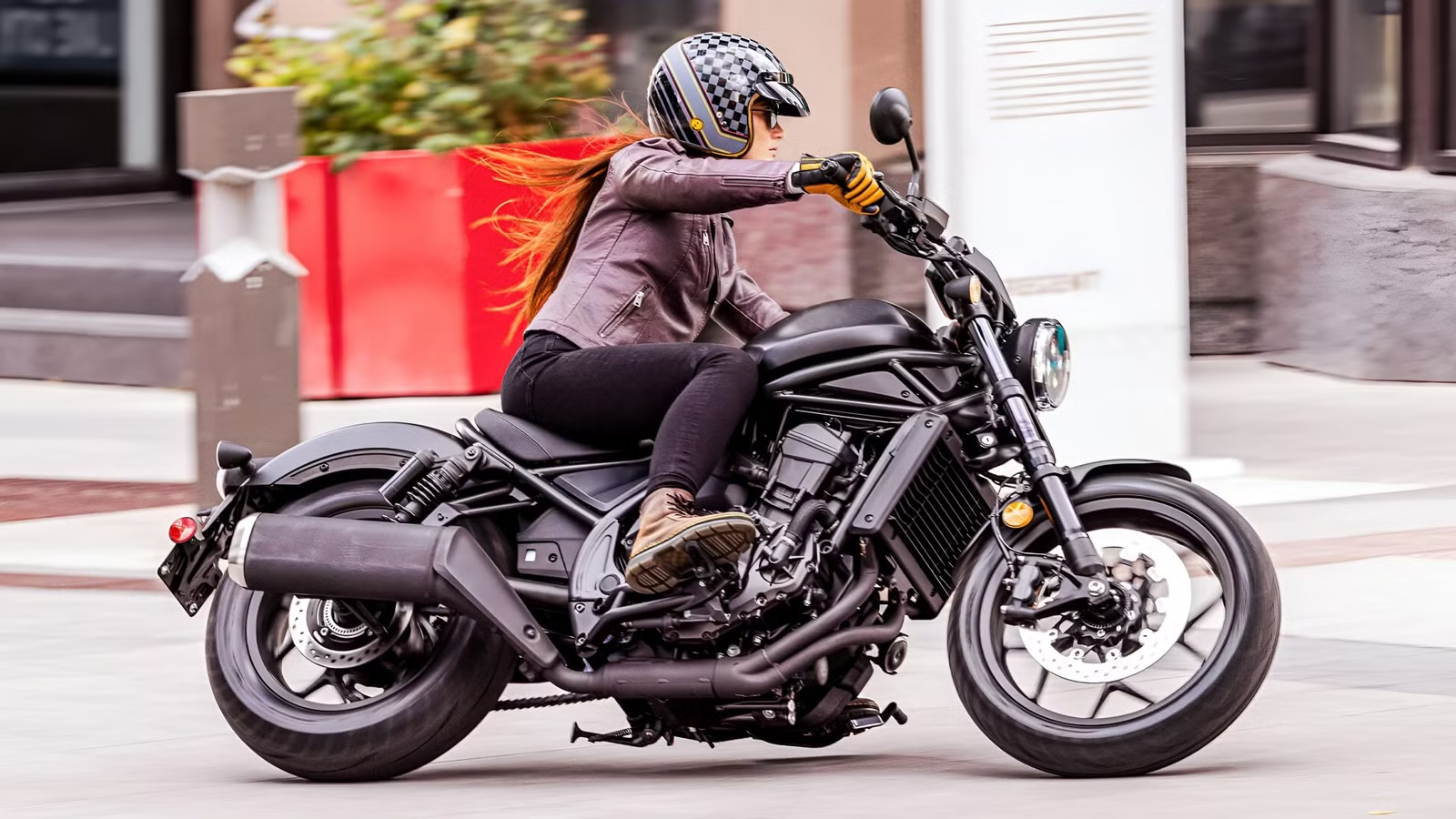
The Rebel 1100 is Honda’s flagship cruiser bike, with an instantly recognizable design language. Its minimal visual cues help keep the dimensions tight and support its do-it-all appeal. In fact, the Rebel 1100 hides its liter-class muscle so well that untrained eyes might not be able to tell the Rebel 500 apart from the 1100. Its modern, lightweight underpinnings, along with a versatile twin-cylinder engine, are shared across various Honda motorcycles, which further contributes to its flexible character.
Then there is its unexpectedly stacked suite of electronic features, including some that are reserved for track-going sportbikes. Honda packs all these features into a reliable flagship cruiser priced surprisingly low at just $9,699. For perspective,the most affordable Harley-Davidson (the Nightster) and Indian (the Scout Sixty Bobber) both start at $9,999. But the price is actually the least surprising thing about the Rebel 1100 — its dimensions shouldn’t make sense for a liter-class bike, and yet somehow they work perfectly.
2026 Honda Rebel 1100 Models Are Exciting And Varied

The base model is bare-bones but stands out as the most affordable 1,000+ cc cruiser on the market. The all-black look and minimal body also add to its custom cruiser appeal. Adding $700 unlocks a whole new dimension of riding with a DCT-equipped Rebel 1100 variant. This makes it the only cruiser bike in 2026 with a truly automatic transmission setup.
Honda also offers a stylized version: the $11,199 Rebel 1100 SE DCT. This trim level stands out with its custom cues like a unique paint job (Deep Pearl Gray), bar-end mirrors, a body-colored headlight cowl, bronze alloy wheels, and a custom solo seat. Finally, we have the Rebel 1100T.

While Honda lists this as a separate model, the 1100T is essentially the bare-bones Rebel with bolt-on touring-focused components. Notable features on the “T” include a cool-looking batwing fairing, standard two-up seating, and weatherproof side cases. The base Rebel 1100T is priced at $10,899, and the DCT model is priced at $11,599.
Its Surprising Middleweight Dimensions Help With Urban Duties

Despite its sizable engine, the Rebel 1100 is surprisingly compact for its class. It has a 59.8-inch wheelbase, a 28-degree rake angle, and a 4.3-inch trail. Couple that with its seat height of just 27.9 inches and a low curb weight of just 497 pounds (for the base trim), and the Rebel 1100 becomes a comfortable, easy urban runabout. It moves like a cruiser should. A few sacrifices make this Honda cruiser bike more versatile. Those include a tiny 3.6-gallon fuel tank, a not-so-traditional silhouette, and neo-retro design language that leans more toward a roadster format than a fully-fledged cruiser.
Powered By A Large-Displacement Parallel-Twin Engine

The Rebel 1100 packs a tractable 1,084 cc parallel-twin engine. This familiar Honda mill powers a variety of motorcycles, including the Africa Twin ADV, the NT1100 tourer, and even the forbidden Hawk 11 café racer. In the Rebel 1100 lineup, this engine is tuned for cruiser duties with meatier mid-range torque, producing roughly 80 percent of its peak torque (72.3 pound-feet) at 3,000 rpm. It produces 87 horsepower at 7,250 RPM.

Power goes to the rear wheel through a standard six-speed manual gearbox. Another sweet addition to the deal is a notable big-bike feature: the available six-speed DCT. This automatic transmission unlocks a whole new, simplified riding experience. In Auto mode, the Rebel 1100 can be operated like a twist-and-go scooter. For more engagement, Honda also offers a manual mode with dedicated paddle-like shifters on the handlebar.
Versatile Underpinnings That Help It Feel At Home On Highways And City Roads

The Rebel 1100 series sits on a semi-double cradle steel main frame shared with the go-anywhere Africa Twin. The aluminum sub-frame and swingarm, however, are modified and designed to suit the cruiser bike stance. The frame sits on 43 mm conventional front forks with 5.5 inches of travel. The rear gets Showa-tuned preload-adjustable dual shocks with 3.7 inches of travel.
Braking duties are taken care of by a single 330 mm disc coupled to a radially-mounted four-piston caliper at the front. The rear gets a 256 mm disc coupled to a single-piston caliper. Grip duties are taken care of by fairly chunky 130-section front and 180-section rear tubeless tires wrapped around lightweight 18-inch front and 16-inch rear alloy wheels. The low unsprung mass, combined with the compact form factor and low curb weight, translates into the Rebel 1100’s flexible riding dynamics on city and highway roads.
Loaded With Big-Bike Electronics

The cockpit features a feature-packed five-inch TFT screen running Honda’s RoadSync software. This allows seamless smartphone connectivity and gives the rider easy access to phone calls, text messages, music playback, and navigation. On the assistive and ride-enhancing front, it gets features like five ride modes (Standard, Sport, Rain, and two custom), ride-by-wire throttle, dual-channel ABS, traction control, Engine Braking Control, and cruise control. Surprisingly, it even gets standard wheelie control, which we see more often on sportbikes.
The Honda Rebel 1100 Offers Big-Bike Energy Without The Stress

The Rebel 1100 is a clever parts-bin project that strikes all the right chords. The engine and main frame are sourced from an ADV. Honda has just revised it into a cruiser bike format with complementary engine characteristics, comfort levels, and design language. Even the technology suite that helps the Rebel 1100 stand out is shared with Honda performance bikes.
This shared nature is also what helps Honda price the Rebel 1100 so aggressively. Another major advantage is Honda’s proven reliability and refinement. This formula is why, despite being five years old, the Rebel 1100 remains undisputed, even as Harley and Indian try hard to lock horns with their most affordable sub-$10,000 cruiser bikes.
Source: Honda Powersports

Related posts

Latest Post



No Comments