The SUV That Makes The Most Sense For Drivers Who Keep Their Cars For 10 Years
10 minutes reading
Saturday, 26 Sep 2026 11:00 0 8 autotech
Buying an SUV that feels right during a 20-minute test drive is easy. Buying one that will still feel like the right decision after 10 years is much harder. Flashy technology can become dated, inexpensive financing eventually gives way to repair bills, and a powerful engine may lose its charm after consuming thousands of dollars in extra fuel. Long-term ownership rewards a different kind of vehicle; one that controls operating costs without becoming too small, too slow, or too compromised for everyday life. Few SUVs balance those competing demands as effectively as one proven compact hybrid, especially when you choose the right model year and trim.
Monthly payments dominate the buying process, but they represent only one piece of a vehicle’s long-term cost. Over 10 years, you will also pay for fuel, insurance, tires, maintenance, repairs, registration, and depreciation. A slightly cheaper SUV can easily become the more expensive choice if it consumes more fuel or loses value faster.
Kelley Blue Book estimates that a representative 2025 version of one particular hybrid SUV will cost approximately $48,681 to own over its first five years. That projection includes roughly $4,763 for fuel, $6,003 for maintenance, and $1,784 for repairs, as well as insurance, financing, fees, and depreciation.
A five-year estimate cannot simply be doubled to predict a decade of ownership. Repair and maintenance costs typically increase as a vehicle ages, while depreciation generally slows. However, the calculation illustrates why an efficient SUV with strong resale value has an enormous advantage over 10 years.
The Right SUV Must Adapt To A Decade Of Life Changes
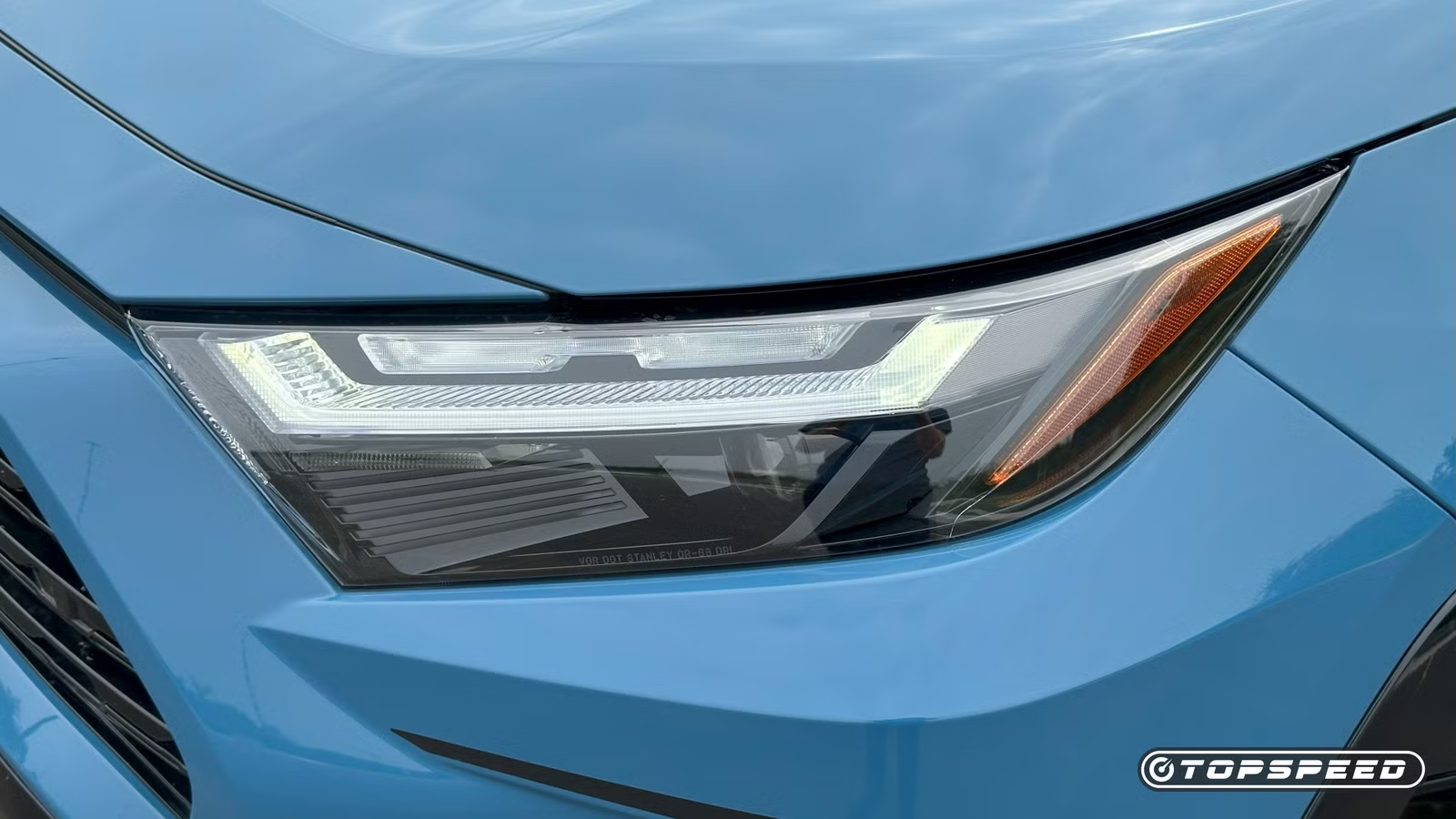
The wheel of a Toyota RAV4 Hybrid Woodland Edition.Toyota
A subcompact crossover may be inexpensive to operate, but it can become frustrating when children, pets, road trips, or bulky cargo come into the picture. A full-size SUV offers greater capability but also comes with higher fuel, tire, insurance, and maintenance costs.
The sweet spot is a compact SUV with enough passenger and cargo room to remain useful without creating unnecessary expenses. The vehicle in question seats five and provides approximately 37.5 cubic feet of cargo space behind its second row. Folding those seats expands the available volume to approximately 69.8 cubic feet.
Those numbers give you enough room for luggage, groceries, home-improvement supplies, and most everyday cargo. It may not replace a three-row SUV for a large family, but it covers a much broader range of needs than its exterior dimensions suggest.
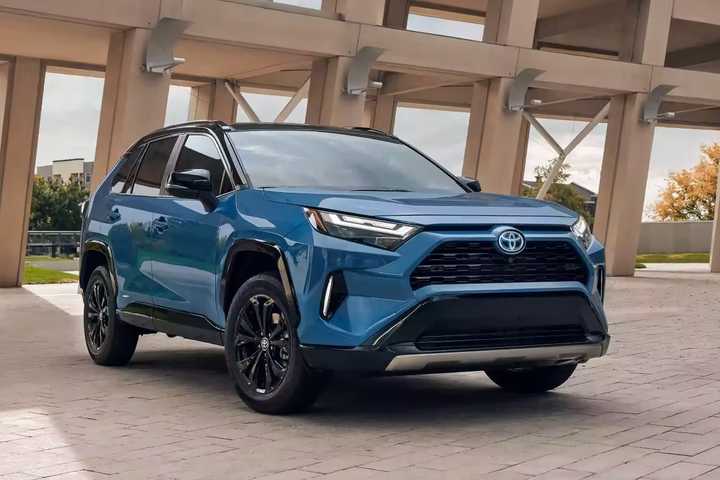
The 2025 Toyota RAV4 Hybrid Is The Long-Term Sweet Spot
A Proven Hybrid System Is More Valuable Than A Complete Redesign
2025 Toyota RAV4 Plug-In Hybrid Red Front Three-QuarterToyota
The 2025 Toyota RAV4 Hybrid is not the newest version of Toyota’s compact SUV. That is precisely why it makes such a strong 10-year purchase. Toyota introduced the fifth-generation RAV4 for the 2019 model year, and the 2025 version arrived without major mechanical changes. By then, the platform and powertrain had been in production for several years. Toyota had time to identify early trouble spots, issue service campaigns, and refine the SUV before replacing it with a redesigned model for 2026.
The 2025 RAV4 Hybrid combines a 2.5-liter four-cylinder engine with electric assistance, producing 219 horsepower. Every hybrid version comes with an electronically controlled continuously variable transmission and electronic on-demand AWD. That setup is not especially exciting, but excitement is not the point. You are getting a mature drivetrain that delivers useful acceleration, excellent efficiency, and fewer first-year unknowns than an all-new design.
Why Lower Trims Outlast Their Loaded Siblings
2025 Toyota RAV4 Plug-In Hybrid Red Front Three-QuarterToyota
The Hybrid LE started at an MSRP of $34,245 when new, while the XLE started at $35,755. By comparison, the Hybrid Limited started at $42,550. That created an $8,305 difference between the least- and most-expensive versions. All three use the same basic 219-horsepower hybrid system. Spending more adds comfort, appearance, and technology features, but it does not fundamentally improve the SUV’s ability to reach its tenth birthday.
A lightly used LE offers the simplest value proposition, while the XLE adds enough convenience equipment to make daily driving more pleasant without pushing the price into near-luxury territory. Features such as larger wheels, panoramic roofs, powered liftgates, and additional electronics can be enjoyable, but each one also represents another component that could eventually require attention.
The Hybrid System Can Save Thousands Before Year 10
A 39-MPG Rating Changes The Ownership Calculation
2025 Toyota RAV4 Plug-In Hybrid Cargo AreaToyota
Most 2025 RAV4 Hybrid trims are rated at 41 city/38 highway mpg, and 39 mpg combined. The Woodland Edition is slightly lower due to its more rugged configuration. A gasoline RAV4 with AWD generally returns between 28 and 30 mpg combined, depending on the trim.
At 12,000 miles per year, a vehicle averaging 39 mpg would consume approximately 308 gallons annually. One averaging 29 mpg would use roughly 414 gallons. That is a difference of about 106 gallons every year. Over 10 years, the hybrid could save approximately 1,060 gallons. The longer you keep the RAV4 Hybrid, the more time its efficiency has to offset its initial price.
The Battery Warranty Matches The Ownership Plan
Profile action shot of 2025 Toyota RAV4 Plug-In Hybrid in blue being driven on roadToyota
The expensive hybrid battery remains one of the first objections raised against keeping a hybrid for a decade. Toyota addresses much of that concern with a hybrid-battery warranty lasting 10 years/150,000 miles, whichever comes first. The broader hybrid control components are covered for eight years/100,000 miles.
If you drive 12,000 miles annually, you will reach approximately 120,000 miles at the end of year 10. That keeps the battery within the mileage limit for the entire ownership period, provided the warranty began when you purchased the vehicle new.
A used example will have less remaining coverage because the warranty is based on the vehicle’s original in-service date. High-mileage drivers could also pass 150,000 miles before reaching 10 years. Even so, the coverage removes much of the financial uncertainty surrounding the vehicle’s most expensive hybrid-specific component.
Strong Resale Value Provides An Exit Strategy
The RAV4 Hybrid Depreciates More Slowly Than Most SUVs
Planning to keep an SUV for 10 years does not guarantee life will cooperate. A growing family, a changing commute, an accident, a relocation, or a financial emergency could force you to sell earlier.
According to iSeeCars, the RAV4 Hybrid loses approximately 25.2 percent of its value over five years. The average hybrid compact SUV loses about 32.8 percent, while the average SUV loses approximately 44.9 percent. That resale strength makes buying one more expensive on the used market, but it also protects you if the 10-year plan changes.
Keeping It After The Loan Ends Creates The Real Payoff
The interior of a 2025 Toyota RAV4 Hybrid LimitedToyota
Strong resale value does not mean the RAV4 Hybrid avoids depreciation. It means the loss should be less severe than with many alternatives. The greater financial benefit comes from keeping the SUV after the loan is paid off.
Trading every three or four years repeatedly resets the depreciation and financing cycle. Keeping the RAV4 through years six, seven, and beyond allows you to benefit from its remaining value without taking on another new-car payment.
The strategy works only if the vehicle remains dependable, which is why buying a mature model with documented maintenance matters more than selecting the newest dashboard or exterior design.
Long-Term Ownership Still Requires More Than A Toyota Badge
Maintenance Records Matter More Than Reputation
A side on shot blue 2025 Toyota RAV4 Hybrid Woodland Edition drivingToyota
Toyota’s reputation does not make the RAV4 Hybrid immune to neglect. The scheduled maintenance plan generally calls for inspections and tire rotations every 5,000 miles or six months. Oil and filter changes typically occur every 10,000 miles or 12 months under normal conditions, although severe driving can require shorter intervals.
The hybrid battery’s cooling intake also needs to remain clean and unobstructed. Pet hair, dust, and debris can restrict airflow and increase battery temperatures. A used RAV4 Hybrid should come with service records, a clean history report, and an independent pre-purchase inspection. A neglected Toyota can still become an expensive Toyota.
Earlier Fifth-Generation Models Have Known Trouble Spots
A rear view shot of a green 2025 Toyota RAV4 Hybrid Woodland Edition parkedToyota
The fifth generation is proven, but it is not perfect. Certain early RAV4 Hybrids experienced refueling problems that prevented owners from using the fuel tank to its full capacity. Toyota responded with the Customer Support Program 20TE06 for qualifying vehicles.
High-voltage cable corrosion is another concern, particularly on AWD hybrids driven in regions where road salt is common. The problem became associated primarily with earlier fifth-generation examples, although any hybrid used in repeated winter conditions deserves an underbody inspection.
These problems strengthen the argument for a 2025 model rather than destroying the RAV4’s long-term case. Toyota had already revised components and addressed several early-production concerns by the final model year. Regardless of the year, you should check the VIN for open recalls, support programs, and completed repairs before buying.
The RAV4 Hybrid Wins By Being Easy To Keep
It Is Not The Cheapest Or Most Exciting Compact SUV
A RAV4 Hybrid can sound strained under hard acceleration, and its cabin lacks the polish found in some competitors. The steering will not make an enthusiast search for a winding road, and the strong resale value means used examples are rarely spectacular bargains.
The redesigned 2026 RAV4 also offers newer technology, more power, and a more modern cabin. What it cannot offer yet is the fifth generation’s accumulated ownership history. That distinction matters when you plan to keep a vehicle until the mid-2030s. New features are appealing, but proven mechanical history carries more weight across a decade.
A clean 2025 Toyota RAV4 Hybrid LE or XLE with documented maintenance is the strongest version of this long-term ownership argument. It offers useful cargo capacity, standard AWD, 39 mpg combined, favorable resale value, and battery coverage that lasts through the entire 10-year plan.
It is not guaranteed to go a decade without needing repairs. No SUV can make that promise. Instead, the RAV4 Hybrid controls several major ownership risks simultaneously without asking you to accept a cramped cabin, excessive fuel consumption, or an unproven powertrain. For a driver who intends to buy once and keep driving long after the payments disappear, that balanced approach makes more sense than chasing whichever SUV happens to be newest.
Base Trim Engine
Dynamic Force Hybrid
Base Trim Transmission
CVT
Base Trim Drivetrain
All-Wheel Drive
Base Trim Horsepower
176 HP @5700 RPM
Base Trim Torque
163 lb.-ft. @ 3600 RPM
Base Trim Fuel Economy (city/highway/combined)
41/38/39 MPG
Base Trim Battery Type
Lead acid battery
Make
Toyota
Model
RAV4 Hybrid
Sources: Toyota, Kelley Blue Book, iSeeCars, Edmunds, NHTSA, Automobile Protection Association











No Comments