
The Japanese Touring Bike That Makes Cross-Country Riding Feel Simple
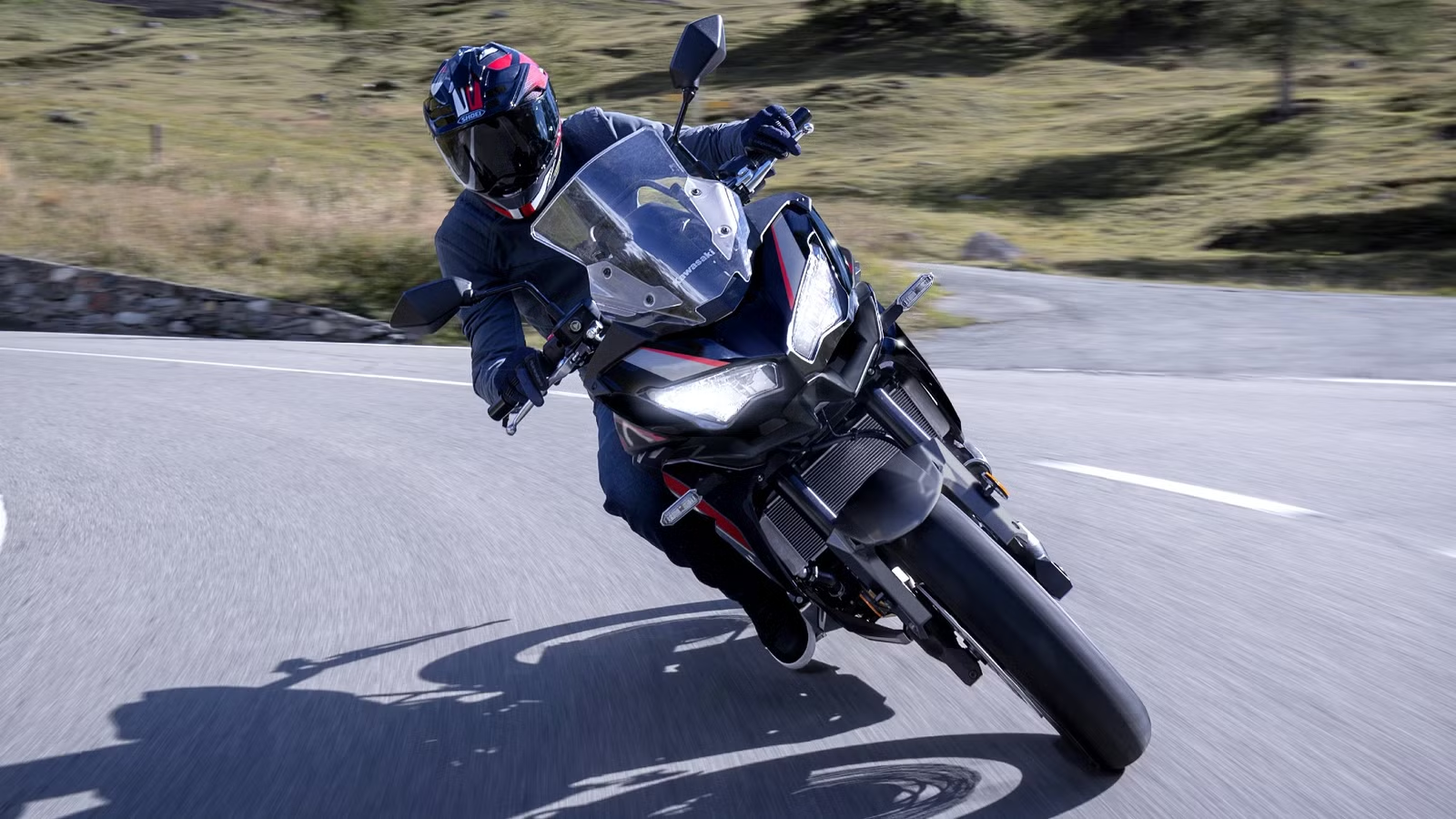
Most cross-country touring motorcycle discussions will invariably lean towards someone saying, “you need a big adventure bike.” The suggestion is rooted in big engines making highway passing effortless, giant fairings keeping the weather away, and increasingly elaborate electronics promising to make long days easier one way or the other. The drawbacks are what usually isn’t elaborated upon after the suggestion.

With the added weight, purchase cost, and complexity that a big adventure bike brings along, there is still plenty to be said for a middleweight tourer that concentrates on getting the basics right. Comfortable ergonomics, decent weather protection, useful luggage capacity, predictable handling, and an engine that chugs along effortlessly. These are what help you manage a bike better with the compounding fatigue when covering serious road miles in a day. Simplicity, thus, can be its own luxury.
Cross-Country Touring Gets Easier When The Motorcycle Stays Manageable
Traditional touring motorcycles have become exceptionally capable, but capability has grown alongside physical dimensions. Full-dress luxury tourers can sail along an Interstate beautifully, while the latest liter-class adventure tourers bring power figures and electronic suspension systems that would have seemed extravagant on superbikes not very long ago. They are excellent tools for the job, provided the rider wants everything that comes with them.


A smaller road-focused adventure-touring bike approaches the miles differently. An upright seating position reduces the strain of supporting your upper body, suspension with more travel than a conventional street bike provides useful compliance over broken pavement, and a reasonably tall windscreen takes some pressure away from the rider at sustained highway speeds. Add luggage without pushing curb weight deep into heavyweight-tourer territory, and the motorcycle remains much easier to deal with once the road trip leaves the highway.

Seventeen-inch road wheels also make sense when the planned adventure involves more asphalt rather than trails. And let’s face it, cross-country riding today involves more of the black stuff than off it. These motorcycles allow conventional sport-touring tire choices while keeping the steering relatively quick, and there is little benefit in carrying the compromises of a 21-inch front wheel if gravel roads aren’t part of the ride.

That combination creates an interesting sweet spot. The bike doesn’t need superbike horsepower, radar-assisted cruise control, electronically adjustable suspension, or enough luggage to move a house. It needs to comfortably run at highway speeds for hours, carry a week’s essentials, deal with bad pavement without complaint, and still feel manageable at slow speeds. Kawasaki has been quietly building precisely this motorcycle for years.
The 2026 Kawasaki Versys 650 LT ABS Keeps Touring Refreshingly Straightforward

The 2026 Versys 650 LT ABS takes Kawasaki’s long-running middleweight road-tourer and adds the touring equipment straight from the factory. At $10,399, the LT comes standard with removable hard saddlebags and hand guards while retaining the regular Versys 650’s adjustable windscreen, 5.5-gallon fuel tank, upright ergonomics, long-travel suspension, ABS, traction control, and 17-inch wheels. Kawasaki lists the standard bike at 482.9 pounds curb, with the LT’s saddlebags and hand guards adding approximately 20 pounds.
The 649cc Parallel Twin Has Enough Power For All Roads

At its core is Kawasaki’s familiar liquid-cooled 649cc parallel twin, producing a claimed 66 horsepower at 8,500 rpm and 45 pound-feet of torque at 7,000 rpm. Those numbers won’t keep a bigger tourer awake at night, but that isn’t the intent here either. Kawasaki tunes this version of the engine around accessible low- and midrange response, and the six-speed transmission keeps the powertrain conventional as well.
The engine’s value over distance comes from how little management it requires. There is enough poke for highway overtaking, while fuel injection and Kawasaki’s secondary throttle valves smooth out the power delivery. Independent testing has also shown the Versys capable of returning roughly 45 mpg in mixed riding, thus putting a 200-mile stint within realistic reach from that 5.5-gallon tank. That is the sort of fuel efficiency that matters considerably more in Nevada than another 30 horsepower.
Its Road-Focused Chassis Makes More Sense Than Pretending To Be A Dirt Bike

The Versys has always occupied an unusual space between a sport-tourer and an adventure motorcycle. Its 41mm upside-down fork provides 5.9 inches of travel and adjusts for spring preload and rebound damping, while the offset rear shock offers 5.7 inches and gets remote manual preload adjustment. The latter is particularly useful on a touring bike because adding a passenger or topping the panniers wouldn’t require messing around the shock with tools.

Both wheels are 17-inch cast aluminum units wearing 120 and 160 section tires front and back respectively. Combined with a relatively short 55.7-inch wheelbase, that brings the Versys closer to a street-bike’s geometry. This also translates to its agility, with a willingness to change direction quickly and surprisingly composed behavior along twisty roads.
The Versys 650 LT Already Has The Touring Hardware

The biggest reason to choose the LT is because Kawasaki equips it with two 7.4-gallon hard saddlebags using its KQR quick-release mounts, giving the bike roughly 14.8 gallons of lockable storage. Both cases use Kawasaki’s One Key system and can be removed without tools. Taking them off at the motel will be a breeze, and the mounting arrangement is much cleaner than the scaffold-like racks fitted to many aftermarket systems.

The Versys keeps its touring tech focused as well with a four-position windscreen, hand guards, color TFT, smartphone connectivity, LED lighting, ABS, and two-level traction control. Added tech like cruise control, semi-active suspension, and IMU-based electronics are given a miss, leaving a conventional six-speed, chain-driven motorcycle that is refreshingly easy to operate.
The Honda NC750X DCT Takes Simplicity In A Different Direction

Honda’s 2026 NC750X DCT is a notable alternative at $9,499. It uses a larger 745cc parallel twin and goes even further in reducing rider workload with its six-speed Dual-Clutch Transmission. Its 31.6-inch seat is lower than the Kawasaki’s 33.3 inches, and Honda also builds a 6.1-gallon storage compartment into the area where a conventional fuel tank would normally sit. At 497 pounds ready to ride, it remains manageable despite carrying the additional DCT hardware.

The Honda is arguably the easier motorcycle in traffic and daily commutes, but it comes less prepared for a week on the road. Its fuel capacity is only 3.7 gallons, hard panniers aren’t standard, and suspension travel is 4.7 inches at each end. The Versys 650 LT costs $900 more, yet brings more factory hard luggage capacity as standard, greater fuel capacity, more suspension travel, along with the peace of mind of a 24-month warranty. Cross-country touring becomes simpler when the motorcycle gives you what the trip needs and leaves most of the complications at home, and that’s precisely what the Versys 650 LT does.
Source: Kawasaki

Related posts


Latest Post


No Comments