
Geely Says Its AI Charging Tech Can ‘Heal’ EV Batteries Instead Of Wearing Them Out
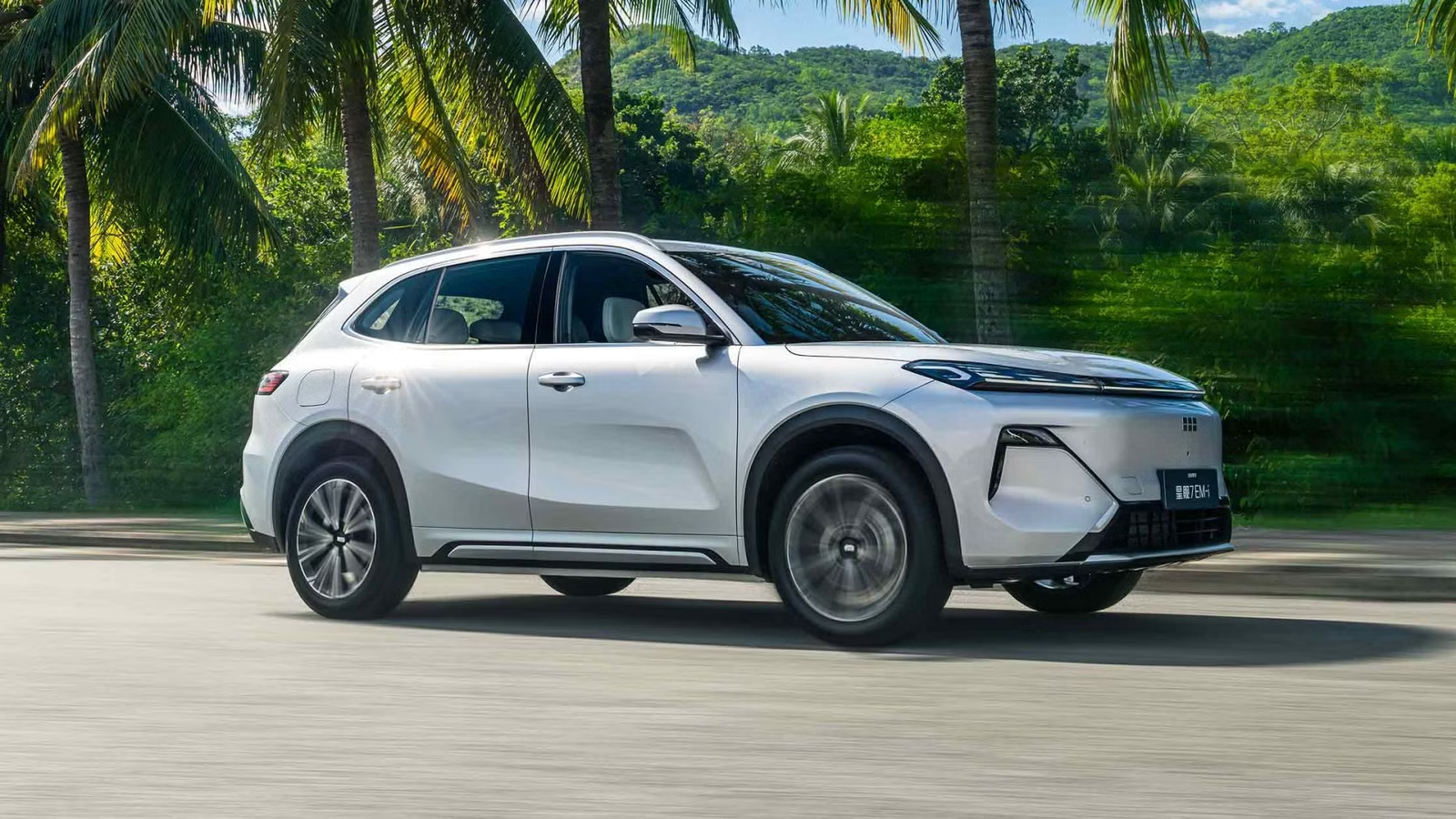
Fast charging has always come with a catch: the quicker you fill a battery, the faster it wears out. Geely says it has found a way around that trade-off. The company’s fifth-generation Smart Charging Station, unveiled September 25 in Ningbo, pairs ultra-fast charging with what Geely calls lithium-ion pulse restoration technology, a system that claims to reverse some of the cellular damage fast charging causes rather than just working around it.

That distinction matters more than the speed numbers Geely also announced. Plenty of automakers can brag about minutes-to-full stats. Geely is the one claiming its charger can add up to 20% more battery cycle life on top of a 4.5-minute fast charge, which, if it holds up in the real world, would reframe how EV owners think about the long-term cost of relying on fast chargers.
How Geely Says It’s Reversing Lithium Plating
The villain in every fast-charging story is lithium plating. Push current into a cell too aggressively and some lithium ions pile up on the surface of the anode instead of properly absorbing into it. Once that happens, those ions stop cycling, and the battery slowly loses usable capacity for good.

Geely’s fix is a system of micro-pulse currents sent through the cells, designed to reactivate lithium ions that have built up at the negative electrode after repeated fast-charging sessions. Combined with AI-managed charging, Geely says the process adds up to 20% more cycle life to the battery. The company also built a slower home-charging strategy meant to work overnight, gradually undoing degradation from a day of fast-charging stops. The idea is straightforward: fast charge on the road, then let a gentler overnight charge at home clean up the damage.
The AI Brain Managing Temperature 30 Seconds Ahead

Running current at these levels generates a lot of heat, which is its own threat to battery life. Geely’s answer is Xingrui PowerMind, an AI model co-developed with Chinese AI company StepFun that coordinates the vehicle, battery, charger, cloud, grid, and energy storage system in real time.
Most EVs today only cut charging power after the battery has already gotten hot. PowerMind is built to forecast battery temperature up to 30 seconds ahead and dial back power before it spikes, adjusting current, cooling, and session length for each vehicle and battery individually. Geely’s targets are an average battery temperature of 55°C during charging with peaks kept under 65°C. To hit those numbers at 2,250 kW, the system uses what Geely calls the industry’s first five-point liquid cooling setup, covering the storage battery, charging pile, cable, port, and the vehicle’s own pack, so no single link overheats and becomes the bottleneck.
The Batteries Behind The Numbers

Geely tested the system on the Lynk & Co 10 and Zeekr 001, both fitted with the Shendun Golden Battery, which supports a 12C peak charging rate. In those tests, the cars went from 10% to 70% charge in 4 minutes and 30 seconds, and to 97% in 8 minutes and 40 seconds.
For cheaper models, Geely is rolling out the Next-Gen Ultra Short Blade Battery, rated at a 6C peak rate. A laser-welding process on the cell tabs and covers is said to cut heat generation during charging by 10%, which is what lets a more affordable battery still support fast charging without the thermal penalty usually attached to it. That’s arguably the more consequential rollout for everyday buyers, since it brings quick charging and the degradation-fighting pulse system to cars that don’t carry Zeekr-level price tags.
Why This Beats Just Throttling Around The Problem

Automakers have known about lithium plating for years, and most have handled it by playing defense. Tesla, for example, has limited Supercharging speeds on packs with a long history of DC fast charges since 2017, essentially rationing speed to protect the battery. Geely’s pulse restoration approach, if it performs as advertised outside a controlled test, tries to fix the underlying damage instead of just slowing down to avoid it.
For EV owners and shoppers weighing fast-charging convenience against long-term battery health, that’s the more useful framing. A 20% cycle-life gain wouldn’t just mean fewer miles lost per year, it could meaningfully change resale value and total ownership cost on a used EV that’s been fast-charged its whole life. The catch is that this is still Geely’s own claim from its own launch event, not independent lab data, and the company hasn’t published a specific battery lifespan figure tied to the 20% number. Whether pulse restoration holds up after years of real-world fast charging, rather than a single demonstration, is the question worth watching before anyone treats this as solved.

Related posts





Latest Post


No Comments