
10 Legendary Toyota Engines That Refuse To Die
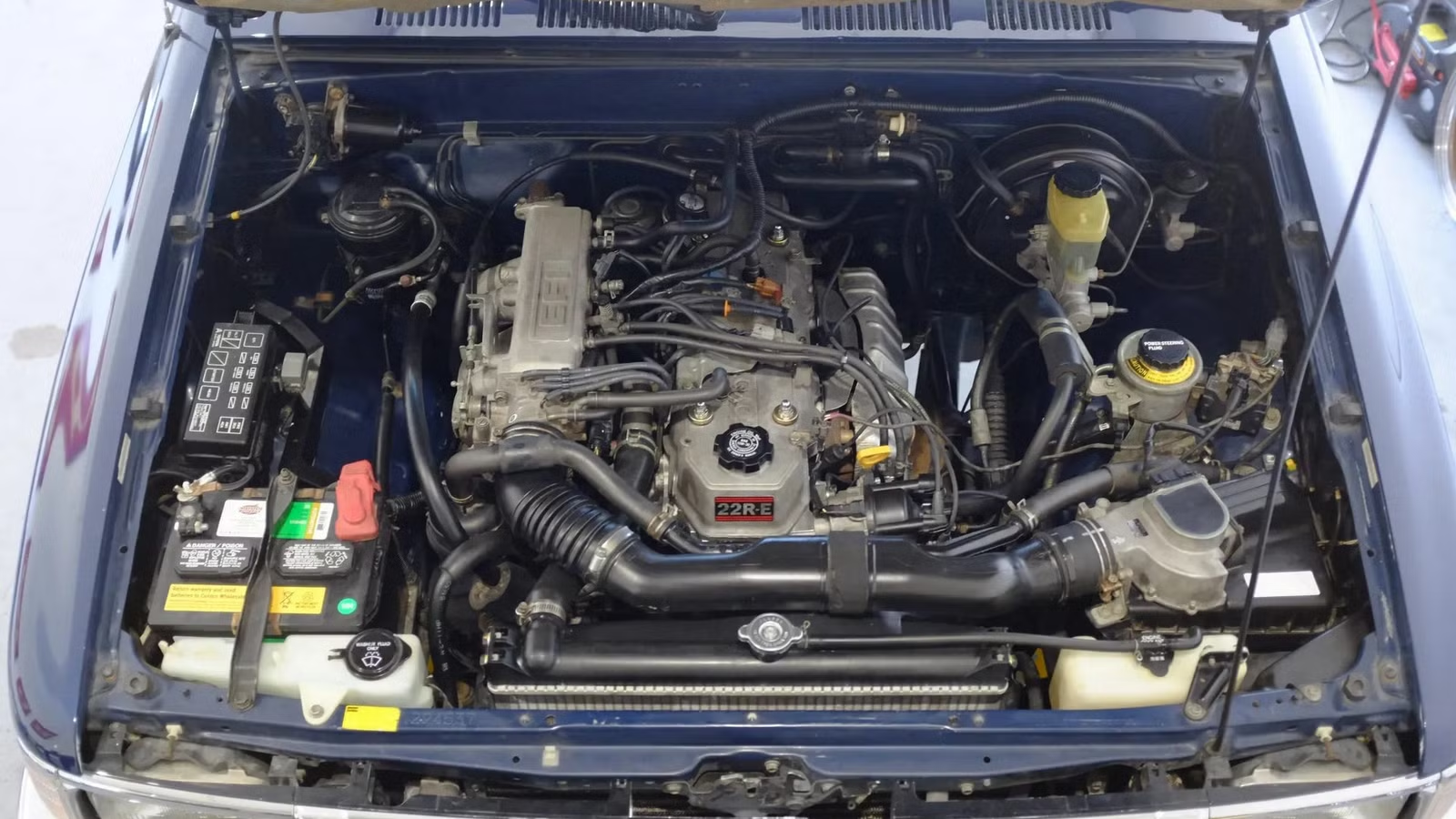
Few automakers have built a reputation on a single engine layout the way Toyota has with the inline-four. Decade after decade, generation after generation, Toyota’s four-cylinder engines have quietly powered some of the most dependable vehicles ever to turn a wheel — and the proof is in the numbers. The Toyota Corolla remains the best-selling car in history, and no single factor explains that achievement better than the unbroken lineage of inline-four engines that has underpinned it across every generation. Toyota has invested more time, resources, and engineering talent into the inline-four than any other automaker — and the results speak for themselves.
Of all the great all-time Toyota engines, inline-four examples outnumber every other layout combined, and it isn’t even close. In that spirit, here is a list of ten legendary Toyota inline-four engines that laid the foundation for the brand’s exceptional reliability.
8R 1.9-liter Inline-Four
Output: 109 Horsepower
In 1959, when Toyota debuted its first North American model, the Toyota Crown, it was an absolute failure. The 1.5-liter R engine that powered the Crown — the first of the R inline-four family — was unsuitable for the speeds found on North American highways, and it lacked the efficiency or reliability qualities needed to make a lasting impression.
1971 Toyota Hilux Engine Specifications And Applications
 64 autotech Manufacturer |
Toyota |
|---|---|
|
Production Years |
1968-1973 |
|
Configuration |
Naturally-aspirated inline-four |
|
Displacement |
1.9-liter |
|
Power |
109 horsepower |
|
Torque |
128 lb.ft |
|
Noteworthy Application |
1971 Toyota Hilux, 1971 Toyota Corona |
Fast-forward to the early 1970s, and Toyota had made critical improvements to the R platform. The 1.9-liter 8R was the first Toyota engine to demonstrate above-average performance and quality. No detail was more significant to its long-term capability than the introduction of a 2-valve overhead camshaft design, which moved Toyota firmly into the modern era and away from the archaic pre-war architecture of its predecessors.
20R 2.2-liter Inline-Four
Output: 90 Horsepower

Development was moving fast with the Toyota inline-four during this period, and only five years after the 8R, Toyota introduced the substantially updated 2.2-liter 20R.
1975 Toyota Hilux Engine Specifications And Applications
|
Manufacturer |
Toyota |
|---|---|
|
Production Years |
1975-1980 |
|
Configuration |
Naturally-aspirated inline-four |
|
Displacement |
2.2-liter |
|
Power |
90 horsepower |
|
Torque |
122 lb.ft |
|
Noteworthy Application |
1975 Toyota Hilux, 1975 Toyota Celica Coupe |
The 8R was a capable engine for its time, but the 20R was the standout of its generation. Key improvements over the 8R included an aluminum hemi-style head, strengthened internals and timing design, and a lengthened stroke. Together, these changes made the 20R more reliable than any Toyota engine that had come before it, while also delivering genuine low-end torque — a first for Toyota’s SOHC R-series engines.
22R 2.4-liter Inline-Four
Output: 97 Horsepower

The 2.4-liter 22R took the 20R’s solid foundation and refined it further through a displacement increase. Toyota clearly recognized it had something special, because the 22R would go on to enjoy nearly four times the production lifespan of its 20R predecessor — close to two decades in total.
1981 Toyota Hilux Engine Specifications And Applications
|
Manufacturer |
Toyota |
|---|---|
|
Production Years |
1981-1995 |
|
Configuration |
Naturally-aspirated inline-four |
|
Displacement |
2.4-liter |
|
Power |
97 horsepower |
|
Torque |
128 lb.ft |
|
Noteworthy Application |
1981 Toyota Hilux, 1984 Toyota Celica |
Both horsepower and torque increased for this generation, and by the end of its production run in 1995, the carbureted 22R had climbed to 109 horsepower and 138 pound-feet of torque.
22R-E 2.4-liter Inline-Four
Output: 105 Horsepower

Although the 22R had a rock-solid internal design, Toyota knew there was one area where both efficiency and performance could still be improved: fueling.
1985 Toyota Hilux Engine Specifications And Applications
|
Manufacturer |
Toyota |
|---|---|
|
Production Years |
1983-1997 |
|
Configuration |
Naturally-aspirated inline-four |
|
Displacement |
2.4-liter |
|
Power |
105 horsepower |
|
Torque |
136 lb.ft |
|
Noteworthy Application |
1985 Toyota Hilux, 1985 Toyota 4Runner |
The 2.4-liter 22R-E was the first R-family inline-four to offer electronic fuel injection, making it the most efficient and most powerful Toyota inline-four of its era. By 1985, a strengthened and refined version of the 22R-E had become the standard engine across many Toyota models, including the newly introduced Toyota 4Runner.
4A-GE 1.6-liter Inline-Four
Output: 112 Horsepower

While the 22R platform was in its prime, Toyota was simultaneously developing a smaller-displacement, high-performance inline-four that would prove foundational to the brand’s sporting legacy: the legendary 4A-GE.
1984 Toyota MR2 AW11 Engine Specifications And Applications
|
Manufacturer |
Toyota |
|---|---|
|
Production Years |
1983-1991 |
|
Configuration |
Naturally-aspirated inline-four |
|
Displacement |
1.6-liter |
|
Power |
112 horsepower |
|
Torque |
97 lb.ft |
|
Noteworthy Application |
1985 Toyota MR2, 1988 Toyota Corolla |
Yamaha and Toyota share a celebrated engineering partnership, and the 1.6-liter 4A-GE inline-four ranks among their finest collaborations. It was one of the first Japanese dual overhead cam 16-valve engines ever produced, and it became an instant hit thanks to its compact dimensions, spirited character, and top-tier reliability. By the end of its production run in 1991, the 4A-GE had grown to 123 horsepower and 110 pound-feet of torque, courtesy of a raised compression ratio.
3S-GTE 2.0-liter Turbocharged Inline-Four
Output: 190 Horsepower

Another successful Yamaha-Toyota collaboration in the late 1980s produced the high-performance 3S-GTE, the only turbocharged engine on this list.
1988 Toyota Celica All-Trac Turbo Engine Specifications And Applications
|
Manufacturer |
Toyota |
|---|---|
|
Production Years |
1986-2007 |
|
Configuration |
Turbocharged inline-four |
|
Displacement |
2.0-liter |
|
Power |
190 horsepower |
|
Torque |
190 lb.ft |
|
Noteworthy Application |
1988 Toyota Celica, 1991 Toyota MR2 |
The 3S-GTE delivered solid reliability through a lower compression ratio and an upgraded engine oiling system compared to the naturally aspirated 3S-GE. By the time it appeared in the SW20-generation Toyota MR2, outputs had climbed to 200 horsepower and 200 pound-feet of torque — with considerably more power potential waiting to be unlocked by tuners.
2RZ-FE 2.4-liter Inline-Four
Output: 142 Horsepower

If the groundbreaking 22R-E had a spiritual successor, it would be the 2.4-liter 2RZ-FE inline-four found in the first-generation Toyota Tacoma.
1995 Toyota Tacoma Engine Specifications And Applications
|
Manufacturer |
Toyota |
|---|---|
|
Production Years |
1995-2004 |
|
Configuration |
Naturally-aspirated inline-four |
|
Displacement |
2.4-liter |
|
Power |
142 horsepower |
|
Torque |
160 lb.ft |
|
Noteworthy Application |
1995 Toyota Tacoma |
The 2RZ-FE was a thoroughly modernized evolution of the 22R-E: it retained the same displacement but added dual overhead cams and four valves per cylinder — double the valve count of its predecessor. Despite producing more power, torque, and fuel efficiency than the 22R-E, the 2RZ-FE was engineered well beyond its output demands, and that overbuilt construction is precisely what gives it legendary long-term reliability.
3RZ-FE 2.7-liter Inline-Four
Output: 150 Horsepower

The 2.7-liter 3RZ-FE is the successor to the 2.4-liter 2RZ-FE, and it is found in the first-generation Toyota Tacoma and third-generation Toyota 4Runner.
1997 Toyota 4Runner Engine Specifications And Applications
|
Manufacturer |
Toyota |
|---|---|
|
Production Years |
1995-2004 |
|
Configuration |
Naturally-aspirated inline-four |
|
Displacement |
2.4-liter |
|
Power |
150 horsepower |
|
Torque |
177 lb.ft |
|
Noteworthy Application |
2000 Toyota Tacoma, 1997 Toyota 4Runner |
Despite the modest displacement increase, the 3RZ-FE managed to extract an additional 17 pound-feet of torque and eight horsepower over the 2RZ-FE. Both engines share the same compression ratio, but the 3RZ-FE distinguishes itself with twin chain-driven balance shafts to reduce vibration — a feature absent from the 2RZ-FE. Combined with a forged crankshaft and connecting rods, the result is an engine built to outlast the vehicle around it, provided timing chain replacements and valve adjustments are performed on schedule.
1ZZ-FE 1.8-liter Inline-Four
Output: 120 Horsepower

By the time Toyota engineered the 1.8-liter 1ZZ-FE inline-four, the brand had already cemented itself as the dominant force in four-cylinder development (Honda a close rival).
1999 Toyota Corolla Engine Specifications And Applications
|
Manufacturer |
Toyota |
|---|---|
|
Production Years |
1997-2008 |
|
Configuration |
Naturally-aspirated inline-four |
|
Displacement |
1.8-liter |
|
Power |
120 horsepower |
|
Torque |
122 lb.ft |
|
Noteworthy Application |
Eighth, ninth, and tenth-generation Toyota Corolla, second-generation Toyota RAV4 |
The 1ZZ-FE appeared in not just one, but three consecutive generations of the Toyota Corolla, along with a variety of other Toyota vehicles from the same era. Its reputation for dead-reliable service stems from an overbuilt construction featuring forged connecting rods and a timing chain in place of the earlier belt designs, all while maintaining a relatively modest power output.
The 1ZZ-FE’s one acknowledged weakness is a tendency toward oil consumption, caused by undersized piston rings and insufficient oil drainage in the pistons. Despite this known quirk, these engines are celebrated for remarkable consistency, and as long as oil levels are monitored regularly, the 1ZZ-FE’s longevity is rarely in question.
1NZ-FXE 1.5-liter Hybrid Inline-Four
Output: 70 Horsepower

Just when it seemed Toyota had exhausted the possibilities of the inline-four, the brand revolutionized what the layout could achieve with the 1.5-liter 1NZ-FXE hybrid inline-four.
Engine Specifications And Applications
|
Manufacturer |
Toyota |
|---|---|
|
Production Years |
1997-present |
|
Configuration |
Naturally-aspirated inline-four |
|
Displacement |
1.5-liter |
|
Power |
70 horsepower |
|
Torque |
82 lb.ft |
|
Noteworthy Application |
2001 Toyota Prius, 2008 Toyota Prius, 2016 Toyota Prius C |
The 1NZ-FXE powers the first- and second-generation Toyota Prius, which led the hybrid revolution alongside the discontinued Honda Insight. It was among the first engines to employ the efficiency-focused Atkinson cycle rather than the conventional Otto cycle found in the vast majority of engines up to that point. The engine’s comparatively low output is seamlessly compensated by the instant torque of an electric motor — exactly the kind of partnership that defines a hybrid powertrain.
Today, dozens of vehicles across virtually every major manufacturer utilize the Atkinson cycle for improved efficiency, a practice pioneered by the first-generation Prius. Few vehicles in history can rival the sheer mileage capability of the Prius, which remains a top choice for taxi and rideshare operators worldwide. If any Toyota engine was engineered to simply refuse to quit, it’s the 1NZ-FXE — an engine that has now accumulated well over two decades of continuous production with no end in sight.
Sources: Toyota

Related posts

Latest Post


No Comments