
An Unlikely Rival To The Ford Maverick Flex Bed Is Getting Hard To Deny

Nissan just published its fourth midgate patent in a matter of months, and at this point the accumulation of filings is doing the talking. Patent US 2026/0274351, published September 21, lays out in precise detail how the rear seat and folding cab panel would collapse to create a level, extended load floor continuous with the truck bed — the same engineering logic Honda applies in the HR-V’s cargo floor, now transplanted into a mid-size pickup.

Three earlier patents dropped on June 25 covering the basic midgate mechanism, rear glass retraction into the folding panel, and a dedicated latch system. Before that, Nissan filed a patent for rear-facing seats that would flip open-air style when the midgate is deployed, and another describing the concept applied to a unibody chassis. Four patents in a few months, each one more detailed than the last. That’s not exploratory IP — that’s a product roadmap.
What a Midgate Actually Does, and Why It Matters
The midgate concept is straightforward: fold the rear seatbacks flat, drop the seat base to the floor, and flip the bulkhead panel down flush with the bed floor. The result is an extended, level load surface that reaches from the tailgate all the way into the cabin — without adding a single inch to the truck’s overall footprint. You get the bed length of a regular cab with the option to restore four-seat capacity whenever you need it.

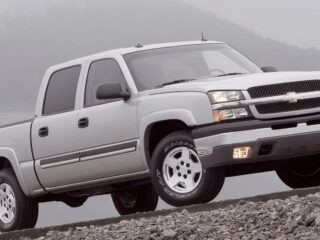
GM proved the idea works in the real world. The 2002 Chevrolet Avalanche launched with a midgate and turned it into a genuine selling point, with the Cadillac Escalade EXT and Hummer H2 SUT following suit. The feature went dormant when those trucks left production, but GM revived it on the Chevrolet Silverado EV and GMC Sierra EV — proof that the engineering holds up and buyers respond to it. Right now, GM is the only automaker offering a midgate on any production vehicle. No mid-size truck has ever had one.
The Latest Patent Gets Into the Mechanics

The September 21 filing is the most detailed of the four. It describes the seat base dropping to the floor first, which allows the seatback to fold lower than it normally could. That lower fold angle is what lets the bulkhead panel hinge down and land flush with the bed — creating the level load floor rather than an awkward step. The patent explicitly notes the mechanism could apply to SUVs and hatchbacks as well, which tracks with Nissan’s broader platform ambitions.
The June 25 trio handled the surrounding systems: how the rear glass retracts into the folding panel rather than having to be removed entirely, and how the latch hardware secures everything in both the open and closed positions. Taken together, the four patents describe a complete, engineered system — not a sketch of an idea.
The Platform Timing Lines Up Perfectly

Nissan is developing a new body-on-frame platform that will debut on the 2028 Xterra, then underpin the next-generation Frontier and larger SUVs shortly after. Nissan executives have confirmed the Frontier follows the Xterra on a similar timeline, likely arriving in the 2028–2029 window. The Xterra will also introduce a hybrid V6, signaling that Nissan is treating this platform generation as a full reset — new architecture, new powertrains, new features.
A midgate would fit that reset perfectly. It’s a feature that costs nothing in overall truck length, adds genuine cargo versatility, and gives the next Frontier a differentiator that no current mid-size competitor — not the Tacoma, not the Colorado, not the Ranger — can match. The Ford Maverick’s Flex Bed is the closest analogue in the segment today, and even that is a simpler fold-flat floor rather than a true pass-through midgate.
A Practical Advantage Over Split Tailgates and a Real Competitor to the Maverick

Split tailgates have been the cargo-innovation headline for the past few years, with Ford, Ram, and GM all offering variations. They’re useful for step-up access and certain loading scenarios, but they don’t change the bed’s usable length. A midgate does. For hauling lumber, bikes, kayaks, or anything that exceeds the bed’s standard length, the midgate is the more practical solution — and it doesn’t require a separate accessory or a bed extender that eats into your payload.
The Ford Maverick Flex Bed has carved out a real niche by letting buyers reconfigure the bed floor for different cargo shapes. A Frontier midgate would compete directly with that feature while operating at a larger scale — mid-size truck bed depth and width versus the Maverick’s compact proportions. Truck buyers who’ve been waiting for a Maverick-style flexibility play in a full mid-size package would finally have an option. Nissan hasn’t confirmed any of this, and patents don’t guarantee production. But four increasingly detailed filings, timed to a new platform launch, make it very hard to imagine the company walking away from the idea now.
Gearheads tracking the next Frontier should keep an eye on the 2028 Xterra reveal — whatever platform decisions Nissan locks in there will tell us a lot about how serious this midgate push really is.

Related posts



Latest Post


No Comments