
Golf R vs GR Corolla: The Best Hot Hatch for Drivers
The hot hatch used to be an easy recipe: small car, bigger engine, minimal restraint. Today, Volkswagen performance cars can bury a frightening amount of computing power beneath familiar hatchback sheet metal, while even electric hot hatches are joining the mix.

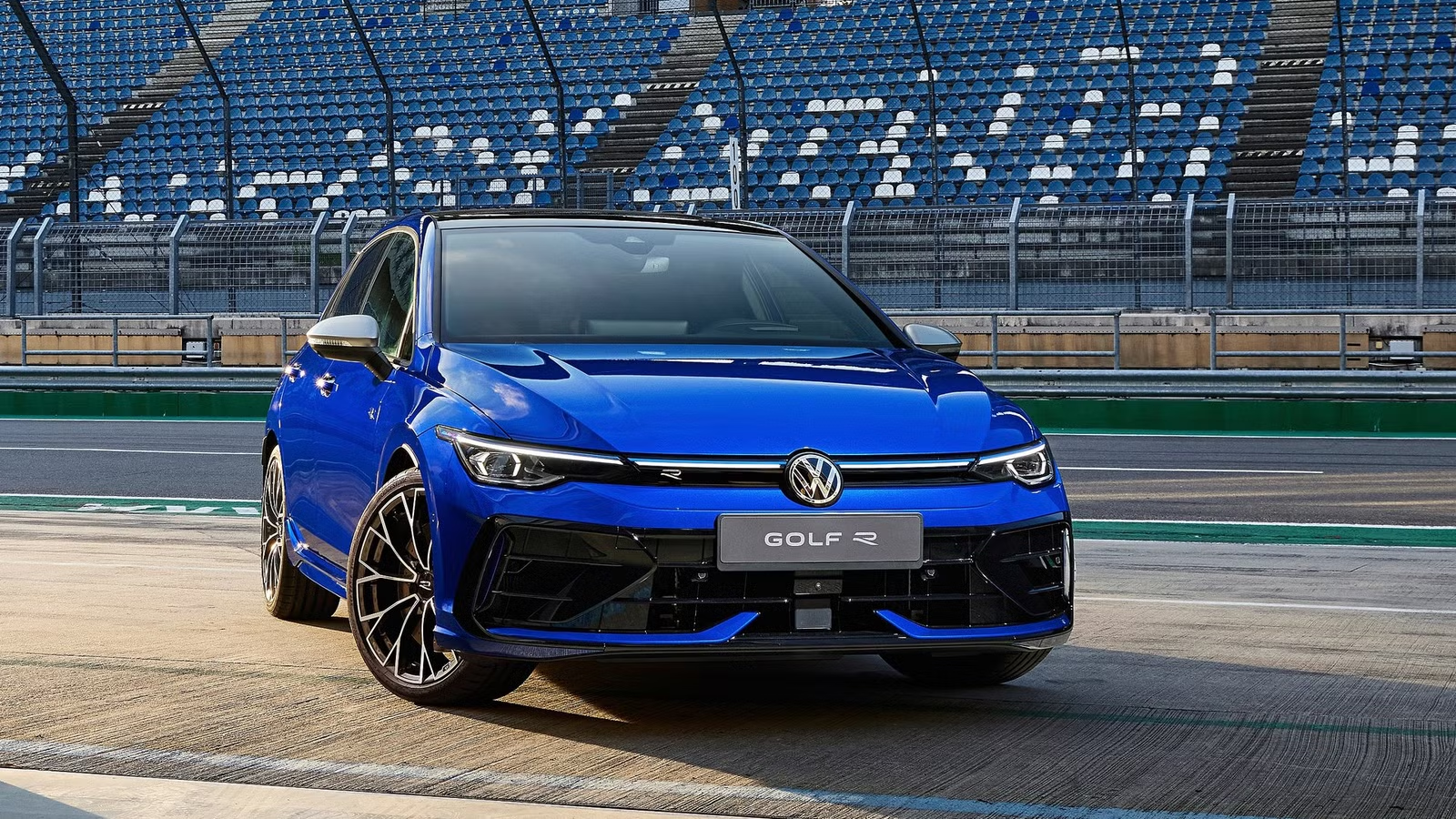
The 2026 Golf R might be the clearest example of how far the idea has evolved. It is brutally quick, genuinely practical, and polished enough to use every day. By most sensible measures, it should end this argument before the other car even arrives.
That conclusion depends on what the driver wants from a hot hatch.
The Golf R’s 328 HP Makes An Almost Unbeatable Case

Start with the numbers, because they’re rude. The 2026 Golf R’s 2.0-liter turbocharged four-cylinder makes 328 hp and 295 lb-ft of torque, with a seven-speed DSG sending everything through R-Performance 4MOTION all-wheel drive. Volkswagen quotes 4.4 seconds from 0-60 mph for the current car, but this Mk8 generation has already demonstrated a 3.9-second sprint in independent testing. That’s serious performance-car territory stuffed into a five-door hatchback that can still carry groceries without requiring a support vehicle. Volkswagen’s own 2026 Golf R performance specifications confirm the current output, torque figure, and factory 0-60 claim.
Then it starts winning the boring stuff, which may actually be more important. The Golf R offers 35.0 inches of rear legroom, 19.9 cubic feet of cargo room behind the second row, and 34.5 cubic feet with those seats folded. That rear-legroom number matters because the mystery rival we’ll get to later has just 29.9 inches. Five inches is not merely a bragging statistic, but put an adult in both back seats and suddenly everybody understands measurements. The Golf R also gets leather sport seats, heated rear outboard seats, ventilated front seats, three-zone climate control, a head-up display, Harman Kardon audio, and adaptive DCC suspension.

And none of this comes at the expense of serious chassis hardware. Volkswagen gives the R a torque-vectoring rear differential, configurable drive modes, adaptive damping, and enough electronic coordination to make 328 hp feel remarkably civilized. This is the attraction of the modern Golf R in one sentence: you don’t have to choose between being an adult and owning something fast. It can handle traffic, bad weather, passengers, luggage, and a weekend back road without suddenly revealing some enormous flaw you have to explain away. For most buyers looking at today’s enthusiast cars, that should be checkmate.
So why would anyone intentionally choose something worse at so many things?
But The Better Daily Driver Can Still Miss The Point

Part of the Golf R’s brilliance is that it makes going very fast feel suspiciously easy. The seven-speed DSG handles the clutch work and snaps through gears while 4MOTION decides where the power should go. Then R-Performance Torque Vectoring joins the party. Its rear differential can vary torque between the rear wheels and send more of the available rear-axle drive toward the outside wheel in a corner, depending on steering angle, throttle position, lateral acceleration, yaw rate, and speed. Instead of waiting for the front tires to start begging for mercy, the Golf R actively helps itself rotate.
And the computers aren’t finished. Volkswagen’s Vehicle Dynamics Manager coordinates the AWD hardware with the electronic differential locks and adaptive DCC dampers, so several systems can react to the same corner at once. Special mode is tuned around the Nürburgring Nordschleife, while Drift mode changes the car’s torque-distribution and stability-control strategy to encourage oversteer on a closed course. You’re still driving the thing, obviously, but there is a small army of electronics working between your fingertips and the tire contact patches. The Golf R hides much of the work involved in driving that quickly.
That’s fantastic if you want a hot hatch that can flatten a back road without turning every fast corner into an exam. But some enthusiasts actually want the exam. They want a clutch pedal they can mistime, a physical lever they can grab, an engine that sounds hard-worked because it genuinely is, and drivetrain settings that change what they have to do next. They aren’t chasing inconvenience just to prove something. They want enough of the messy stuff left exposed that getting a corner right still feels like their achievement.
The Golf R makes speed feel tidy, while its rival leaves more of the work to the driver.
The Unexpected Answer Is The 2026 Toyota GR Corolla

Meet the 2026 Toyota GR Corolla. Hidden underneath its five-door Corolla shell is a 1.6-liter turbocharged three-cylinder producing 300 hp and 295 lb-ft of torque, which is already remarkable before you consider there are only three cylinders doing the work. Buyers can choose Toyota’s eight-speed Direct Automatic Transmission, but a six-speed iMT manual with rev matching remains available. Front and rear Torsen limited-slip differentials are standard, too. Toyota’s 2026 GR Corolla technical details confirm that the latest car keeps both transmissions while adding structural and cooling changes for 2026.
The GR-FOUR AWD system is where the attitude becomes obvious. Normal mode targets a 60:40 front/rear split, Gravel goes 50:50, and Track can continuously move between 60:40 and a rear-biased 30:70 depending on driver input and vehicle conditions. And yes, the GR Corolla still has a mechanical handbrake. That combination—the manual option, physical handbrake, adjustable AWD, twin Torsen differentials, and compact high-output engine—is why this car feels less like an upgraded Corolla and more like a vehicle with rally-car priorities smuggled in. It is one of the more singular members of the current Toyota GR family, and that is meant as a compliment.

Straight-line testing makes the difference in philosophy even clearer. Instrumented tests of the early manual GR Corolla produced results ranging from roughly 4.2 to 5.4 seconds to 60 mph. That is an enormous 1.2-second spread for essentially the same car, and much of it comes down to launch technique, gearing, surface conditions, and how aggressively the driver is prepared to work the clutch and drivetrain. The Golf R’s DSG launch is repeatable by design. The manual Toyota can make you work for the number.
That inconsistency is annoying if all you want is the number, but it is part of the GR Corolla’s appeal. It gives away plenty elsewhere, too. Its rear seat is cramped by comparison, its cabin materials don’t feel as expensive, and its ride and general demeanor are busier. Unlike the Golf R, the GR Corolla makes the driver work harder to cover ground quickly.
The 2026 Hot-Hatch Rivalry Is Bigger Than Manual Versus DSG

This used to be an easy argument to oversimplify: Golf R equals clever automatic, GR Corolla equals old-school manual. The GAZOO Racing Direct Automatic Transmission, or DAT, blows that up. Toyota added the eight-speed DAT for 2025 and kept it for 2026, but the interesting part isn’t simply that an automatic now exists. Toyota says the transmission monitors brake and accelerator inputs so it can anticipate when the driver is likely to want another gear before vehicle behavior alone would normally trigger the shift. It also gets launch control. The goal is not merely smoother commuting; Toyota specifically tuned the gearbox around aggressive driving.
That matters because it proves this rivalry was never really about three pedals versus two. The Golf R uses electronics, torque vectoring, adaptive damping, and a rapid-fire DSG to make performance astonishingly easy to deploy. Toyota uses plenty of electronics too, but surrounds them with hardware and calibration meant to preserve some friction between the driver and the result. The manual remains beside the DAT, along with the mechanical handbrake and Torsen differentials. GR-FOUR still gives the driver meaningful choices, and the DAT broadens the GR Corolla’s appeal without turning it into a discount Golf R.

Then there’s the 2026 GRMN Corolla, which removes any doubt about where that philosophy leads when practicality stops getting a vote. Toyota keeps the 1.6-liter triple at 300 hp but raises torque to 302 lb-ft, deletes the rear seat, fits a six-speed manual only, adds Nürburgring- and Super Taikyu-developed chassis changes and forged wheels with Michelin Pilot Sport Cup 2 tires, and limits global production to 730 examples. The GRMN Corolla specifications read less like an attempt to make a sensible hatchback faster and more like engineers asking how much sensible hatchback they could remove.
That may become the bigger question for the whole Toyota performance lineup. More software, smarter differentials, faster gearboxes, hybrid systems, and eventually electric power can make small performance cars quicker than ever. None of that is inherently bad. A faster shift is a faster shift, and grip is useful whether a computer helped find it or not.
But as performance becomes easier to deliver, effort may become a feature. The Golf R is the better car for almost every ordinary Tuesday. It’s quicker to exploit, much roomier in the back, more richly equipped, and spectacularly good at turning 328 hp into clean, repeatable speed.
The GR Corolla asks you to give some of that polish back. For the wrong driver, that’s a deal-breaker. For the right one, that’s why you buy it.

Related posts



Latest Post


No Comments