
This German Sports Car Had AWD, A Manual, And A Turbo… In The ’80s
Few cars can claim to have genuinely rewritten the rulebook. The Audi Quattro is one of them. When it debuted at the 1980 Geneva Motor Show, it arrived with a combination of ingredients that performance-car buyers had never seen packaged together: all-wheel drive, a turbocharged five-cylinder engine, and a manual gearbox. The result didn’t just win rallies — it changed what a sports car could be, and every turbocharged AWD performance machine that followed owes it a debt.

But one car changed all that. Whereas rallying had been all about drifting around bends, the rear wheels searching for grip, one manufacturer rightly noticed that having all four wheels looking for traction might actually make more sense. Then, by strapping a turbocharger onto the engine, those tires would have plenty of power to channel into the ground.
Naturally, this being the ’80s, manual gearboxes were still all the rage, so one of those was thrown into the mix. These ingredients turned out to work extremely well together, and voilà, a legend — and a new type of sports car entirely — was born. Ever since, carmakers across the world have used this recipe to create ever faster and more capable machines. This is the story of how one car from the past changed the future.
The Original Audi Quattro Changed The World Of Sports Cars

The concept of the Audi Quattro may seem pretty mainstream these days. Turbocharged cars are everywhere. Four-wheel-drive cars are everywhere. Manual cars are…OK, well, not so much. But it is fair to say that forced-induction cars with AWD and a stick shift hold a significant place in the history of fast cars. When the Quattro arrived in 1980, the world was a different place. The net was something you used for fishing, Twitter was something that interested ornithologists, and a proper performance car was rear-drive only and wanted to put you into a hedge on every bend. The engineers at Audi must have watched Ford Escorts power-sliding through forests and wondered what would happen if you added a whole lot more grip to a rally car.
Audi Chose Rallying To Add Motorsport Kudos To The Brand
In the late ’70s, Audi was looking for a motorsport program to build its racing pedigree. The company settled on rallying, which was where real car enthusiasts gathered in the damp and mud with cups of tea. Audi borrowed the all-wheel-drive system from the Volkswagen Iltis, a utilitarian off-roader built in Canada, and fitted it into a front-drive Audi 80 platform. A center differential ensured that drive could be distributed between the two axles and out to all four 15-inch wheels, preventing wind-up.
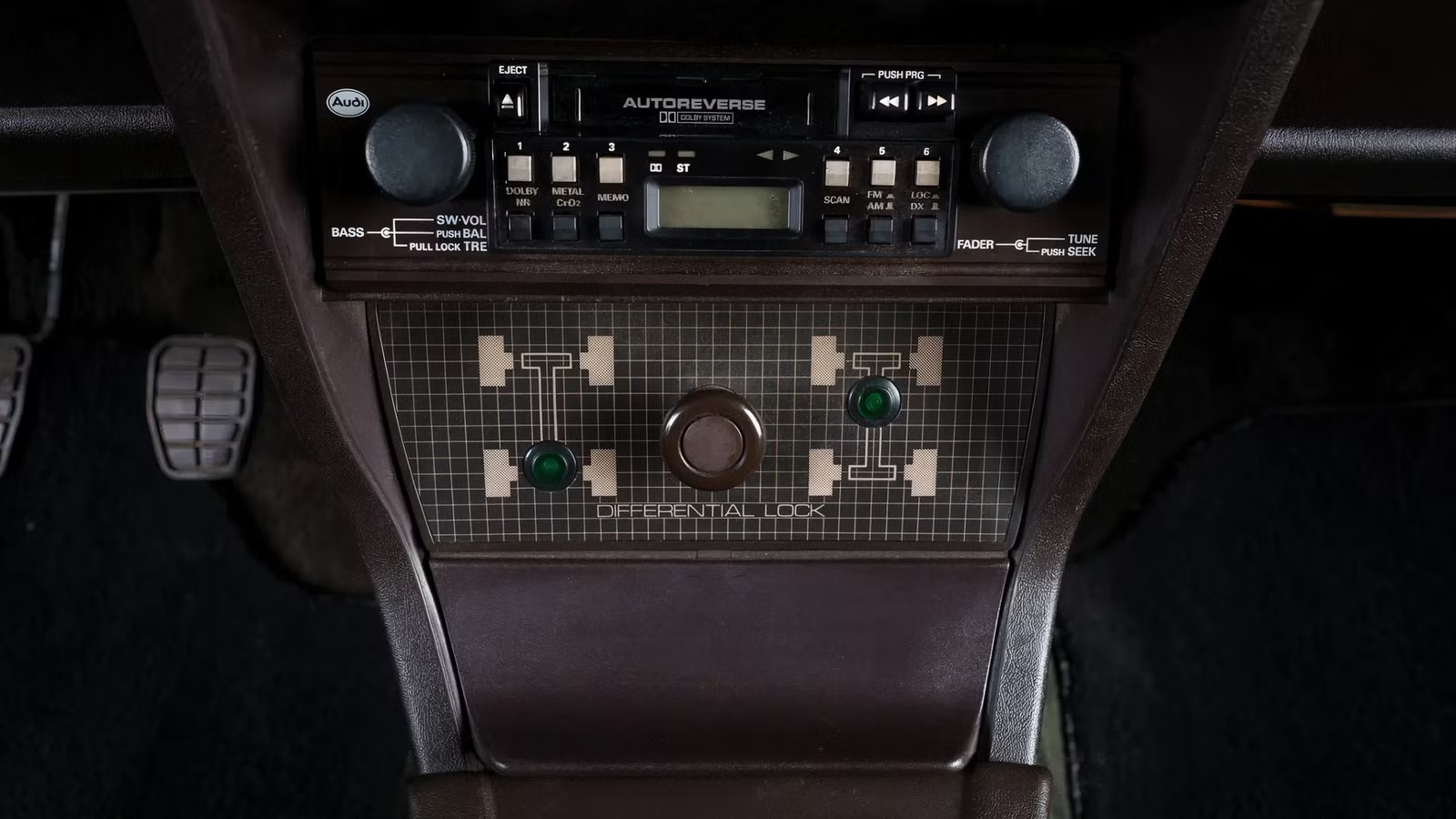
The front-wheel-drive transaxle layout allowed for a propshaft to exit the back of the gearbox and connect to the rear axle. Differential locks can be operated from the driver’s seat via a switch on the center console. Audi fitted the 200 saloon’s 2.1-liter five-cylinder engine, good for 172 horsepower — enough to propel the Quattro to a 137-mph top speed and 60 mph in 7.3 seconds, making it extremely quick for the early ’80s. At its debut at the Geneva Motor Show on March 4, 1980, the Quattro took the world by storm.
The Quattro Evolved Through Its Life
1990 Audi Quattro 20V Specs
|
Engine |
2.2-liter turbocharged five-cylinder |
|
Power |
214 hp |
|
Torque |
228 lb-ft |
|
0-60 mph |
5.9 seconds |
Source: Audi
Audi originally planned to sell 400 Ur-Quattros for the road but had moved 11,500 cars by the end of its production run in 1990. The car was a huge success in rallying, accumulating 23 victories in the World Rally Championship. Even after the Quattro was retired from competition, the model continued to be developed for the road. It is said that the Quattro was due to go out of production in 1988, but devoted fans encouraged Audi to keep building them.
A year later the Quattro was significantly improved, with a larger-displacement 2.2-liter five-cylinder engine, a revised four-wheel-drive system, and a sophisticated Torsen differential. The car also gained four valves per cylinder — earning it the “20-valve” name — and output climbed to 214 horsepower and 228 lb-ft of torque. The later car is naturally quicker, reaching 60 mph in 5.9 seconds and a top speed of 143 mph.
Audi Made An Extreme Short Wheelbase Version Of The Quattro
The Audi Quattro was initially homologated for Group 4, with a 400-unit minimum production requirement. This group was more conservative than the wild 200-unit Group B specials that followed, with manufacturers using the rules to create incredibly rapid mid-engined rally monsters such as the RS200, Peugeot 205 T16, Metro 6R4, Ford RS200, and Lancia Delta S4. In response, Audi developed the shorter-wheelbase S1 machine, which was derived from the Sport Quattro road car. Just over 200 road-going variants of the S1 were produced, with power rising to 302 horsepower courtesy of a larger turbo and intercooler.
The Quattro Was Actually Beaten To The First AWD Sport’s Car Title By Almost 15 Years

1967 Jensen FF Specs
|
Engine |
6.3-liter V8 |
|
Power |
325 hp |
|
Torque |
424 lb-ft |
|
0-60 mph |
7.7 seconds |
Source: Jensen
The Audi Quattro undeniably changed the game for sports cars, opening the door for some of the most famous models to ever come out of Japan. However, the Jensen FF arrived in 1967 as the first production sports car to feature all-wheel drive. The model looked similar to the Jensen Interceptor, but it was actually very different. The body was longer, and underneath, there was a key mechanical distinction.
Ferguson Research — hence the FF’s name (Ferguson Formula) — developed a four-wheel-drive system for the two-door, four-seat coupe, which was powered by a 6.3-liter Chrysler V8 engine. The FF was never available in North America, and it remained an incredibly rare car, with just 320 units built through 1971. It also holds the distinction of being the first production car to offer ABS.
Buying An Audi Quattro In 2025

Used Prices Of Audi Ur-Quattros
- 1981 Audi Quattro: $63,304
- 1982 Audi Quattro: $40,146
- 1985 Audi Quattro: $46,018
- 1988 Audi Quattro: $47,221
- 1990 Audi Quattro: $86,702
Source: Classic.com
Audi’s original coupe Quattro is highly collectible these days. Whereas there was a time when these cars could be picked up relatively cheaply, you need fairly deep pockets to get the keys to one now. It is tempting to think that the early ’80s cars might be the most collectible, as these were the examples most closely linked to Audi’s groundbreaking technology and rallying exploits, but it’s the later 20V cars that command the most desire — and the highest prices.
You could be looking at close to $100,000 for a 20V car, whereas buyers on a tighter budget should seek out a mid-production-run example from around 1985 to 1988, where you’ll need roughly half that. The ultra-rare Audi Quattro Sport models are in a whole different league. According to Classic.com, you’ll need an average of $711,750 to park one of these in your garage.
Source: Audi, Classic.com.

Related posts




Latest Post


No Comments