
The European Motorcycle That Quietly Became The Enthusiast’s Choice
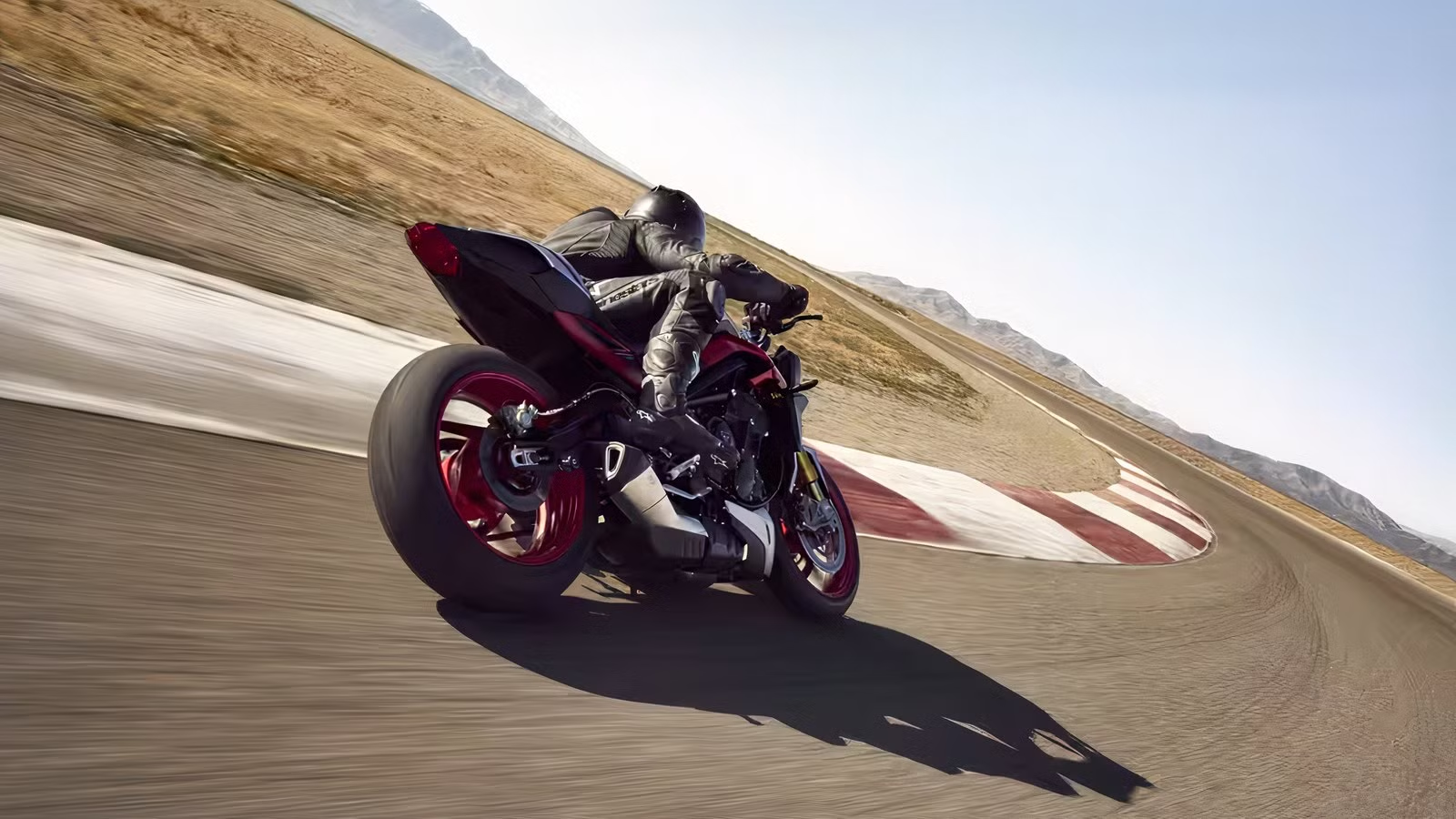
Every motorcycle enthusiast’s dream garage would have a Ducati or a BMW parked somewhere in the garage, ready to grab the moment a track day gets circled on the calendar. At least, that’s the default assumption. That would shatter when you ask around at the actual track. The bike getting the most attention won’t be the one you’d expect. Instead of these big boys, the enthusiasts choose something that they know exactly what they’re doing with, not the one chasing big numbers on the spec sheet. While there are not many of these kinds of bikes around, there’s still one European naked that has earned this respect, and its newest version grabs every enthusiast’s attention.
What Makes A Motorcycle Suitable For Enthusiasts
It would be surprising if the salesperson would tell you to choose a less powerful bike instead of a flagship when you walk into a dealership. They have sales targets to meet. Seasoned riders know better, though. Ask one, and they’ll tell you the engine character wins over peak output almost every time. Outright horsepower is rarely fun as a bike where every part actually has the perfect combination.
Does the engine pull hard out of a slow corner, or does it leave a flat spot where the power was needed? Does the suspension tell you how much grip is left mid-lean or just soaks up bumps and stays quiet about everything else? Do the brakes bite hard enough to trust the front tire deep into a corner? Do the electronics avoid confusing the rider with unnecessary interruptions?

Each of these is what enthusiasts actually weigh before deciding if a motorcycle is worth their money. And none of these questions get answered on the showroom floor. A bike can look every bit the part standing still and fall apart the moment the pace goes up. The combination of performance, feedback, and usability is what separates a genuinely engaging motorcycle from one that simply looks impressive on paper. But there’s one such European bike that in its latest form answers all these questions, and has quietly been claiming spots in enthusiasts’ garages.

The Triumph Street Triple 765 RX Promises To Lure Enthusiasts

That’s the newest version of the Street Triple, the 765 RX. While the best-known bike in the Street Triple family has been the 765 RS, its latest added sibling grabs all the attention. It is built on Triumph’s proven Street Triple formula, but with more of a race breed. It gets all the main things right – a heart that performs effortlessly, premium underpinnings, aggressive ergonomics, and electronics that matter. Basically, answering all the questions an enthusiast would have and thus becomes one of their favorites.
But You Do Pay A Premium Price

The Street Triple 765 RX carries an MSRP of $14,495, which is $950 more expensive than the RS. But, you might feel that’s nothing considering the equipment it offers: fully adjustable Ohlins suspension front and rear, clip-on bars for that aggressive stance, and a machined top yoke are all standard. Even after being on the premium side in the Street Triple family, the RX actually costs $4,500 less than the Ducati’s Streetfighter V2 S, which offers a similarly focused package.
The RX Takes The Street Triple Formula A Step Further

The Street Triple has firmly cemented its popularity in the mid-weight naked segment. The combination of a characterful inline-three engine and sharp handling dynamics has made the standard Triumph Street Triple 765 RX the go-to benchmark for canyon carvers. While the standard bike is brilliant on the road, true enthusiasts often resort to swapping handlebars and modifying rear-sets to get a more committed stance for racetracks. With the RX, Triumph simply bypassed the need for aftermarket accessories. The RX carries the Street Triple formula but bolts on a true supersport geometry to turn this proven platform into an uncompromising track weapon.
Moto2-Derived Heart That Brings Attention

At the heart of the RX sits Triumph’s familiar 765cc inline-triple, the same unit that powers the RS and has become synonymous with the Moto2 World Championship. The liquid-cooled DOHC engine pumps out 128 horsepower and 59 pound-feet of torque, placing it firmly at the sharp end of the mid-weight naked bikes. Below 6,000 rpm, it’s smooth and predictable. Past 7,000 rpm, it transitions into an urgent top-end rush that feels serious. An added advantage is the quickshifter.
Racetrack Underpinnings As Standard

With the RX, Triumph didn’t cut any corners but offered more goodies. The lightweight aluminum frame from the RS is carried over, and it has a promising wet weight of 414 pounds. So the RX has the same agility as its sibling. This is topped with a fully adjustable Ohlins NIX30 fork up front and an Ohlins STX40 piggyback shock at the rear. This ups the front-end feel and cornering precision.
The RX’s braking hardware is equally premium. Twin 310mm front discs are paired with Brembo Stylema monoblock calipers and a Brembo master cylinder for sharper feel. To finish it off, the bike rolls on sticky Pirelli Diablo Supercorsa SP V3 tires. Put all these together, and you get a feel like a superbike’s underpinnings rather than a typical naked mid-weight.
Ergonomics Built For Spirited Rides

The motorcycle might look the same as the RS from a distance, but that thing changes completely once you throw a leg over it. Triumph ripped off the upright handlebars of the standard streetfighter and bolted on a set of aggressive, low-slung clip-ons. Pair that with rear-set foot pegs, and the RX instantly forces you into a committed race crouch. You are no longer sitting casually on the bike; your body weight is aggressively shifted forward.
It drops any pretense of being a relaxed daily commuter and focuses entirely on cornering leverage and aerodynamic efficiency. Triumph dropped the passenger seat too, in favor of a single-seat tail. It is unapologetically built to go fast and look sporty without being demanding. True enthusiasts love it exactly for that lack of compromise.
Modern Electronic Suite That Enhances Safety

The Triumph Street Triple 765 RX packs a comprehensive electronics suite. The cockpit features a crisp 5-inch TFT display that reads out gear position, digital speedometer, fuel gauge, distance to empty, and more. A six-axis IMU runs cornering ABS and traction control across five riding modes (Rain, Road, Sport, Track, and a configurable rider mode). It also gets a quick shifter for flawless, clutch less gear changes. While it’s not the fanciest of the lot, these riding aids don’t get in the way when you start pushing the limits.
The Street Triple RX Quietly Sets The Benchmark

In a segment flooded with bikes trying to be everything to everyone, the Street Triple 765 RX skips the compromises. The RX goes toe-to-toe with the exotic Ducati Streetfighter V2 S, which offers phenomenal Italian chassis dynamics and undeniable badge prestige. However, Ducati’s new 890cc V2 tops out at 120 horsepower, leaving it down on power compared to the 128-hp British triple. While the Ducati offers a similarly focused track package, its price tag sits in another stratosphere compared to the Triumph.

The Aprilia Tuono 660 Factory costs less and brings a punchy twin-cylinder character, but it pays a massive penalty on the dyno, offering 105 horsepower and giving up a massive 23-horsepower advantage to the Triumph. Meanwhile, the Yamaha MT-09 SP brings premium KYB and Ohlins hardware to the table, but its upright supermoto posture can never match the laser-focused front-end commitment of the RX’s clip-ons.

At the end of the day, the Street Triple RX is aimed squarely at riders who prioritize cornering precision, front-end feel, and aggressive ergonomics over everyday comfort. By blurring the line between a naked roadster and an authentic supersport, the RX makes it much harder to justify moving up to an expensive, 200-horsepower flagship just to have fun on a track day.
Source: Triumph Motorcycles

Related posts



Latest Post


No Comments