
The Fast Car With Toyota Reliability And Porsche-Level Grip
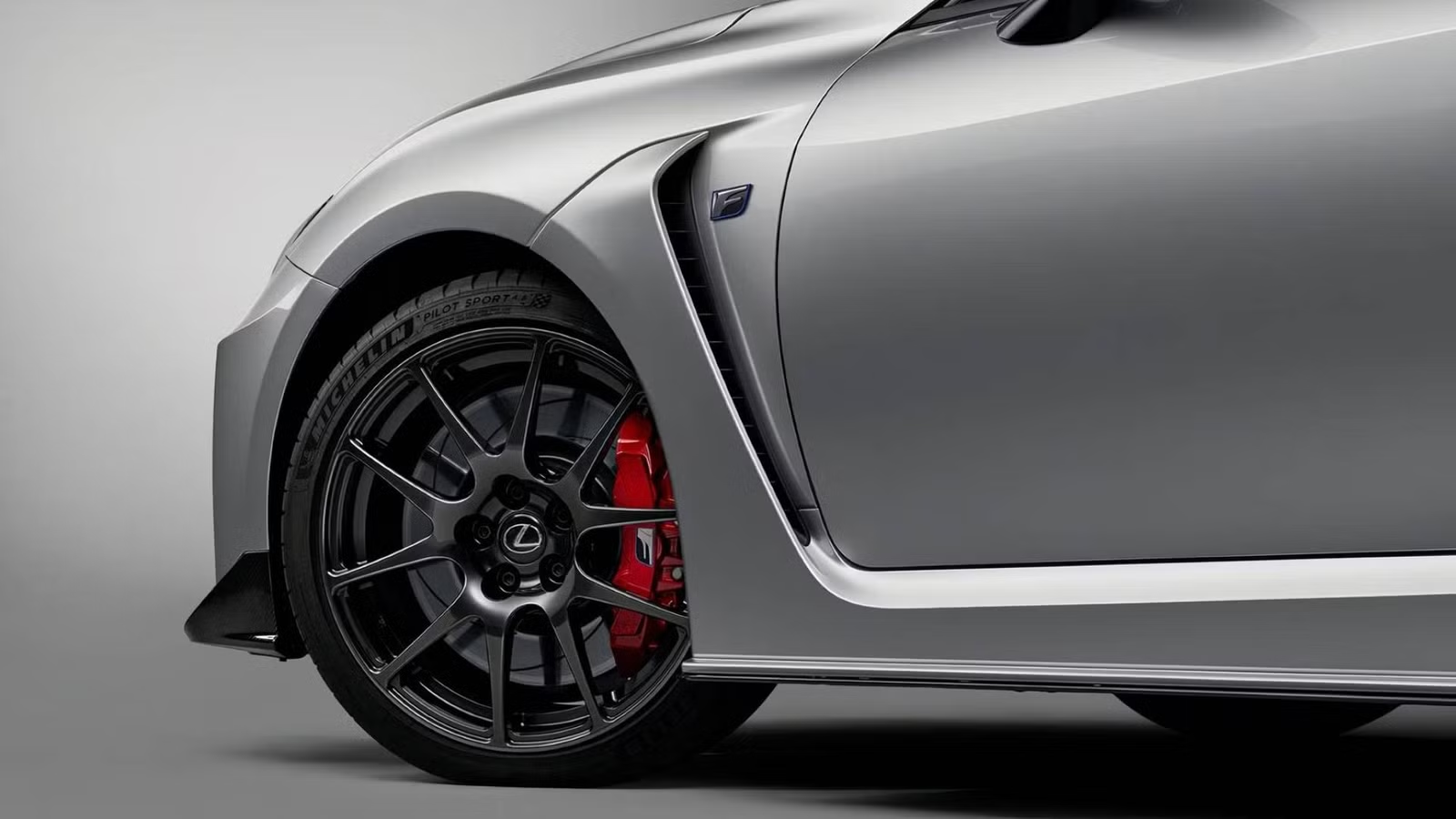
The naturally aspirated V8 is a dying breed, and enthusiasts are starting to notice. As turbocharged engines and electrified powertrains take over the performance segment, a small window remains to own one of the last great examples of the old formula — a high-revving eight-cylinder that demands to be wrung out, wrapped in genuine luxury, and backed by the kind of long-term reliability that European rivals have rarely managed to match. The Lexus RC F arrived quietly, but it represents exactly that: a performance coupe built for drivers who want the theater of a screaming V8 without bracing for a punishing repair bill every time the warranty expires.
Lexus F Performance Takes On The Germans

While the established European automakers were undoubtedly intimidated by the arrival of Lexus, their performance divisions — Mercedes-AMG and BMW M — had remained safe. That suddenly changed in 2007, when Lexus expanded its portfolio beyond cushy, easygoing luxobarges with the debut of the IS F sport sedan.
It featured a 5.0-liter, naturally aspirated V8 with cylinder heads developed by Yamaha, aimed directly at Germany’s eight-cylinder BMW M3 and Mercedes-AMG C63 of the same era. Its giant Brembo brakes and firm suspension were balanced by signature Lexus reliability — an unmatched combination at a time when high-strung German V8s were still threatening drivers with costly faults. The IS F also introduced a world-class eight-speed Sport Direct-Shift automatic, which could lock the torque converter for shockingly quick upshifts and DCT-like downshifts through the paddle shifters.

With Lexus’s rock-solid reliability reputation successfully carried over to a sportier crowd, the F performance brand was gradually expanded. The LFA launched in 2010 as the automaker’s rather unprecedented halo car, flaunting a hauntingly sonorous 4.8-liter naturally aspirated V10 and a six-speed automated manual. The larger GS sedan received the F badge as well, pairing a naturally aspirated V8 and track-focused rear-wheel-drive layout with the same practical four-door body as the standard GS. With the IS F and GS F sedans already establishing a distinctive naturally aspirated V8 pattern, Lexus decided to pack this same formula into the RC two-door coupe.

The RC F Is a Lexus Built For the Track

By the time the RC F arrived for the 2015 model year, Lexus had already proven it could build a legitimate performance sedan. The coupe represented something different. Rather than chasing outright Nürburgring supremacy, Lexus focused on building a grand touring performance car that rewarded long-term ownership just as much as fast lap times. It inherited lessons from the IS F, borrowed technology from the LFA, and wrapped everything in one of the last naturally aspirated V8 luxury coupes the industry would ever see.
Compared to the RC grand tourer it was based on, the F model was far more track-ready. It featured a 5.0-liter naturally aspirated V8 shared with the GS F sedan, sending 472 hp and 395 lb-ft of torque exclusively to the rear wheels. Stopping power was massively improved thanks to a Brembo braking system. The coupe’s chassis was upgraded with reinforced bracing, stiffer bushings, and an adaptive suspension system, while its widened body, active rear wing, and functional air ducts improved aerodynamics. Curb weight was reduced through the use of various aluminum components, and later special edition models utilized carbon fiber reinforced plastic to further shed weight from the roof, hood, and spoiler.

The RC F was met with divided opinions at launch. Critics doubted that it could truly separate itself from the more tame, luxurious nature of the standard RC’s platform, and weight-saving measures failed to keep the performance coupe from tipping the scales at nearly 4,000 pounds. However, optimists noted the coupe’s charming naturally aspirated V8, which undoubtedly stood out at a time when the rest of the performance coupe segment was chasing the modern advantages of forced induction.
A Raw, Naturally Aspirated V8 Under the Hood

While most European rivals were turning to forced induction, the RC F’s high-revving 2UR-GSE 5.0-liter V8 stubbornly remained naturally aspirated. As a result, drivers are treated to an increasingly rare, old-school power delivery that builds to a screaming 7,300-rpm redline, with a visceral exhaust note to match. Total output from the highly traditional eight-cylinder initially came in at 467 hp and 389 lb-ft of torque, but a mid-cycle refresh for the 2020 model year nudged those figures to 472 hp and 395 lb-ft. While the RC F’s peak horsepower is highly competitive with turbocharged rivals such as the BMW M4 and Mercedes-AMG C63 Coupe, the Germans undeniably have Lexus beat in terms of torque — their turbochargers deliver maximum pulling power much lower in the rev range, at the cost of aural drama.
Power is managed by the state-of-the-art eight-speed Sport Direct-Shift automatic first introduced in the IS F sedan. This sophisticated gearbox was heavily updated for the RC F, featuring revamped software programming to accommodate a wider variety of selectable drive modes, as well as more clutch plates to confidently handle the coupe’s higher output. Lexus also added a larger dedicated oil cooler for the transmission, as the unit used in the IS F often struggled to cope with aggressive track driving.
Signature Lexus Reliability

Bulletproof reliability is ultimately what separates the RC F from nearly every European rival of its era. While BMW and Mercedes-AMG were embracing increasingly complex turbocharged powertrains, Lexus doubled down on proven engineering. The naturally aspirated 2UR-GSE avoids many of the heat-related issues that accompany forced induction, while Toyota’s conservative engineering philosophy has helped the engine earn an outstanding reputation among long-term owners. Combined with the proven eight-speed Sport Direct-Shift automatic, the RC F has become one of the few modern luxury performance cars that owners routinely trust well beyond 150,000 miles.
The coupe’s mechanical durability is further elevated by Lexus’s unparalleled quality standards. The 2UR-GSE engine is hand-assembled by the automaker’s highly skilled craftsmen, known as Takumi, a word that means “artisan” in Japanese. Production takes place at Toyota’s Tahara plant, which also built the original Lexus LS400. By blending a robust, naturally aspirated powertrain with Toyota’s unrivaled quality control, the RC F offers a rare combination of respectable track performance and long-term dependability.
Why The RC F Is Still an Underrated Bargain

Depreciation of the RC F once made it seem like an overlooked alternative to Germany’s performance elite. Today, it’s becoming something else entirely: one of the last affordable entries into the naturally aspirated V8 luxury coupe segment. While pricing originally started at around $60,000, clean examples from the performance coupe’s earlier model years are now selling for $38,988 on average, according to The Classic Valuer. A 2015 model with 47,000 miles sold for $41,250 on Cars and Bids, and another from the same model year with 89,000 miles sold for $32,000. And although special editions have already begun attracting collector attention, standard models remain attainable enough to offer enthusiasts a rare opportunity to own an increasingly endangered type of performance car.
Sources: Bring a Trailer, Cars and Bids, Lexus, The Classic Valuer

Related posts





Latest Post


No Comments